

AP Syllabus focus:
‘Address common challenges in planning statistical studies, including avoiding bias in sample selection, minimizing variability through adequate sample size, and adhering to ethical standards in data collection. Discuss strategies to overcome these challenges to ensure the integrity and credibility of the study's conclusions.’
Collecting reliable data requires careful planning to avoid systematic errors, control natural differences among individuals, and maintain ethical standards that protect participants and support trustworthy statistical conclusions.
Understanding Challenges in Data Collection
Statistical studies rely on data that accurately reflect the population of interest. However, problems such as bias, variability, and ethical concerns can undermine credibility if not addressed. These challenges arise at the planning stage and influence every subsequent step of a study, from sampling to interpretation. Properly managing these issues is essential for producing data that support valid inferences.
Bias in Sample Selection
Bias refers to a systematic tendency for certain outcomes or individuals to be favored over others during data collection. When bias is present, estimates consistently miss the true population value in the same direction. Bias reduces the trustworthiness of conclusions, and efforts to avoid it begin with understanding how it arises.
Types of Bias Relevant to Study Planning
Although many specific forms of bias are covered across the AP Statistics curriculum, at this planning stage the central concern is preventing situations that unfairly influence who enters the sample or how responses are obtained. Bias can enter through flawed sampling, poorly designed surveys, or unrepresentative study procedures. When such factors influence the results, the sample no longer reflects the entire population, weakening generalizability.
Designing Strategies to Reduce Bias
To minimize bias during data collection, researchers should incorporate the following approaches:
Use of random selection, ensuring every member of the population has a known chance of being chosen.
Clear operational definitions, reducing ambiguity in what is being measured or who qualifies for inclusion.
Avoidance of leading or confusing questions, which can distort how participants respond.
Training data collectors, so procedures are followed consistently.
Because bias cannot be fixed by increasing sample size, eliminating its causes is the most important step in producing credible data.
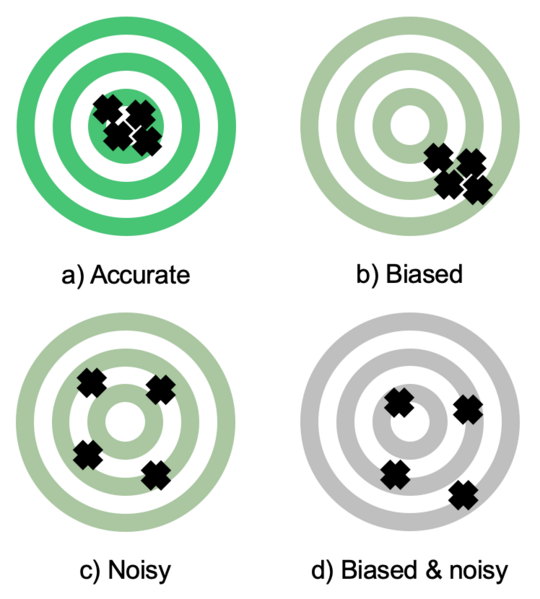
This target diagram contrasts unbiased/precise, biased, noisy, and biased plus noisy results. Bias appears when the shots are systematically off-center, while noise is reflected in scatter. The image slightly exceeds syllabus scope by generalizing to any statistical error, but it directly supports the distinction between systematic bias and natural variability. Source.
Variability and the Role of Sample Size
Even with unbiased collection procedures, variability—the natural differences among individuals or responses—can affect the stability of results. Variability is an unavoidable feature of real-world data, but researchers can manage it through study design.
Understanding Variability
Variability describes how much responses differ within a population or sample. High variability makes it harder to detect patterns, while lower variability produces more precise estimates.
Variability: The natural spread or dispersion in data that reflects differences among individuals or measurements.
A normal sentence reminding that variability is inherent in all data helps connect this concept to practical study planning.
Controlling Variability in Study Design
Reducing variability increases the precision of sample estimates, making comparisons more meaningful. Key strategies include:
Increasing sample size, which reduces the variability of sample statistics and leads to more stable conclusions.
Using consistent data collection procedures, ensuring that observed differences reflect true patterns rather than inconsistent methods.
Defining the population clearly, preventing unintended differences from entering the study.
Planning for replication, which allows researchers to observe whether patterns hold across repeated measurements.
Although variability cannot be completely eliminated, strong design choices help researchers interpret findings with greater confidence.
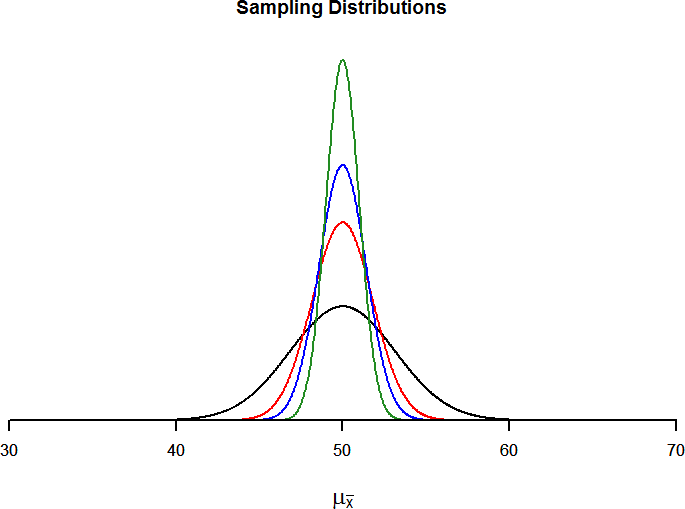
This graph shows sampling distributions for different sample sizes, with larger samples producing narrower, less variable curves. It demonstrates how increasing n reduces the spread of the sampling distribution. The population values shown extend beyond syllabus requirements but clearly illustrate the role of sample size in controlling variability. Source.
Ethics in Data Collection
Ethics plays a central role in all statistical studies. Researchers must protect participants, respect privacy, and ensure honesty in how data are gathered and reported. Failure to uphold ethical standards compromises not only the study but also trust in scientific research.
Core Ethical Principles
Ethical data collection relies on widely accepted principles:
Informed consent, meaning participants understand the study and agree to take part voluntarily.
Protection from harm, ensuring no physical, psychological, or social injury results from participation.
Confidentiality, safeguarding participants’ information from unauthorized disclosure.
Transparency, including honest reporting of methods and results without fabrication or selective omission.
Informed Consent: The process in which participants receive clear information about a study and voluntarily agree to participate.
Including at least one sentence here reinforces how ethical safeguards support valid scientific practice.
Ethical Planning in Statistical Studies
Researchers must embed ethics into each stage of planning. Practical steps include:
Reviewing procedures through ethics committees or institutional review boards, when required.
Designing surveys and experiments that minimize burden, ensuring that participation is reasonable and respectful.
Avoiding deceptive practices, unless justified and approved under strict guidelines.
Communicating results honestly, regardless of whether they support expectations or hypotheses.
Integrating Bias, Variability, and Ethics in Study Planning
High-quality data collection requires simultaneously addressing bias, variability, and ethics. Together, these considerations shape how researchers select participants, design procedures, and interpret findings. By planning carefully and prioritizing fairness, accuracy, and responsibility, researchers strengthen the integrity and credibility of statistical conclusions.
FAQ
Researchers often conduct a pilot study or run cognitive interviews to explore whether questions, sampling frames, or procedures unintentionally favour certain responses.
They may also map the target population and identify groups at risk of underrepresentation.
Common checks include:
Reviewing whether recruitment times or locations systematically exclude groups.
Ensuring language and terminology are accessible to all subgroups.
Consulting domain experts to identify overlooked biases tied to context or culture.
When enlarging the sample is not feasible, consistency becomes the primary tool.
Researchers can:
Standardise instructions, settings, and measurement tools.
Train all data collectors to follow identical procedures.
Narrow the definition of the population to reduce inherent diversity.
Use repeated measurements and average them to stabilise responses.
Ethics requires that questions do not pressure, mislead, or distress participants.
This affects design by encouraging:
Neutral wording that avoids implying a desired response.
Limiting sensitive items unless essential, and providing opt-out options.
Avoiding double-barrelled or ambiguous questions that may confuse or disadvantage participants.
Transparency builds accountability and credibility, ensuring that results can be trusted by reviewers, policymakers, and future researchers.
It allows independent parties to:
Understand how decisions were made.
Assess whether ethical standards were upheld.
Replicate or build upon the study using accurate methodological information.
Ethical practice requires respecting participant autonomy while maintaining data integrity.
Researchers may:
Include partial responses only if consent still applies and no sensitive data are revealed unintentionally.
Clearly communicate during recruitment how partial data will be used.
Remove incomplete cases when their inclusion risks misinterpretation or breaches confidentiality.
Practice Questions
Question 1 (1–3 marks)
A researcher conducts a survey about dietary habits by approaching people in a shopping centre during weekday mornings.
(a) Identify one type of bias that may arise from this data collection method.
(b) Explain why this bias could affect the reliability of the survey results.
Question 1
(a) 1 mark
Correctly identifies a relevant bias such as undercoverage, convenience sampling bias, or nonresponse bias.
(b) 1–2 marks
1 mark for a basic explanation of why this bias affects reliability (e.g., the sample is not representative).
2 marks for a clear explanation linked to the scenario (e.g., weekday morning shoppers may not represent the full population, leading to systematically different dietary habits).
Total: 2–3 marks
Question 2 (4–6 marks)
A team of statisticians is planning a study to evaluate customer satisfaction with a large public transport system. They want to ensure the data collected are trustworthy and ethically obtained.
(a) Describe one method the team could use to reduce variability in the results.
(b) Explain why obtaining informed consent is essential in this context.
(c) The team plans to send email surveys to randomly selected customers, but many addresses bounce or receive no reply. Identify the type of bias this creates and explain how it could affect the study’s conclusions.
Question 2
(a) 1–2 marks
1 mark for identifying an appropriate method to reduce variability (e.g., increasing sample size, standardising data collection procedures).
2 marks for explaining how the chosen method reduces variability in the study's estimates.
(b) 1–2 marks
1 mark for stating the importance of informed consent (e.g., ethical requirement, voluntary participation).
2 marks for explaining its significance in the study context (e.g., customers must understand how their responses will be used and be free from pressure).
(c) 2–3 marks
1 mark for identifying nonresponse bias.
1–2 marks for explaining how nonresponse bias could distort conclusions (e.g., those who do not respond may differ systematically, such as being less satisfied or disengaged, leading to misleading overall satisfaction estimates).
Total: 4–6 marks
