

AP Syllabus focus:
‘The confidence interval for a population mean when σ is unknown is given by: x ± (t* × s/√n), where x is the sample mean, t* is the critical value from the t-distribution with n-1 degrees of freedom, s is the sample standard deviation, and n is the sample size.
- For matched pairs, calculate the mean and standard deviation of the differences, then use these in the formula for the one-sample t-interval.’
This section explains how to calculate a confidence interval for a population mean when the population standard deviation is unknown, using the t-distribution framework.
Calculating the Confidence Interval for a Mean
A confidence interval for a population mean provides a range of plausible values for the true mean, based on sample data. When the population standard deviation σ is unknown—which is almost always the case in applied statistics—students must rely on the sample standard deviation s, making the t-distribution the appropriate tool for inference.
Why the t-Distribution Is Used
Because substituting s for the unknown σ introduces extra variability, the resulting sampling distribution is wider than a normal distribution. The t-distribution accounts for this by having heavier tails, especially when sample sizes are small. As the sample size increases, the degrees of freedom grow, and the t-distribution approaches the normal distribution.
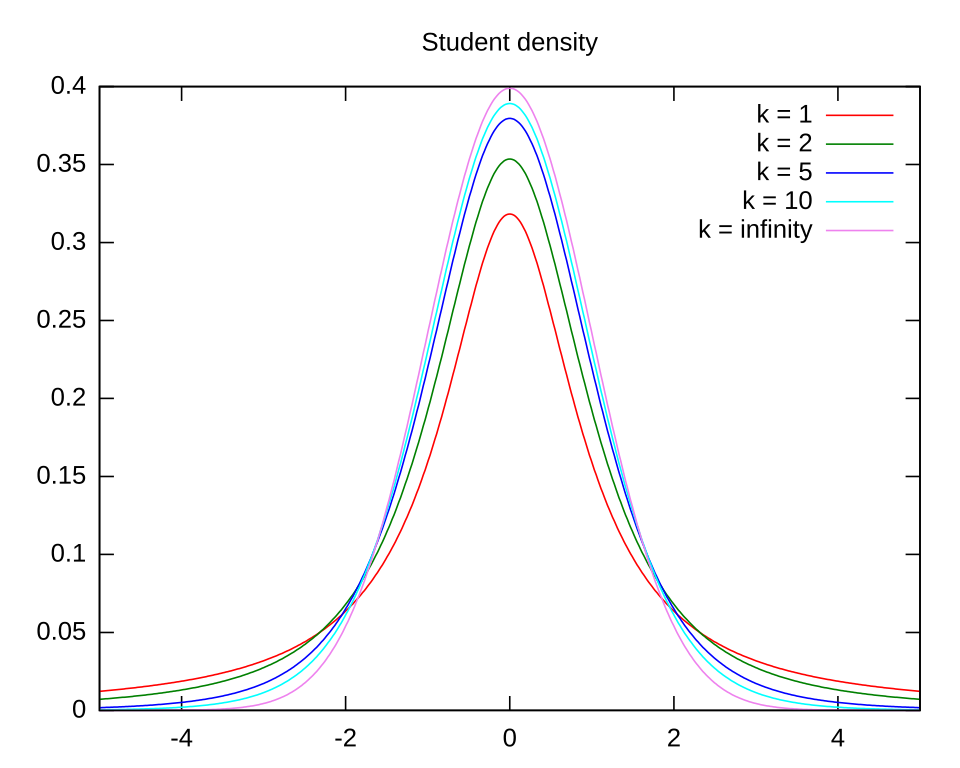
This plot compares Student’s t-distributions with the standard normal curve, illustrating heavier tails for low degrees of freedom and convergence toward normality as the degrees of freedom increase. Source.
Components of a Confidence Interval for a Mean
A one-sample t-interval requires three essential summary statistics from the sample: the sample mean, the sample standard deviation, and the sample size. These determine the standard error, which measures how much the sample mean is expected to vary across different random samples of equal size.
EQUATION
= Sample mean
= Critical value from the t-distribution with degrees of freedom
= Sample standard deviation
= Sample size
The critical value t* depends on the desired confidence level (commonly 90%, 95%, or 99%) and on degrees of freedom, which for a one-sample t-interval is n – 1. Technology or tables provide exact values.
Interpreting the Standard Error
The standard error of the sample mean describes the typical distance between the sample mean and the true population mean across repeated samples. When n is larger, the standard error decreases, leading to a narrower confidence interval.
EQUATION
= Sample standard deviation
= Sample size
This measure plays a direct role in determining the width of the confidence interval and the precision of the estimate.
Constructing the Interval Step by Step
To calculate the confidence interval for a population mean when σ is unknown, follow these structured steps:
Identify sample statistics: Determine , , and from the sample data.
Compute the standard error: Use to quantify variability in the estimate.
Find the critical value t*:
Use the chosen confidence level.
Use n − 1 degrees of freedom.
Calculate the margin of error: Multiply by the standard error.
Construct the interval:
Lower bound:
Upper bound:
These steps provide a structured, repeatable process for any one-sample t-interval.
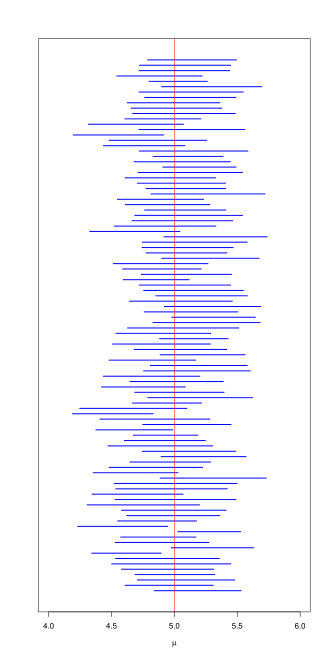
Each horizontal line represents a 95% confidence interval from a different random sample, illustrating the variation in interval endpoints and the long-run proportion of intervals that contain the true mean. Source.
Understanding the Margin of Error
The margin of error is the quantity added to and subtracted from the sample mean to create the confidence interval. It reflects uncertainty due to sampling variability.
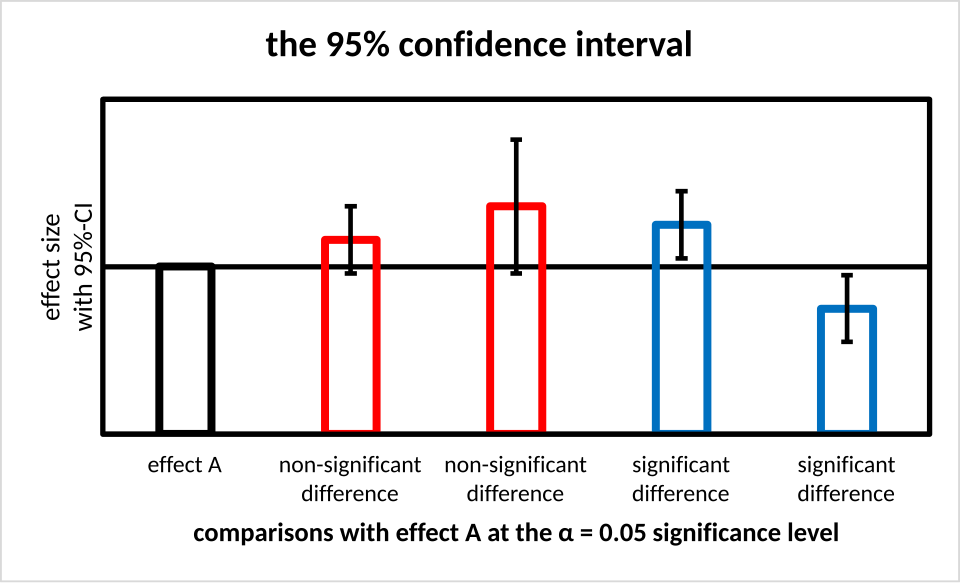
This bar chart displays sample means with their associated 95% confidence intervals, showing how the margin of error expands or contracts depending on variability and sample size. The figure also includes additional comparative context beyond the core syllabus requirement. Source.
Larger t* values (associated with higher confidence levels or smaller sample sizes) increase the margin of error.
A larger standard deviation also widens the interval.
Increasing the sample size reduces the standard error and narrows the interval.
This relationship shows how design choices such as sample size affect precision.
Matched Pairs Situations
When dealing with matched pairs, such as before-and-after measurements on the same individuals, the analysis shifts the focus from individual observations to the set of paired differences.
Matched Pairs: A study design where each observational unit contributes two linked measurements, producing a difference used for single-sample inference.
For matched pairs:
Compute the mean of the differences, .
Compute the standard deviation of the differences, .
Let n be the number of paired differences.
Use the same one-sample t-interval formula, replacing with and with .
This method ensures that the interval estimates the population mean difference rather than the means of separate groups.
Interpreting the Confidence Interval
A correctly computed confidence interval describes a range of plausible values for the population mean based on the observed sample. The interpretation must always connect back to the context in which the data were collected. The interval’s width and location reflect sampling variability, sample size, and the chosen confidence level, helping students judge the reliability of estimates drawn from real-world data.
FAQ
Rounding intermediate values, especially the standard error or the critical value, can slightly widen or narrow the final interval. This effect is usually small but becomes more noticeable with very small samples.
To minimise distortion:
• Keep at least three decimal places for the standard error.
• Use the full precision of the t critical value provided by technology.
• Round the final interval only at the end, typically to two or three decimal places.
The estimate of the standard deviation becomes more reliable as the sample size increases. With small samples, the sampling distribution of the mean has greater uncertainty, leading to heavier tails in the t-distribution.
As degrees of freedom increase, this uncertainty diminishes, and the distribution becomes narrower and more similar to the normal distribution. This is why confidence intervals become more precise with larger samples.
Yes. Even if summary statistics match, the confidence interval also depends on:
• Sample size
• Degrees of freedom
• Chosen confidence level
Two samples may share identical means and standard deviations but differ in size or intended confidence, leading to intervals of different widths. This reflects the fact that confidence intervals summarise both sample information and inferential choices.
Mild skewness or a few moderate outliers generally have little effect, especially when the sample size is above 15–20.
However, strong skewness or heavy-tailed distributions can distort the accuracy of the t-based interval. In such cases:
• Larger samples are needed for the Central Limit Theorem to stabilise the mean.
• Transformations or non-parametric methods may be more suitable, though these fall outside this subsubtopic.
A confidence interval may misrepresent uncertainty if:
• The data are not randomly sampled
• The sample contains hidden clustering or dependence
• The standard deviation is inflated by measurement error
• Matched pairs are analysed incorrectly as independent samples
In these situations, the interval may be either too narrow or too wide, failing to reflect the true variability in the underlying population.
Practice Questions
Question 1 (1–3 marks)
A researcher collects a random sample of 18 observations from a population with unknown standard deviation. The sample has a mean of 12.4 and a standard deviation of 3.1. The researcher wishes to construct a 95% confidence interval for the population mean.
(a) State the appropriate distribution to use. (1 mark)
(b) Identify the degrees of freedom. (1 mark)
(c) Explain why this distribution is used instead of the normal distribution. (1 mark)
Question 1
(a) 1 mark: States that a t-distribution (one-sample t-interval) is used.
(b) 1 mark: Correctly identifies degrees of freedom as 17.
(c) 1 mark: Explains that the t-distribution is used because the population standard deviation is unknown and the sample size is small, meaning extra variability must be accounted for.
Total: 3 marks
Question 2 (4–6 marks)
A nutritionist measures the iron content (in mg) of 22 randomly selected cereal servings. The population standard deviation is unknown. The sample mean is 8.7 mg and the sample standard deviation is 1.9 mg.
(a) State the formula for a confidence interval for a population mean when the population standard deviation is unknown. (1 mark)
(b) Explain what the term margin of error represents in the context of this confidence interval. (2 marks)
(c) Describe how increasing the sample size would affect the width of the confidence interval and give a reason for this effect. (2 marks)
(d) State whether the confidence interval would be wider or narrower if a 99% confidence level were used instead of 95%, and explain why. (1 mark)
Question 2
(a) 1 mark: States the confidence interval formula x̄ ± t* × (s / sqrt(n)).
(b) 2 marks:
• 1 mark for stating that the margin of error is the amount added to and subtracted from the sample mean to create the interval.
• 1 mark for explaining that it reflects the uncertainty due to sampling variability (i.e., how much the sample mean might differ from the true population mean).
(c) 2 marks:
• 1 mark for stating that increasing sample size narrows the interval.
• 1 mark for explaining that the standard error decreases because dividing by the square root of a larger n reduces variability.
(d) 1 mark: States that the interval becomes wider at 99% because a higher confidence level requires a larger critical value, increasing the margin of error.
Total: 6 marks
