AP Syllabus focus:
‘The Articles created no national court system, making it difficult to resolve disputes between states and enforce uniform legal standards across the country.’
Under the Articles of Confederation, the United States operated without a true federal court system. This structural gap made interstate conflicts harder to settle and prevented consistent, nationwide interpretation and enforcement of law.
What “no national judiciary” meant under the Articles
The Articles of Confederation created a unicameral Congress but did not establish a standing set of federal courts to hear cases, interpret laws, or provide uniform legal remedies.
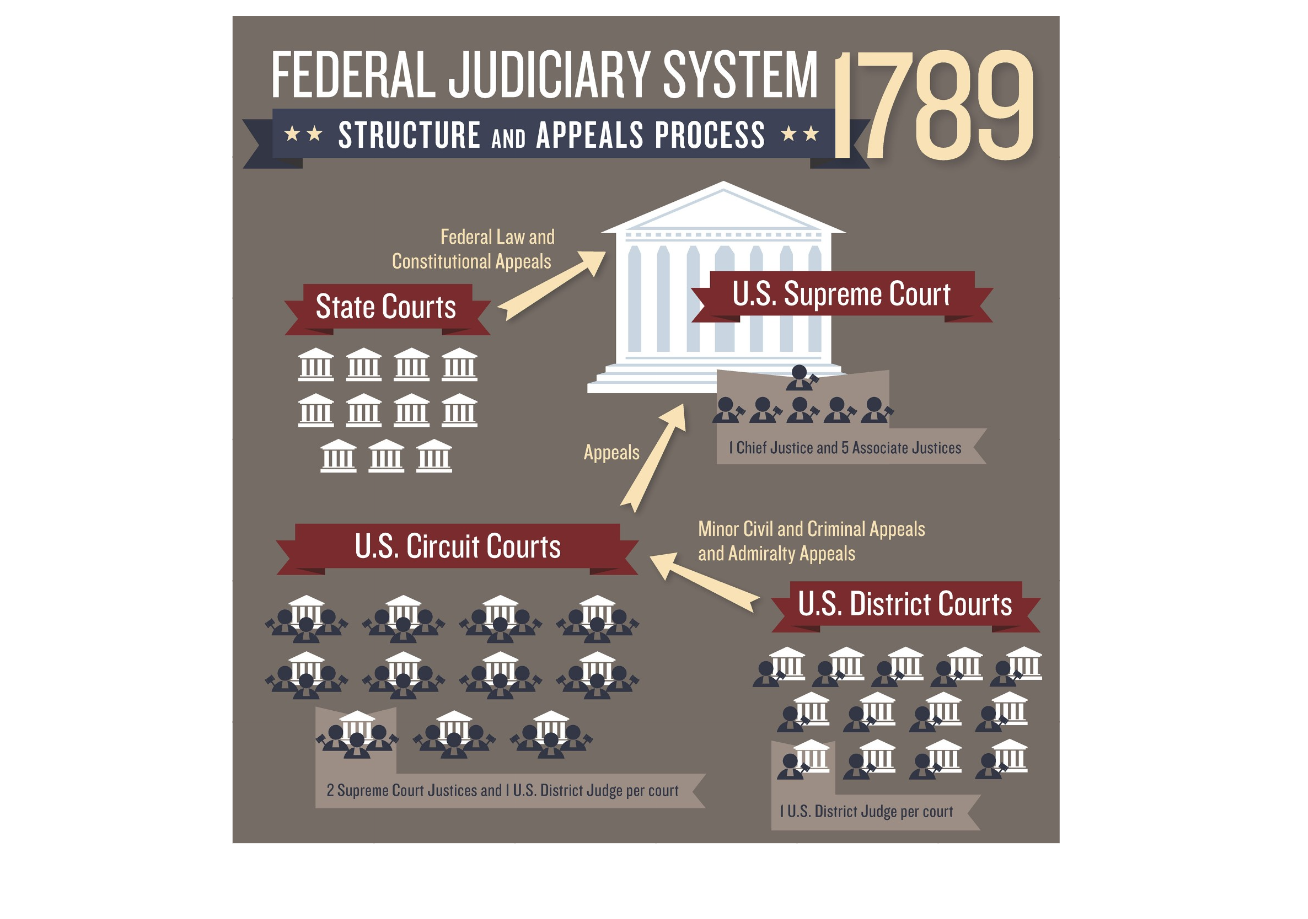
This diagram summarizes the basic structure created under the Judiciary Act of 1789, showing a tiered federal judiciary with the Supreme Court at the top and lower federal courts beneath it. It reinforces the idea that “uniform legal standards” require an institutional pathway for cases to move through a national system rather than remaining fragmented across separate state courts. Source
National judiciary: a system of courts at the national level with authority to interpret national law, resolve disputes, and issue binding judgments.
With no independent national judiciary, most legal disputes were handled by state courts, each applying its own procedures, precedents, and political priorities.
Limited and improvised dispute resolution
Congress could sometimes serve as an ad hoc forum for certain conflicts, but it lacked the institutional features of a court:
No permanent judges with defined tenure and judicial independence
No consistent rules of evidence or procedure applied across cases
No routine enforcement mechanism for decisions comparable to judicial orders
Why interstate disputes were difficult to resolve
Without a national court system, controversies between states were more likely to become prolonged political battles rather than being channelled into a predictable legal process.
Types of disputes that exposed the weakness
Interstate disputes could involve:
Boundary disagreements and competing land claims
Conflicts over commerce-related policies that spilled across borders
Disputes involving citizens of different states, where each state’s courts might favour in-state parties
Interpretation of national commitments, such as obligations that required consistent application
Even when states wanted resolution, there was no widely trusted, neutral judicial forum to supply finality and uniformity.
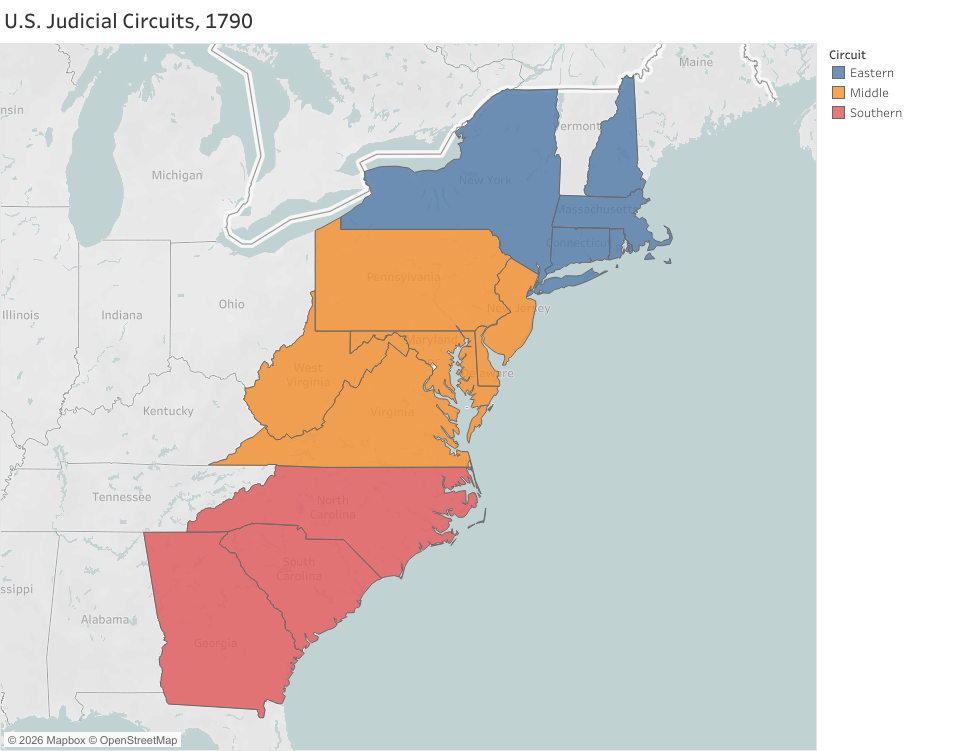
This map shows the early regional organization of the federal judiciary into circuits (as implemented after the Constitution), using color to distinguish circuit groupings. It helps explain how a national court system can impose consistent structure across states—making interstate disputes less dependent on ad hoc politics or parochial state-court decision-making. Source
Lack of uniform legal standards
Because state courts were the primary legal institutions:
Legal outcomes could vary sharply by state, undermining predictability
States could interpret shared national rules in self-interested ways
The national government struggled to ensure consistent compliance when states disagreed about meaning or obligations
This was especially damaging for any area requiring stable expectations across state lines, since inconsistency increases conflict and reduces cooperation.
Why enforcement of national rules was weak
A central function of courts is to make law effective by issuing binding judgments and remedies. Under the Articles, there was no routine federal pathway to translate national decisions into enforceable legal outcomes.
Dependence on voluntary state compliance
With no national judiciary to issue binding orders applicable across the country, Congress often depended on:
States voluntarily enforcing national decisions through their own courts
Political negotiation rather than legal compulsion
Informal pressure instead of a recognised system of legal accountability
When a state chose not to cooperate, there was no standing national court to authoritatively declare the controlling rule and bind the parties to a judicial resolution.
Consequences for legitimacy and stability
The absence of a national judiciary contributed to:
Lower trust that disputes would be resolved fairly
More frequent stalemates, because there was no accepted final legal arbiter
A weaker sense that the United States functioned under one coherent legal order rather than a collection of separate legal regimes
Connection to constitutional redesign
The inability to resolve interstate disputes and enforce uniform legal standards highlighted a broader institutional problem: a national government needs independent adjudication to translate shared rules into consistent practice. A judiciary can:
Provide neutral interpretation when political bodies disagree
Create uniformity across jurisdictions
Offer binding dispute resolution that reduces retaliation and escalation between states
The experience under the Articles helped persuade many leaders that a workable union required a true national court system capable of supporting national governance through consistent, enforceable law.
Practice Questions
Question 1 (2 marks) Explain one reason why the lack of a national judiciary under the Articles of Confederation made it difficult to resolve disputes between states.
1 mark: Identifies a valid reason (e.g., no neutral federal court; reliance on state courts; inconsistent rulings).
1 mark: Explains how that reason hindered dispute resolution (e.g., bias towards in-state parties, lack of final binding judgment, prolonged political conflict).
Question 2 (5 marks) Analyse how the absence of a national court system under the Articles of Confederation weakened the enforcement of uniform legal standards across the United States.
1 mark: States that there was no standing national judiciary/federal courts.
1 mark: Explains reliance on state courts and variation in procedures/interpretations.
1 mark: Connects variation to lack of uniform national legal standards (different outcomes across states).
1 mark: Explains enforcement weakness (dependence on voluntary state compliance; limited binding remedies).
1 mark: Develops impact on the union (greater interstate conflict, reduced predictability/legitimacy).
FAQ
Yes, there were narrow-purpose bodies (for example, maritime-related adjudication during wartime), but they were limited and did not function as a general federal judiciary for ordinary interstate or national-law disputes.
A legislature is designed for bargaining and representation, not neutral adjudication. It lacks stable judicial procedure, independence, and a routine mechanism for issuing and enforcing case-specific judgments.
It increased forum-shopping and inconsistency. Parties could face different rules depending on where a case was heard, and state courts might (or appear to) favour in-state litigants.
Key features include protected tenure or job security, salary protection, a professionalised bench, and authority to issue binding rulings without needing approval from political branches case by case.
Without uniformity, similar conduct can produce different legal outcomes across states, undermining predictability and cooperation. This can intensify interstate friction and weaken commitment to shared national rules.