AP Syllabus focus:
‘The Articles’ weaknesses included no centralized military power; the national government struggled to respond effectively to crises such as Shays’ Rebellion.’
Shays’ Rebellion exposed a core flaw of the Articles of Confederation: the national government lacked the coercive capacity to keep order. The episode helped convince many leaders that a stronger central authority was necessary.
Context: Governing Under the Articles
The Articles of Confederation created a loose union in which the states retained most governing power.
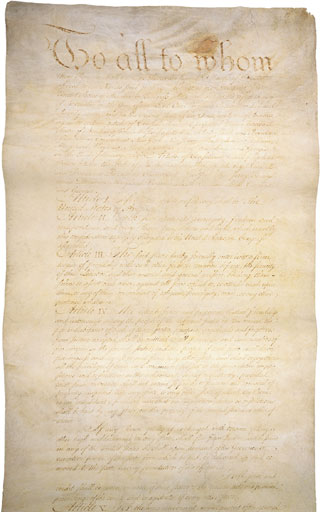
High-resolution scan of the engrossed Articles of Confederation (the United States’ first national constitution), preserved by the National Archives. Using the original document in notes underscores that the ‘loose union’ was a deliberate design choice—one that shaped the federal government’s limited ability to act quickly in domestic crises. Source
In moments of internal unrest, this structure mattered because public safety and domestic order often require rapid, coordinated action.
Why “centralized military power” mattered
Under the Articles, the national government did not have a robust, reliable way to raise, fund, and deploy forces to address emergencies within states. Instead, it depended on voluntary state cooperation, which could be slow, uneven, or politically contested.
Shays’ Rebellion: What Happened and Why It Alarmed Leaders
Shays’ Rebellion refers to an uprising in Massachusetts in 1786–1787 in which armed farmers and debtors resisted state economic policies and attempted to shut down courts to prevent foreclosures and debt collection.
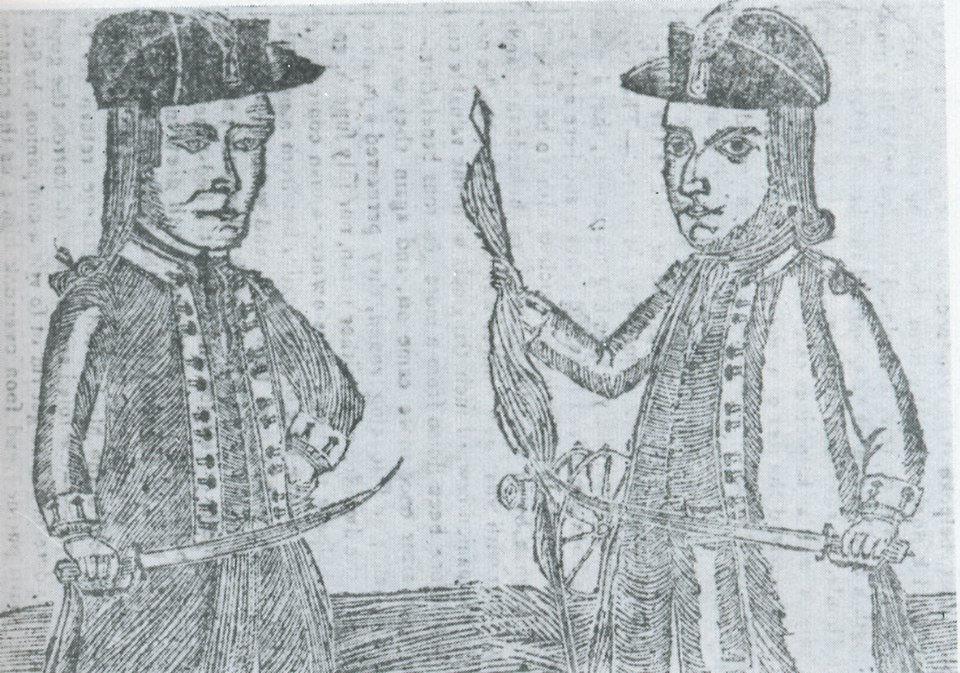
Cover-style woodcut portraits of Daniel Shays and Job Shattuck, two prominent leaders associated with the Massachusetts “Regulators.” Seeing the leaders reinforces that Shays’ Rebellion was an organized, politically motivated movement rooted in economic grievance and resistance to state enforcement. Source
Shays’ Rebellion: A 1786–1787 armed uprising in Massachusetts that challenged state authority and highlighted the national government’s inability under the Articles to respond effectively to domestic unrest.
Even though the rebellion occurred within one state, it carried national implications because it raised urgent questions about whether republican government could maintain order and stability without sliding into either anarchy or authoritarianism.
Why it became a “national” crisis
The rebellion suggested that economic distress could quickly become political violence.
It tested whether governments could enforce laws when confronted by organized resistance.
It signaled to elites and officeholders that the Confederation lacked the capacity to guarantee internal security across the union.
The Key Weakness: No Centralized Military Power
The syllabus emphasis is direct: “The Articles’ weaknesses included no centralized military power; the national government struggled to respond effectively to crises such as Shays’ Rebellion.” This weakness was not just about having soldiers; it was about having a dependable national mechanism to act.
What “no centralized military power” looked like in practice
No standing national force that could be quickly mobilized for domestic emergencies.
Reliance on state militias, controlled by state governments and not automatically available for national purposes.
Collective-action problems: states might delay, refuse, or bargain over contributing troops or resources.
Reduced credibility: if the national government could not respond, it appeared weak, encouraging further defiance elsewhere.
Why the response was difficult
Without centralized military capacity, a fast-moving crisis forced leaders into improvised solutions. The national government’s limited ability to coordinate an effective response made it harder to deter violence and harder to reassure the public that republican institutions could protect lives and property.
Political Impact: From Crisis to Calls for Change
Shays’ Rebellion intensified arguments that the Confederation structure was inadequate for basic governance. The event became a persuasive example for those who wanted reforms because it illustrated a gap between formal authority and practical power.
How the rebellion influenced constitutional thinking
It strengthened the case that a republic needs enough national power to preserve order while remaining constrained by law.
It reframed “liberty” as requiring both freedom and security, since rights are vulnerable when governments cannot enforce rules.
It contributed to momentum for reworking national institutions so the United States could respond more effectively to future crises.
What students should be able to explain
How Shays’ Rebellion demonstrated that the national government could not reliably manage internal unrest.
Why the lack of centralized military power under the Articles made crisis response slow and uncertain.
How this episode became evidence in broader debates about whether the United States needed a stronger national framework.
Practice Questions
(2 marks) Explain one way Shays’ Rebellion exposed a weakness in the Articles of Confederation.
1 mark: Identifies the weakness: the national government had no centralised military power (or could not readily raise/deploy forces).
1 mark: Explains the consequence: the national government struggled to respond effectively to the crisis (e.g., depended on state forces/voluntary cooperation, causing delay or ineffectiveness).
(6 marks) Analyse how the lack of centralised military power under the Articles of Confederation affected the national government’s ability to respond to Shays’ Rebellion.
Up to 2 marks: Describes the structural limitation (no standing national force; reliance on state militias; dependence on voluntary state cooperation).
Up to 2 marks: Applies the limitation to crisis response (slow mobilisation, uneven support, weak deterrence, difficulty restoring order promptly).
Up to 2 marks: Analysis of implications (national government appears weak; increases fear of instability; encourages demands for institutional change to handle future crises).
FAQ
It suggested similar uprisings could spread if economic conditions worsened.
It also raised doubts that republican government could protect property and maintain public order without a dependable national capacity to act.
Yes—policy choices at the state level sometimes reduce pressure that turns protest into violence, such as:
phased debt relief measures
procedural reforms in courts
temporary adjustments to enforcement practices
Information travelled slowly and often through partisan channels.
That uncertainty could amplify fear, making the uprising seem like a broader collapse of authority than it may have been in any single report.
Support often came from rural communities facing tight credit and aggressive debt collection.
Motivations typically mixed economic survival with a belief that government policies were unresponsive to ordinary citizens.
For many, it sharpened the view that liberty depends on stable enforcement of law.
The episode pushed some to prioritise institutional capacity—especially coercive capacity—while still seeking safeguards against abuse.