AP Syllabus focus:
‘The Articles provided no power to regulate interstate commerce and no exclusive power to coin money; inconsistent state policies hindered trade and economic stability.’
The Articles of Confederation created a loose union that struggled to manage the national economy. Two closely linked weaknesses—commerce policy and currency policy—produced conflict among states, unstable markets, and declining confidence in American trade.
What the Articles Did Not Authorise
Under the Articles, Congress lacked key tools for building a coherent economic union.
No national authority to regulate interstate commerce (trade among the states)
No exclusive national authority to coin money or control a uniform currency
States could pursue their own economic self-interest even when it harmed other states
Key Terms
Tariff: A tax placed on imported goods; under the Articles, states used tariffs and related fees to protect local business and raise revenue.
These gaps mattered because trade and money function best when rules are consistent across a shared market.
Commerce Problems: Trade Without National Rules
Because Congress could not regulate commerce among the states, states often treated one another like separate countries.
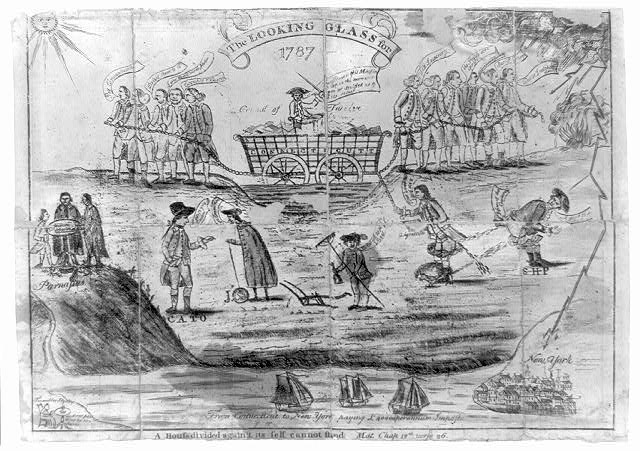
This 1787 political cartoon (“The Looking Glass for 1787”) satirizes the economic and political dysfunction of the Confederation era, with “Connecticut” weighed down by debts and paper money while competing factions pull in opposite directions. It helps illustrate how arguments over imposts (tariffs) and monetary policy could paralyze coordinated action, reinforcing the idea that states behaved like rival jurisdictions rather than a single economic union. Source
State Trade Barriers and Rivalries
States erected trade barriers that disrupted the flow of goods.
Tariffs on goods coming from other states
Fees and restrictions on the use of ports, rivers, and roads
Preferential policies benefiting in-state merchants and producers
This encouraged retaliation: when one state taxed or restricted another state’s goods, the targeted state could respond with its own restrictions, shrinking trade overall.
Fragmented Market and Higher Costs
A fragmented commercial system increased transaction costs and uncertainty.
Merchants faced different rules, taxes, and inspections at different borders
Businesses struggled to plan prices and supply chains across state lines
Consumers often paid more as tariffs and compliance costs were passed along
Without a national referee, disputes over access to markets and transportation routes were harder to resolve through uniform policy.
Weak National Bargaining Position
The inability to regulate commerce also reduced leverage in dealing with outside economic pressures.
States could undercut one another by offering different trade terms
A patchwork of rules made American trade less predictable and less attractive to partners
The national government could not set a unified commercial strategy to stabilise trade
Currency Problems: Too Many “Dollars”
The Articles also failed to create a stable, uniform money supply.
No Exclusive National Power to Coin Money
Congress did not have exclusive control over coinage. States could issue their own forms of money, and different monies circulated at once.
Multiple state currencies created confusion about value
Exchange between currencies imposed costs on trade
Counterfeiting and inconsistent acceptance were persistent risks
Paper Money, Inflation, and Depreciation
Many states issued paper money to address shortages of hard currency and to ease debt burdens, but over-issuance often reduced its value.
Rapid increases in money supply could contribute to inflation (rising prices)
Depreciation made it harder for merchants and creditors to predict the real value of payments
Contracts and debts became contentious when repayment occurred in weakened currency
Credit, Investment, and Confidence
An unstable currency environment discourages lending and long-term investment.
Creditors feared being repaid in less valuable money
Businesses faced uncertainty when pricing goods across state lines
Lack of confidence in currency undermined economic stability beyond any single state
How Commerce and Currency Weaknesses Reinforced Each Other
Trade barriers and currency instability interacted to intensify economic problems.
Tariffs reduced trade volume; reduced trade made currency problems more acute by limiting reliable exchange
Multiple currencies complicated interstate transactions already burdened by border policies
The overall effect was inconsistent state policies that hindered trade and economic stability, matching the core weakness identified in the syllabus
Practice Questions
(2 marks) Identify two ways in which the Articles of Confederation created economic problems relating to commerce or currency.
1 mark for identifying lack of national power to regulate interstate commerce (or equivalent).
1 mark for identifying lack of exclusive national power to coin money / existence of multiple state currencies (or equivalent).
(6 marks) Explain how inconsistent state policies under the Articles of Confederation hindered trade and economic stability. In your response, refer to both interstate commerce and currency.
1 mark: Explains that states could impose tariffs/trade barriers on other states’ goods.
1 mark: Explains how retaliatory measures or rivalry reduced overall interstate trade.
1 mark: Explains that Congress could not create uniform commercial rules across states.
1 mark: Explains that states issued different currencies / no exclusive national coinage.
1 mark: Explains how depreciation/inflation/uncertain value undermined contracts or credit.
1 mark: Links commerce and currency problems to broader instability (e.g., higher costs, reduced confidence, disrupted markets).
FAQ
Yes. Merchants used private contracting, established trusted credit networks, and relied on major port cities as clearing points.
Some states negotiated ad hoc arrangements, but these were limited and could be reversed quickly.
Specie shortages were linked to trade imbalances, limited domestic minting, and post-war economic disruption.
Scarcity mattered because specie-backed expectations constrained inflation; without it, paper currency values were more volatile.
They changed enforcement of contracts, repayment terms, and creditor remedies across borders.
That legal inconsistency made lenders more cautious and raised the cost of doing business between states.
Coastal states with major ports often had more opportunities to raise revenue through port duties and related fees.
Interior states could be disadvantaged by dependence on coastal access for imports and exports.
Cooperation required voluntary compliance and sustained coordination, which was difficult when states faced different fiscal pressures.
States also had incentives to preserve control over money issuance as a tool for local debt and budget management.