AP Syllabus focus:
‘Weaknesses in defense, enforcement, courts, commerce, and currency drove debate over granting the national government greater power previously reserved to the states.’
The Articles of Confederation created a loose union that struggled to govern effectively.
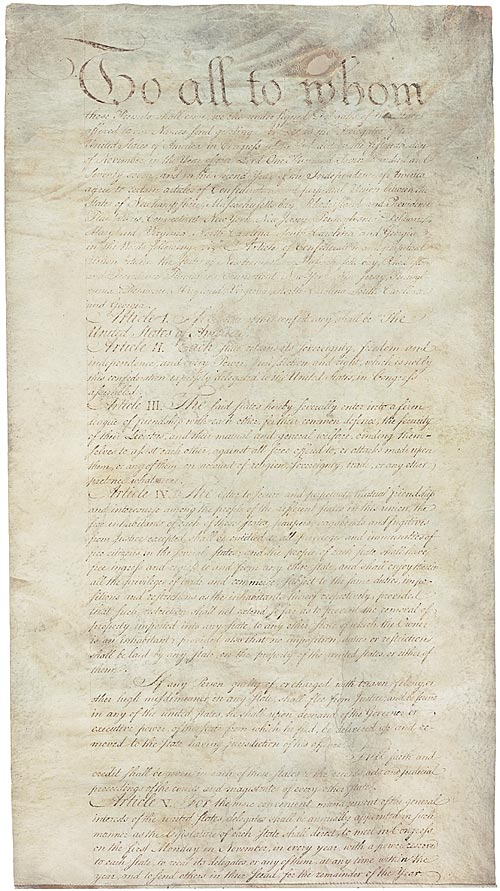
Engrossed (official) copy of the Articles of Confederation, the United States’ first national constitution. Using the original document helps emphasize that the “weak confederation” was not a vague idea but a concrete institutional design that left Congress heavily dependent on state cooperation for money and enforcement. Source
Mounting problems—security, money, trade, and legal disputes—convinced many leaders that only a stronger national government could preserve stability and the union.
Why “weak confederation” became a crisis
Under the Articles, the national government relied heavily on state cooperation. When states disagreed or refused to comply, Congress lacked practical tools to respond. The resulting policy failures did more than cause inconvenience; they threatened the union’s capacity to function as a single nation.
Core idea: authority was too decentralised
A confederation prioritises state sovereignty, which can make national coordination difficult when collective action is required.
Confederation: A system in which states retain primary sovereignty and delegate limited powers to a central government that depends on the states for enforcement and resources.
This structure shaped the central debate: whether the United States could remain secure and economically viable without shifting key powers upward to the national level.
Weaknesses that drove calls for stronger federal power
The syllabus emphasises five linked weaknesses—defence, enforcement, courts, commerce, and currency—and how they fuelled debate over granting new national powers previously held by states.
Defence: inadequate national capacity to respond
Without dependable national military capacity, the union struggled to manage internal unrest and external threats.
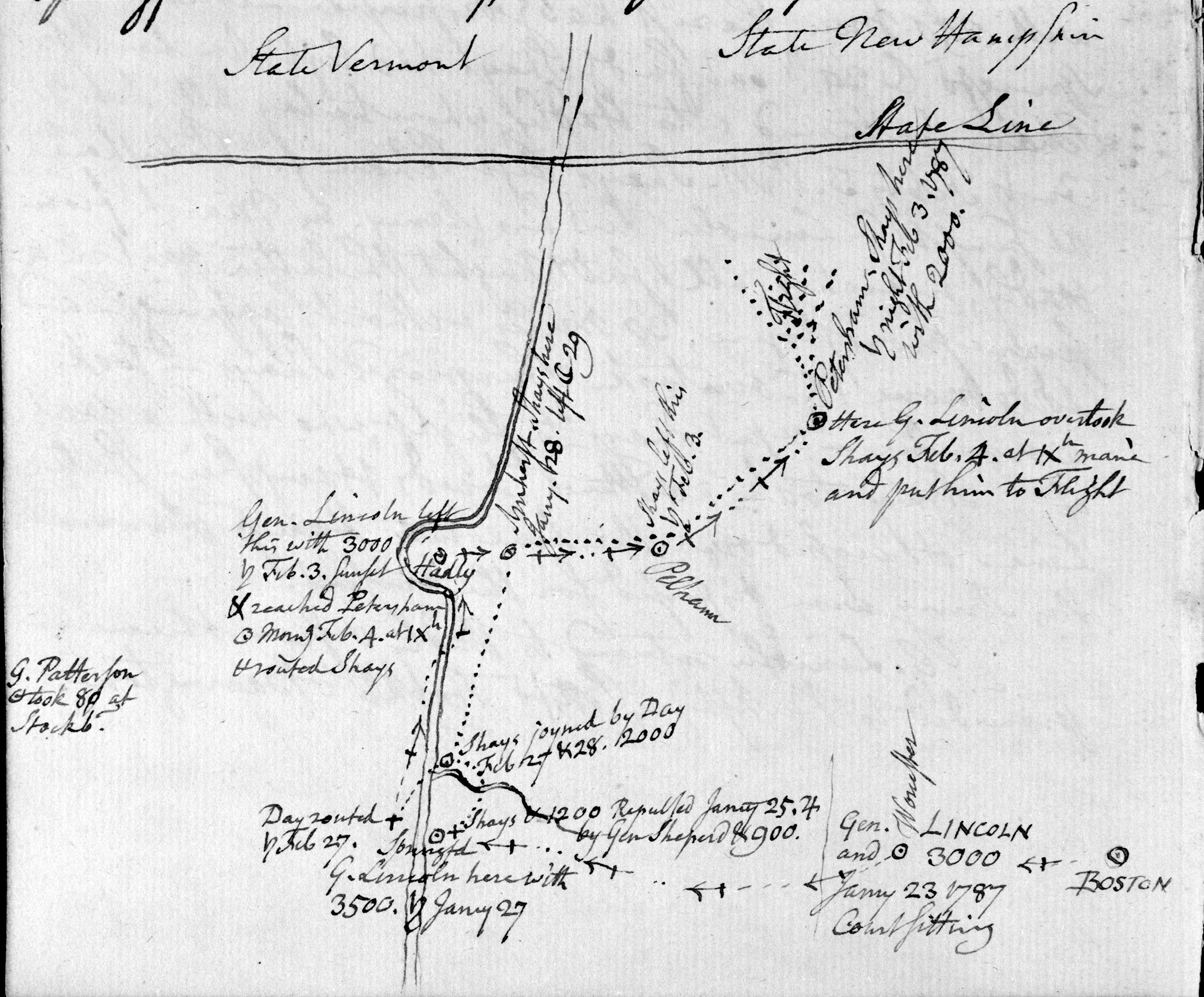
Annotated 1787 map (drawn by Ezra Stiles) tracing militia and “Regulator” movements during Shays’ Rebellion in Massachusetts. It illustrates how internal unrest tested the confederation’s ability to maintain order—an experience frequently cited by reformers as evidence that the union needed stronger, more reliable national capacity. Source
National leaders feared that disorder could spread if the central government could not ensure domestic tranquillity.
Security problems strengthened arguments for a government able to coordinate defence across state lines.
Enforcement and revenue: laws without leverage
A government that cannot reliably raise revenue or ensure compliance will struggle to govern.
States could ignore national requests, making federal policy uneven and unpredictable.
The inability to secure consistent funding undermined basic national functions and long-term planning.
Courts: no uniform mechanism to resolve disputes
Without a strong national judiciary, interstate conflicts could escalate or remain unresolved.
Disputes between states risked becoming political standoffs rather than legal questions.
Lack of consistent legal interpretation weakened the idea of a single national rule of law.
Commerce: trade barriers and coordination problems
Economic conflict between states exposed the limits of decentralised authority.
States could adopt policies that advantaged their own economies while harming neighbours.
Calls increased for national authority to establish consistent rules for interstate economic activity.
Currency: instability and reduced confidence
When states pursued separate approaches to money and finance, economic uncertainty grew.
Uneven currency practices disrupted trade and contracts.
Instability encouraged demands for national capacity to promote economic reliability.
The debate: what “stronger federal power” meant
The push for reform was not simply about “more government,” but about reallocating powers so the union could solve collective-action problems that states could not address effectively on their own.
Powers reformers wanted to strengthen at the national level
Reform-minded leaders argued that national authority needed to be credible in areas tied to national survival and economic integration:
Coordinated defence and security planning
Reliable implementation of national decisions
National legal resolution of interstate disputes
Consistent regulation of interstate economic relationships
Greater stability in financial and monetary policy
Why the shift mattered for American democracy
Increasing federal power raised enduring questions central to American government:
How to make national action effective without creating unchecked power
How to preserve meaningful state authority while preventing interstate conflict
How to design institutions that could govern a large republic with diverse interests
Practice Questions
Identify two weaknesses of the Articles of Confederation that contributed to demands for stronger federal power.
1 mark for identifying one valid weakness (defence, enforcement/revenue, courts, commerce, or currency).
1 mark for identifying a second, different valid weakness.
Explain how weaknesses in commerce, currency, and the lack of a national judiciary under the Articles of Confederation fuelled debate about granting more power to the national government.
1 mark: Explains a commerce-related weakness (e.g., inconsistent state trade policies).
1 mark: Links that commerce weakness to the case for national authority.
1 mark: Explains a currency-related weakness (e.g., instability harming contracts/trade).
1 mark: Links that currency weakness to the case for national authority.
1 mark: Explains a judiciary-related weakness (e.g., interstate disputes lacking uniform resolution).
1 mark: Links that judiciary weakness to the case for national authority.
FAQ
Some states could leverage autonomy to pursue short-term advantages.
They could shape trade or tax choices around local interests.
Political leaders feared losing influence to distant national institutions.
Resistance often reflected calculations about power, not just principle.
When states acted as competitors, collective problems worsened.
Economic retaliation, regulatory inconsistency, and boundary disagreements created spillover harms that a single state could not fix alone.
This made national solutions more attractive to those prioritising union-wide stability.
Reformers wanted national decisions to have dependable effect.
Examples of tools they sought included clearer supremacy of national law, mechanisms to compel compliance, and reliable revenue capacity so national commitments were credible.
Unpredictable money conditions can undermine trust in government.
If citizens and businesses cannot rely on stable rules for payment and contracts, they may view governing institutions as ineffective, increasing pressure for structural change.
It created a lasting tension: national problem-solving versus local control.
Later disputes repeatedly revisited the same underlying issue—whether union-wide needs justify shifting authority away from states in specific policy areas.