AP Syllabus focus:
‘Each branch can check and balance the others through constitutional powers and shared responsibilities, reducing the risk that one branch becomes too powerful.
Checks and balances is the Constitution’s practical method for controlling government power. By giving each branch distinct tools to counter the others, it makes domination difficult and requires bargaining to govern.
What “checks and balances” means
The Framers assumed power can be abused, even in a republic. Instead of trusting one “best” institution, the Constitution creates overlapping powers so that ambition and institutional interests limit each other.
Checks and balances: A constitutional system in which each branch has independent powers and shared responsibilities that allow it to restrain the other branches.
This design helps ensure that major national decisions typically require agreement across branches, not unilateral action.
How the branches restrain one another
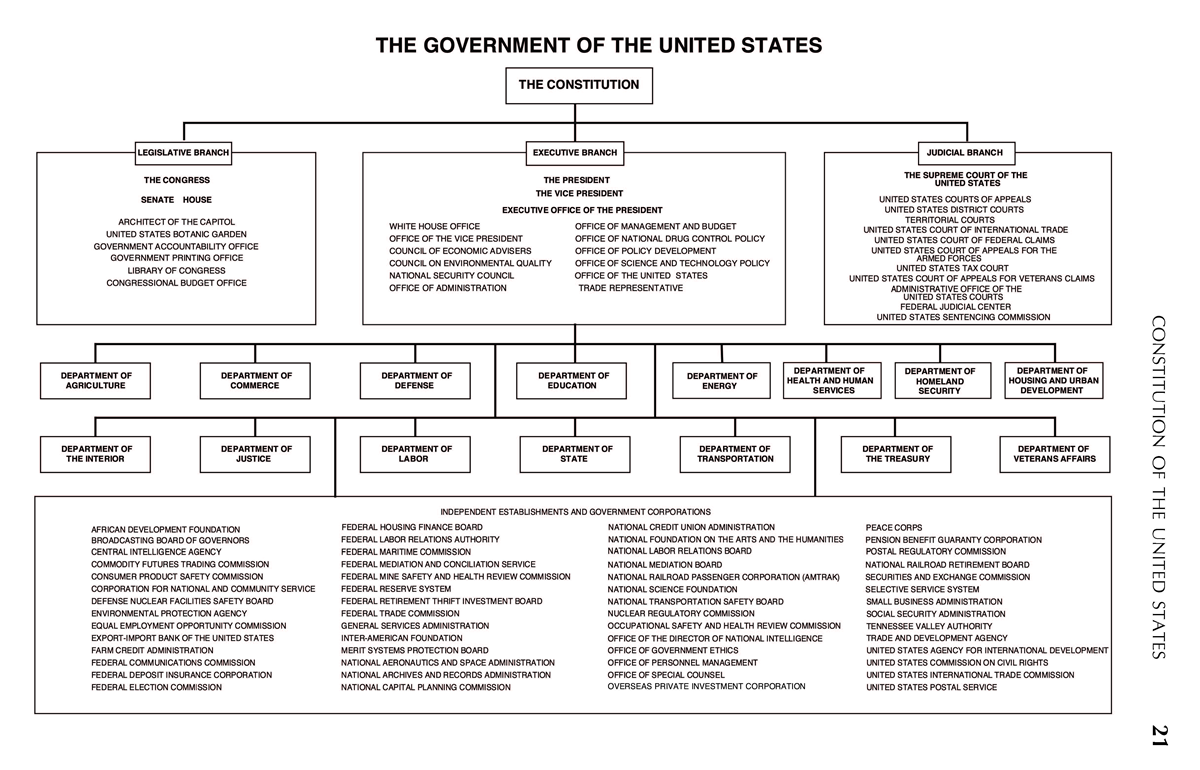
Organizational chart showing how the U.S. Constitution structures the federal government into legislative, executive, and judicial branches. This kind of “who’s in which branch” map helps clarify that checks and balances operate between institutions that are constitutionally separate, even as they share power in governing. Source
Checks and balances works through specific, constitutionally grounded actions that allow one branch to block, shape, or review another branch’s use of power.
Legislative branch checks (Congress)
Congress checks the executive and judiciary primarily through its control over lawmaking, funding, and institutional oversight.
Overrides and constraints on executive action
Override a presidential veto with a supermajority, preventing the president from being the final lawmaking authority.
Use the power of the purse (appropriations) to limit, condition, or refuse funding for executive priorities.
Control over personnel and structure
Senate advice and consent on many presidential appointments shapes who leads executive departments and sits on the federal judiciary.
Create, reorganise, or limit executive agencies by statute, defining what the bureaucracy may do.
Oversight and investigation
Hold hearings, demand information, and investigate administration of laws, increasing accountability and deterring misuse of authority.
Executive branch checks (President and executive agencies)
The executive checks Congress and influences the judiciary through vetoes, enforcement choices, and appointment powers.
Checks on Congress
Veto legislation, forcing Congress to revise bills or muster a supermajority.
Use agenda-setting tools (messages to Congress, public leadership) to pressure or steer legislative outcomes.
Checks involving the courts
Nominate federal judges, influencing the long-term direction of constitutional and statutory interpretation.
Checks through implementation
Execute laws through rulemaking and enforcement; while bounded by statute and courts, implementation choices can narrow or broaden a law’s practical effect.
Judicial branch checks (Federal courts)
The judiciary checks the elected branches by interpreting law and applying the Constitution as a limit on government action.
Review of constitutionality
Strike down laws or executive actions that conflict with constitutional requirements, preventing Congress or the president from exceeding lawful authority.
Binding interpretation
Issue authoritative interpretations of statutes and constitutional provisions that executive agencies must follow when enforcing laws.
Judicial checks are strongest when decisions are accepted as legitimate and are practically enforceable through compliance by political actors.
Shared responsibilities that force cooperation
The specification emphasises shared responsibilities: key governing tasks require participation from more than one branch, creating built-in negotiation and mutual restraint.
Making laws: a multi-branch process
To become law, a policy must pass both houses of Congress and survive presidential approval (or veto override). This means:
Congress cannot legislate effectively without considering executive acceptance.
The president cannot make durable domestic policy alone without statutory authority.
Staffing government: appointments as a check
High-level appointments are a shared responsibility:
The president selects nominees, promoting executive leadership and direction.
The Senate confirms or rejects, preventing unilateral control over top officials and judges.
Treaties and major national commitments
For treaties:
The executive negotiates and signs.
The Senate must approve by supermajority, limiting unilateral foreign-policy commitments and encouraging broader consensus.
Effects and trade-offs of checks and balances
Checks and balances aims to reduce the risk that one branch becomes too powerful by making power fragmented and contestable.
Protection against concentration of power
Competing institutions can expose abuses and block overreach.
Deliberation and stability
Policies that survive multiple veto points often reflect broader agreement and may be more stable.
Potential for delay and stalemate
The same restraints that prevent domination can produce gridlock when branches are controlled by different parties or disagree sharply.
Practice Questions
(3 marks) Define checks and balances and describe one way the executive can restrain Congress.
1 mark: Accurate definition of checks and balances (branches restrain one another through constitutional powers/shared responsibilities).
1 mark: Identifies an executive restraint (e.g., veto).
1 mark: Brief description of how it restrains Congress (e.g., forces revision or supermajority override).
(6 marks) Explain how shared responsibilities in (a) lawmaking and (b) appointments operate as checks and balances, and explain why this reduces the risk of one branch becoming too powerful.
Up to 2 marks: Lawmaking explained (bicameral passage plus presidential signature/veto; override).
Up to 2 marks: Appointments explained (presidential nomination plus Senate advice and consent).
Up to 2 marks: Clear link to restraint (requires interbranch agreement; blocks unilateral control; prevents concentration of authority).
FAQ
No. It requires that each branch has the capacity to resist.
In practice, branches may cooperate when incentives align, and still preserve the ability to check if conditions change.
A check is a specific power to stop or limit another branch (e.g., veto, confirmation vote).
A balance is the overall distribution of authorities that prevents any branch from dominating across time.
Unified party control can reduce the willingness to use checks aggressively.
Divided party control often increases oversight, veto threats, and interbranch bargaining.
Yes, through oversight and funding tools.
Hearings and investigations
Appropriations conditions or delays
Reporting requirements imposed on agencies
Courts depend on compliance and practical enforceability.
Limits can arise from difficulties in monitoring implementation, ambiguous rulings, or political resistance that does not directly violate a court order.