AP Syllabus focus:
‘Federalist No. 51 explains how separation of powers and checks and balances are designed to control potential abuses by majorities and protect liberty within a republic.’
Federalist No. 51 (James Madison) defends the Constitution by explaining how its institutional design restrains power. It focuses on preventing abuse by majorities while still allowing representative government to function.
Core purpose of Federalist No. 51
Federalist No. 51 argues that a free government must be built to handle two persistent problems:
Government officials may abuse power
Majorities may use political power to threaten liberty
Madison’s solution is structural: rather than relying on civic virtue alone, the Constitution uses institutional incentives and competing power centres to reduce the likelihood that any single political majority can dominate.
Key concept: majority abuse and liberty
Madison assumes that political majorities can act unjustly, especially when passions run high. The Constitution therefore aims to protect liberty within a republic by dividing and balancing power so that temporary majorities face barriers before they can impose harmful policies.
Tyranny of the majority: A situation where a political majority uses government power to violate the rights or interests of individuals or minority groups.
In Federalist No. 51, preventing majority tyranny is not framed as stopping all majority rule, but as ensuring majorities must govern through constitutional processes that slow, filter, and constrain power.
Separation of powers: dividing authority to prevent domination

This diagram organizes the federal system into distinct branch functions—lawmaking (legislative), enforcement (executive), and interpretation (judicial)—and then layers in key checking powers that limit each branch. Visually separating duties from checking mechanisms helps clarify the difference between “separation of powers” (division of authority) and “checks and balances” (tools for resisting encroachment). In Federalist No. 51 terms, it shows how institutional structure makes domination harder even when political incentives push toward power accumulation. Source
Madison emphasises separation of powers as a first line of defence. By giving different responsibilities to separate branches, the Constitution reduces the chance that a single majority can quickly control the entire national government.
Why separation matters in Federalist No. 51
Concentrated power makes it easier for a majority (or faction) to act decisively and oppressively
Divided power forces agreement across institutions with different roles and incentives
Independence of branches makes it harder for one electoral majority to capture all decision-making at once
Checks and balances: “ambition” restraining ambition
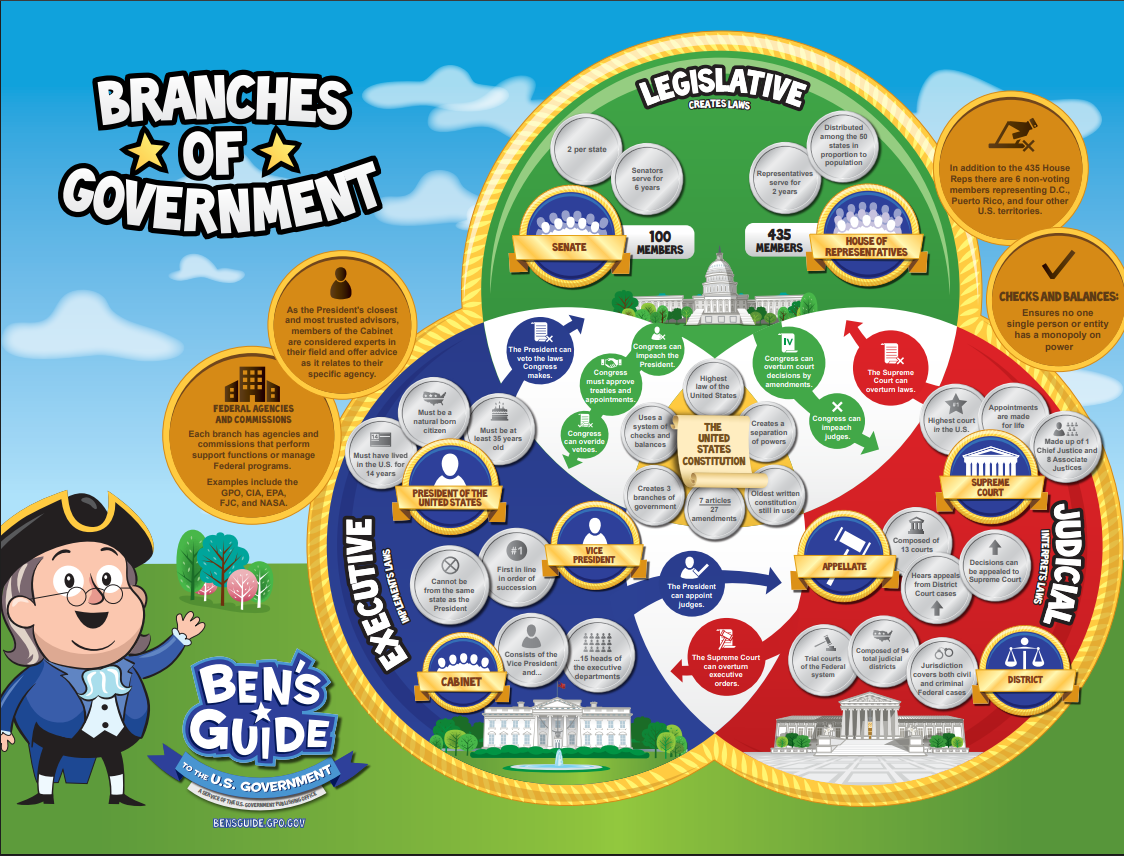
This diagram summarizes how the legislative, executive, and judicial branches share power through formal checks such as vetoes, overrides, appointments/confirmations, and judicial review. By mapping specific “veto points” between institutions, it illustrates Madison’s argument that ambition can be used to counteract ambition. The overall structure shows why policy change typically requires cross-branch agreement rather than a single, momentary majority. Source
Federalist No. 51 is especially known for its account of checks and balances, where each branch has constitutional tools to resist encroachment by the others. Madison’s logic is incentive-based: officeholders will defend their branch’s power because their careers, prestige, and influence depend on it.
“Auxiliary precautions” in practice
Madison argues that structural safeguards supplement popular control. Key features include:
Mutual veto points (for example, actions that require concurrence of more than one branch)
Shared powers that force negotiation and compromise
Institutional self-interest, encouraging each branch to protect its own authority
This design makes it more difficult for a single majority coalition to translate its preferences into immediate, unchecked policy outcomes.
How the design restrains majorities (without eliminating democracy)
Federalist No. 51 treats majority rule as legitimate, but potentially dangerous if unrestrained. The Constitution reduces risk by creating multiple hurdles that require broader, more durable support.
Mechanisms that complicate majority control
Different institutions, different constituencies: Separate branches are chosen in different ways and may respond to different public pressures.
Staggered decision-making: Not all political institutions change hands at the same time, limiting sudden, sweeping shifts.
Multiple stages of lawmaking: Passing and enforcing policy requires navigating more than one institution, increasing deliberation.
The overall effect is to make policymaking more consensus-driven and less vulnerable to short-lived majorities.
Protecting liberty within a republic: the balancing goal
Federalist No. 51 links institutional design to liberty: freedom is safest when no single political force can easily dominate. Madison’s approach assumes:
Popular elections alone may not adequately protect rights
Internal controls are necessary because leaders and citizens are imperfect
A republic must be energetic enough to govern, yet constrained enough to prevent oppression
By combining separation of powers and checks and balances, Federalist No. 51 explains how the Constitution aims to control potential abuses by majorities while preserving representative self-government.
Practice Questions
(2 marks) According to Federalist No. 51, explain one way the Constitution is designed to prevent abuse of power by majorities.
1 mark: Identifies a relevant mechanism (e.g., separation of powers or checks and balances).
1 mark: Explains how it restrains majority abuse (e.g., creates veto points/forces agreement across branches/slows rapid action).
(6 marks) Using Federalist No. 51, analyse how Madison justifies checks and balances as a protection for liberty within a republic.
1 mark: Defines or accurately describes checks and balances in context.
2 marks: Explains Madison’s incentive-based logic (e.g., “ambition” counteracting ambition; branch self-interest).
2 marks: Connects the structure to limiting majority tyranny (e.g., multiple veto points, bargaining, delayed decision-making).
1 mark: Links the argument to protecting liberty within a republic (rights less vulnerable to temporary majorities).
FAQ
He believes written limits alone cannot restrain power if officials have incentives to ignore them.
Federalist No. 51 therefore stresses enforceable structures—institutions that can actively resist one another.
It assumes self-interest is permanent in politics.
Rather than expecting constant virtue, the Constitution channels self-interest into institutional competition that can deter power grabs.
It argues for government strong enough to govern but designed to avoid oppression.
The aim is balance: energy plus restraint, not paralysis or complete mistrust of governing.
It addressed fears that the new national government would become tyrannical.
Madison’s response was that the Constitution’s internal structure would limit both officials and popular majorities better than the existing alternatives.
Critics argue branches may not compete if the same political coalition controls them, reducing checking behaviour.
Others note that informal norms and party incentives can sometimes matter as much as constitutional design.