AP Syllabus focus:
‘Powers are separately delegated to Congress, the president, and the courts; dividing authority helps prevent any one branch from dominating the federal government.'
Separation of powers is a core constitutional design that assigns distinct governing responsibilities to three branches. Understanding what each branch is empowered to do clarifies how national policy is made and why authority is intentionally divided.
Constitutional Principle: Separation of Powers
Separation of powers: The constitutional division of governmental authority among the legislative, executive, and judicial branches, with each assigned distinct roles and powers.
The Constitution separates national power by delegating different kinds of authority to different institutions:
Article I delegates legislative power to Congress
Article II delegates executive power to the president
Article III delegates judicial power to the federal courts
This structure reflects the syllabus emphasis that powers are separately delegated and that dividing authority helps prevent any one branch from dominating the federal government.
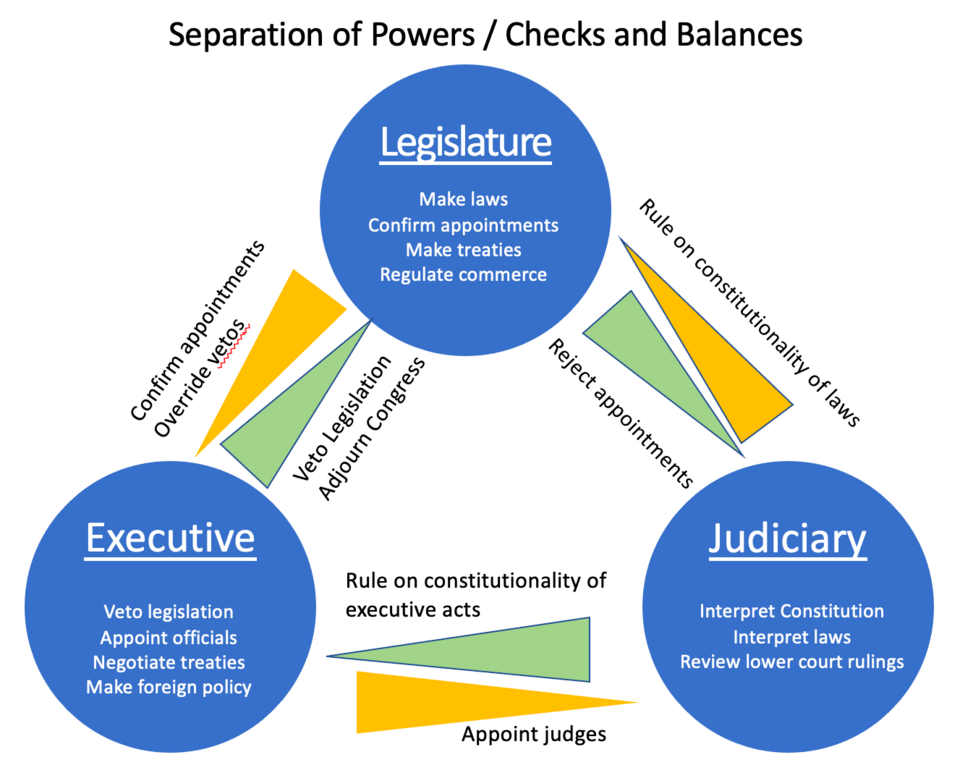
Diagram summarizing U.S. separation of powers and key checks and balances among Congress (legislative), the president (executive), and the federal courts (judicial). It visually emphasizes that each branch has distinct core powers while also holding tools that limit the others, which helps prevent dominance by any single institution. Source
Congress (Legislative Branch): Making National Law
Core role
Congress’s primary responsibility is lawmaking—creating general rules that apply nationally.
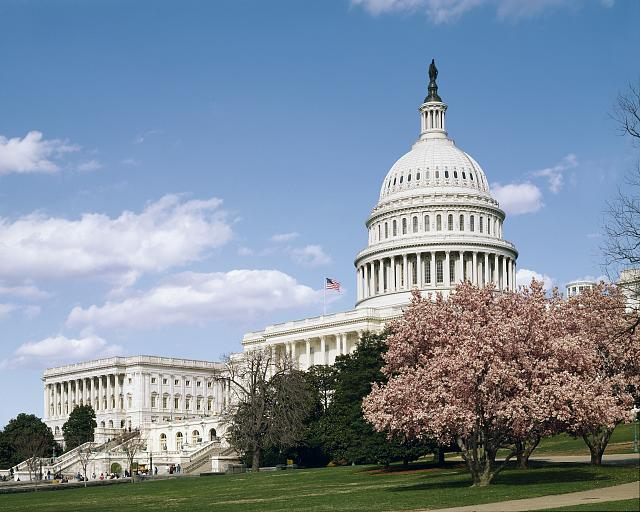
Photograph of the U.S. Capitol in Washington, D.C., the principal workplace of Congress (House and Senate). As a visual reference point, it helps connect the abstract idea of “legislative power” to the institution that drafts, debates, and passes federal statutes. Source
What “legislative power” includes
Key responsibilities associated with Congress’s distinct role include:
Drafting, debating, and passing statutes (federal laws)
Representing constituencies through a bicameral legislature (House and Senate)
Setting broad national priorities by deciding which issues receive legislative attention
Establishing the structure of government through laws that create agencies, programmes, and procedures (while operating within constitutional limits)
Why this role is separate
By placing lawmaking in a multi-member, representative body, the Constitution makes national rules harder to create quickly, encouraging deliberation and reducing the chance of concentrated power.
President (Executive Branch): Enforcing and Administering Law
Core role
The executive branch’s central responsibility is faithful execution of the laws passed by Congress.
What “executive power” includes
In carrying out law enforcement and administration, the president:
Directs executive departments and officials who implement federal statutes
Coordinates national administration to ensure laws are applied across the country
Sets enforcement priorities within the boundaries of existing law and available resources
Acts as the single nationally elected executive, creating energy and accountability in administration
Why this role is separate
The Constitution concentrates execution in a single president to promote decisiveness in administration, while still keeping that function distinct from writing the laws.
Federal Courts (Judicial Branch): Interpreting and Applying Law
Core role
The judicial branch’s responsibility is to interpret the Constitution and federal law while resolving disputes that arise under them.
What “judicial power” includes
Federal courts:
Decide cases and controversies brought under federal jurisdiction
Interpret legal meaning by applying constitutional and statutory text to real disputes
Provide uniformity in the application of federal law across states (especially through appellate review)
Why this role is separate
By assigning interpretation to courts, the Constitution aims to ensure legal disputes are resolved through reasoned judgment rather than political pressure, helping keep adjudication distinct from making or enforcing law.
Why Division of Power Prevents Domination
Separation of powers is designed to reduce the likelihood that any single institution can control:
Rulemaking (writing the law)
Rule enforcement (executing the law)
Rule interpretation (deciding what the law means in disputes)
Keeping these functions institutionally distinct:
slows abrupt changes in national policy
creates multiple centres of authority
promotes accountability by clarifying which branch is responsible for which governing task
Practical Boundaries and Overlap (Without Merging Roles)
Although branches interact in practice, the key AP focus is that their primary powers are distinct. In general:
Congress should not directly execute the laws it passes
the president should not unilaterally create statutes
courts should not act as lawmakers or administrators
Tensions often arise at the boundaries—especially when modern governance requires complex administration—making the constitutional separation of roles a continuing foundation for how American national government operates.
Practice Questions
Question 1 (2 marks) Define separation of powers and identify the primary constitutional role of one branch of the federal government.
1 mark: Accurate definition of separation of powers (division of authority among legislative, executive, judicial branches with distinct roles).
1 mark: Correct identification of a branch and its primary role (e.g., Congress makes laws; president executes/enforces laws; courts interpret/apply law in cases).
Question 2 (5 marks) Explain how the Constitution’s separation of powers assigns distinct roles to Congress, the president, and the federal courts, and analyse how dividing authority helps prevent any one branch from dominating the federal government.
1 mark: Explains Congress’s distinct legislative role (making/passing laws; Article I).
1 mark: Explains the president’s distinct executive role (executing/enforcing laws; Article II).
1 mark: Explains the federal courts’ distinct judicial role (interpreting/applying law in cases; Article III).
1 mark: Analysis of how dividing authority reduces concentration of power (different institutions control different functions).
1 mark: Further analysis linking division to prevention of domination (e.g., slows unilateral action; prevents one body from controlling making, enforcing, and interpreting law simultaneously).
FAQ
Writers such as Montesquieu argued that liberty is threatened when legislative, executive, and judicial functions are held by the same hands.
American constitution-makers adapted this to a written constitution by assigning functions to separate institutions to reduce arbitrary government.
Formal approaches emphasise keeping branch roles strictly distinct.
Functional approaches accept some blending if it helps government work effectively, as long as no branch accumulates excessive control over a core function.
Independent agencies often combine rulemaking, enforcement, and adjudication within one organisation.
This raises questions about where “executive” administration ends and quasi-legislative or quasi-judicial activity begins, even if courts still review certain actions.
The nondelegation doctrine is the idea that Congress should not hand over its legislative power wholesale to the executive.
In practice, Congress may delegate discretion if it provides an “intelligible principle” to guide administration, though how strict this should be is debated.
Unitary executive theory argues that executive power is vested in the president, implying strong presidential control over executive officials.
Disputes often centre on the extent to which Congress may insulate administrators from direct presidential direction while still preserving an executive branch that can carry out the law.