AP Syllabus focus:
‘Checks and balances allow legal action against officials who abuse power: the House may impeach by formally charging misconduct, and the Senate may remove upon conviction in an impeachment trial.’
Impeachment is the Constitution’s primary internal remedy for serious misconduct by federal officials. It is a deliberately difficult, political-legal process that protects democratic accountability while reducing the chance of partisan removals.
Impeachment and Removal as Checks and Balances
Impeachment is a congressional check on abuses of executive and judicial power. It divides authority between the chambers to slow down removal and require broad agreement:
The House of Representatives acts like a prosecutor by approving formal charges.
The Senate acts like a court by conducting a trial and deciding whether to convict and remove.
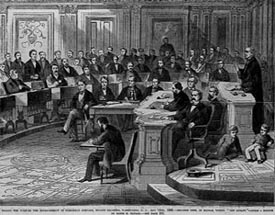
Historical depiction of a Senate impeachment trial, showing the Senate chamber arranged in a courtroom-like format. The image helps illustrate how impeachment is a political-legal process: the House presents the case, the accused is represented by counsel, and senators function as jurors who vote on conviction. Source
This structure reflects the syllabus emphasis: the House may impeach by formally charging misconduct, and the Senate may remove upon conviction in an impeachment trial.
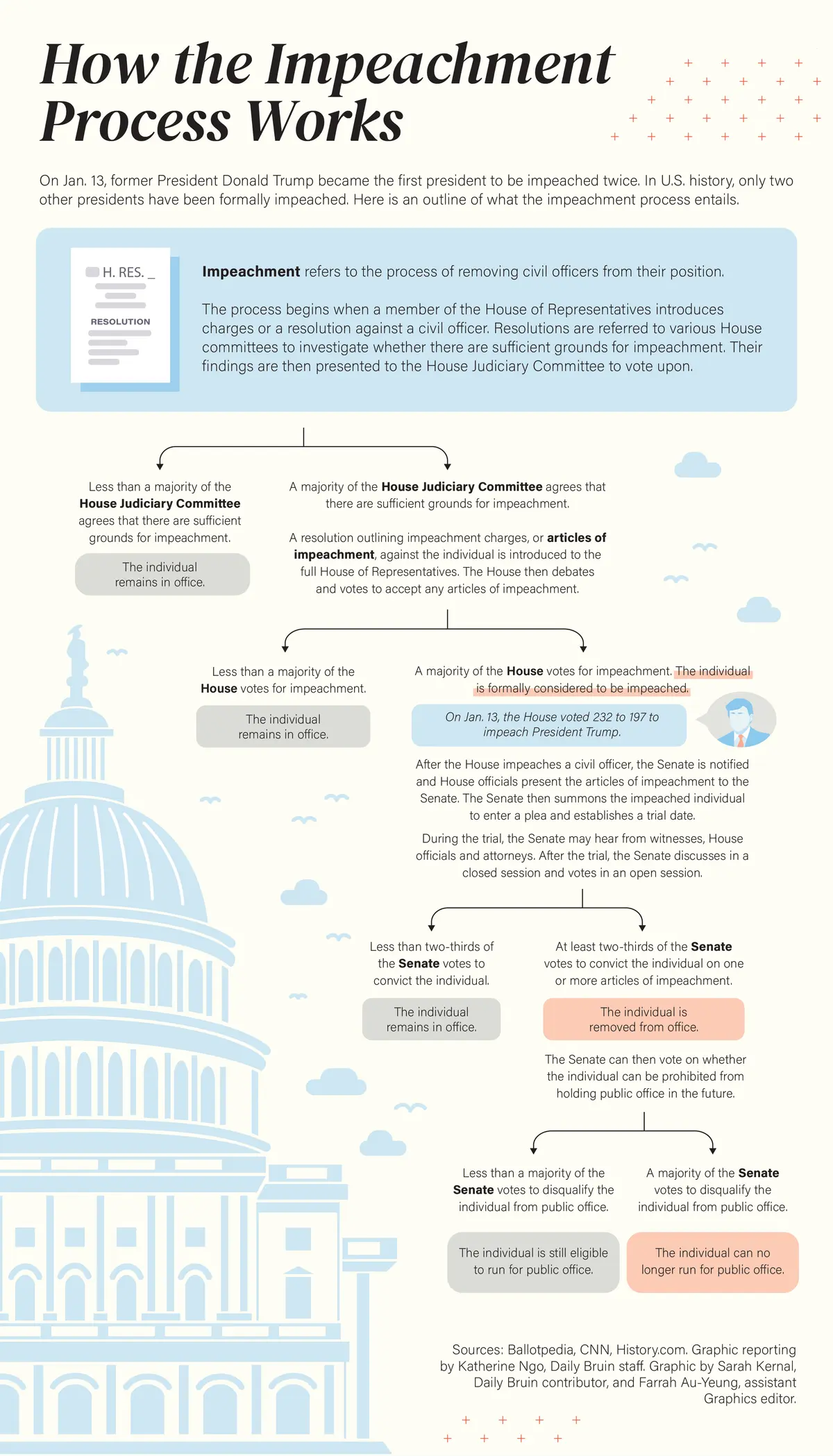
Flowchart summarizing the federal impeachment pathway from House investigation and adoption of articles of impeachment (simple majority) to the Senate trial and conviction threshold (two-thirds of senators present). It also distinguishes the automatic penalty of removal upon conviction from the separate, additional Senate vote on possible future disqualification from federal office. Source
Constitutional Foundations and Key Terms
Impeachment: The House’s formal process of accusing a federal official of impeachable misconduct by approving articles of impeachment (charges).
Impeachment itself does not remove an official; it triggers a Senate trial.
Removal (upon conviction): The constitutional consequence when the Senate convicts an impeached official, resulting in mandatory removal from the current office.
The Constitution authorises impeachment for the president, vice president, and other civil officers (commonly understood to include federal judges and executive officials).
What counts as impeachable misconduct?
The Constitution uses the standard “treason, bribery, or other high crimes and misdemeanors.” In practice, this is not limited to indictable crimes; it can include serious abuses of public trust, corruption, or conduct incompatible with office. Because the standard is broad, impeachment outcomes often depend on political judgement about severity and legitimacy.
The House Role: Impeachment (Charging Misconduct)
The House has the sole power of impeachment. Typical steps include:
Investigation (often through committees) and gathering evidence
Drafting and debating articles of impeachment
A House vote on each article; a simple majority is sufficient to impeach
Appointment of House managers to present the case in the Senate
The House’s function is to decide whether the official’s conduct warrants a trial-level response by the Senate, not whether the official should ultimately remain in office.
The Senate Role: Trial and Conviction (Removal)
The Senate has the sole power to try impeachments. Key features:
Senators act as jurors and take an oath to do impartial justice
Evidence and arguments are presented, typically led by House managers and the official’s counsel
For presidential impeachments, the Chief Justice presides to avoid the vice president (the Senate’s usual presiding officer) overseeing a trial that could involve presidential succession
Conviction requires a two-thirds vote of senators present
If the Senate convicts, removal from office follows automatically.
Penalties and limits
Impeachment penalties are limited to:
Removal from office (after conviction)
Possible disqualification from holding future federal office (a separate Senate decision after conviction)
Impeachment is separate from criminal law. An official can still face criminal investigation or prosecution through the courts, but impeachment itself is not a criminal conviction and does not impose imprisonment or fines.
Why the Process Is Hard to Use (and Why That Matters)
Impeachment is intentionally difficult because it can overturn election results or disrupt governance. The system aims to balance:
Accountability: Congress can respond to severe wrongdoing.
Stability: Supermajority conviction makes removal unlikely without substantial cross-party or broad support.
Independence of branches: Especially for judges, impeachment exists but is rare, supporting judicial independence while preserving an ultimate remedy for serious misconduct.
Common AP-Level Pitfalls
Confusing impeachment (House charging) with removal (Senate conviction).
Assuming impeachment requires a statutory crime; the constitutional standard can reach serious abuses of office.
Forgetting the Senate’s two-thirds conviction threshold and the limited nature of impeachment penalties.
Practice Questions
Explain the difference between impeachment and removal. (2 marks)
1 mark: States impeachment is the House formally charging an official (e.g., passing articles of impeachment).
1 mark: States removal occurs only if the Senate convicts in an impeachment trial (leading to the official leaving office).
Describe how the House and Senate roles in impeachment illustrate checks and balances, and explain two constitutional features that make removal difficult. (6 marks)
1 mark: Describes the House’s role as bringing charges/impeaching by majority vote.
1 mark: Describes the Senate’s role as trying the case and voting on conviction.
1 mark: Links the split roles to checks and balances (power divided to prevent easy/partisan removal).
1 mark: Explains the Senate conviction requirement as a high threshold.
1 mark: Explains another constraining feature, e.g., limited penalties (removal/disqualification only) or Chief Justice presiding for presidential trials to reduce conflict of interest.
1 mark: Uses accurate constitutional language (e.g., “sole power”, “articles of impeachment”, “conviction”).
FAQ
No. The Senate tries impeachments. The Chief Justice presides only when the President is tried, but this is not Supreme Court judicial review of the outcome.
Resignation can end the immediate need for removal, but it does not necessarily prevent the House or Senate from continuing proceedings, especially if disqualification from future office is sought.
Disqualification is a Senate decision to bar the convicted official from holding future federal office. It is considered after conviction and is separate from the vote to remove.
The basic structure is the same (House impeaches; Senate tries), but judges do not trigger the Chief Justice presiding requirement, and cases often focus on ethical misconduct or abuse of judicial office.
It is a constitutional standard focused on serious abuse of public trust, not a list of specific offences. Congress interprets it case-by-case, which is why impeachment judgments can be politically contested.