AP Syllabus focus:
‘Separation of powers and checks and balances create multiple access points for stakeholders and institutions to shape public policy across branches and levels of government.’
A key feature of the US system is that policymaking is deliberately fragmented. This creates many places where proposals can be influenced, slowed, changed, or blocked by different political actors.
Core idea: many places to influence policy
What “multiple access points” means
Access points: institutional opportunities for individuals and groups to influence government decisions, including agenda-setting, drafting, approval, implementation, and judicial review.
Because power is divided, policy rarely moves through a single, simple pathway; it travels through several institutions, each with its own procedures and incentives.
Why the Constitution creates them
Separation of powers divides authority among Congress, the presidency, and the courts, while checks and balances give each branch tools to limit the others. Together, these design choices multiply decision-makers and stages in the process, increasing opportunities for influence and opposition.
Where access points appear (branches and levels)
Congress: many internal “entry doors”
Stakeholders can shape policy in Congress at multiple stages:
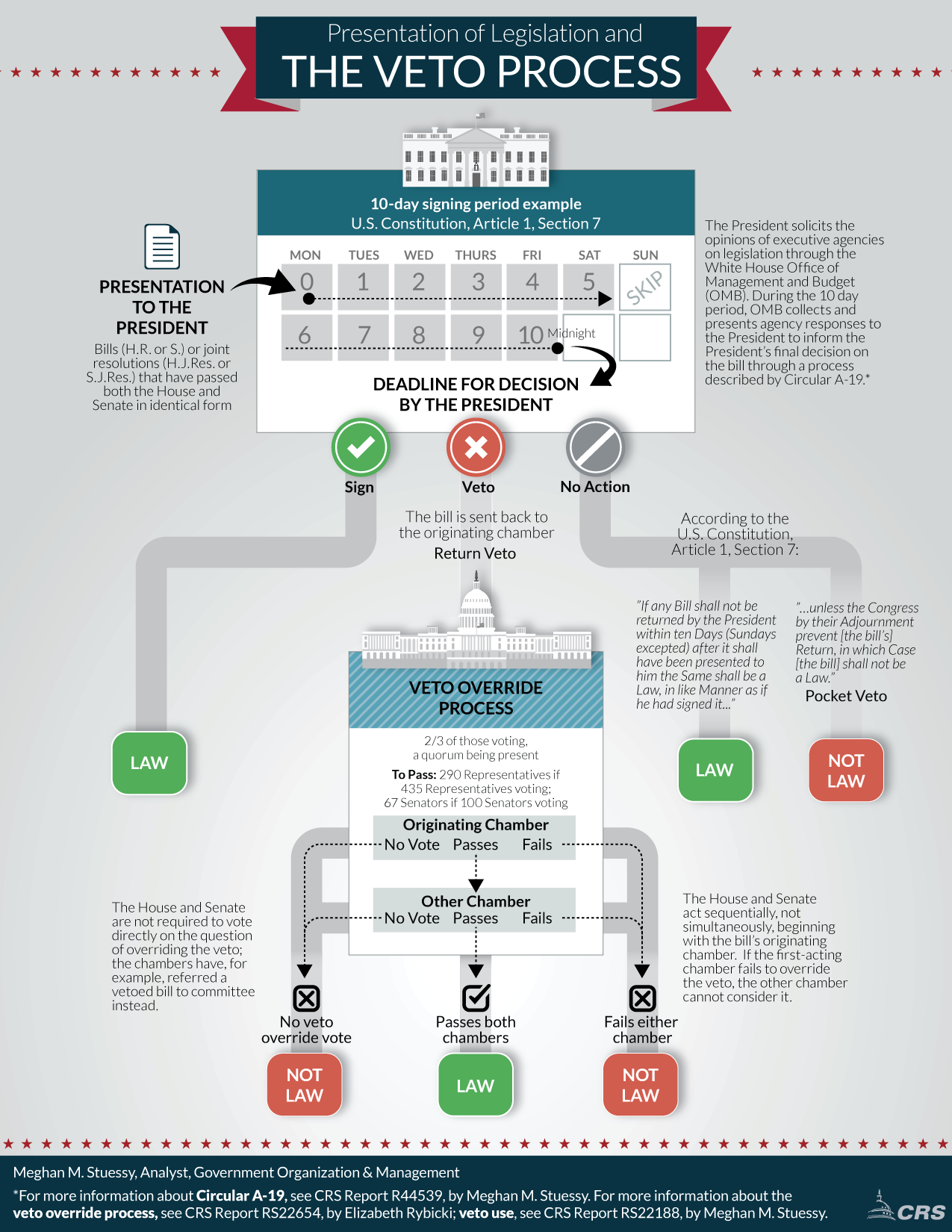
This Congressional Research Service infographic diagrams what happens after a bill passes both chambers and is presented to the president. It highlights the president’s options (sign, veto, or take no action) and shows how Congress can respond through a veto-override vote, illustrating how separation of powers creates additional decision points that can stop or reshape legislation. Source
Agenda setting: persuading leaders and members to prioritise an issue.
Committees and subcommittees: influencing hearings, markups, and specialised drafting.
Bicameralism: winning support in one chamber does not guarantee success in the other, creating additional negotiating points.
Coalition-building: assembling cross-party or regional alliances to move a bill forward.
Oversight and funding: influencing how programs operate through conditions attached to appropriations and oversight pressure.
Presidency: influence through execution and bargaining
The executive branch is an access point both because it participates in lawmaking and because it implements policy:
Legislative role: proposing priorities, negotiating with Congress, and using the veto threat to shape final content.
Administrative direction: guiding implementation choices that affect how broad laws operate in practice.
Appointments: staffing agencies can shift policy emphasis within the bounds of statutory authority.
Courts: access through litigation and interpretation
Courts create access points because they can determine whether a policy is constitutional and how it must be applied. Stakeholders may:
Bring or support lawsuits to challenge laws or administrative actions.
Seek interpretations that expand or narrow policy meaning. Judicial involvement makes policy change possible even when elected branches are gridlocked, while also allowing opponents to delay or overturn outcomes.
Federalism: access points across “branches and levels”
The syllabus emphasises access points “across branches and levels of government.” Federalism adds additional arenas:
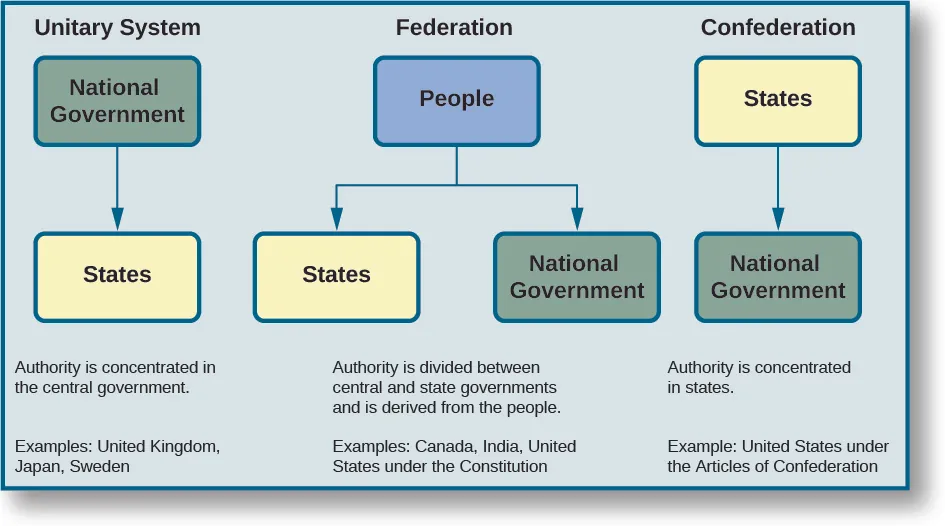
This figure contrasts three system types—unitary, federal (federation), and confederal—using a simple flowchart of where authority originates and where it is exercised. The “federation” panel visually captures the logic of U.S. federalism: power is divided between national and state governments, creating multiple levels where policy can be adopted, resisted, implemented, or litigated. Source
State governments can adopt, resist, or reshape policy within their authority.
National policymakers may need state cooperation for administration and compliance.
Interest groups can pursue parallel strategies in states and nationally, shifting to whichever venue is most favourable.
Who uses access points (stakeholders and institutions)
Stakeholders
Stakeholders include individuals, interest groups, professional associations, businesses, unions, social movements, and advocacy organisations. They use access points to:
Place issues on agendas.
Provide information and expertise to decision-makers.
Mobilise public support or opposition.
Pressure officials through elections, messaging, and sustained contact.
Institutions as strategic venues
Because different institutions have different rules, stakeholders often “venue shop,” choosing the most promising access point:
If Congress stalls, they may focus on executive implementation.
If executive action is controversial, they may seek judicial review.
If national action fails, they may pivot to state-level policy.
Effects on policymaking
Multiple access points tend to:
Increase compromise and incrementalism, because many actors must agree (or at least not block).
Make policy outcomes more stable once enacted, because they survived many hurdles.
Create more opportunities for minority interests to slow or reshape policy, even when a national majority supports change.
Raise the importance of organisation, persistence, and resources, since navigating many venues can be costly and time-consuming.
Practice Questions
Define access points and explain why the US system has many of them. (2 marks)
1 mark: Correct definition (institutional opportunities to influence policy decisions).
1 mark: Explains cause (separation of powers and checks and balances fragment authority).
Explain how separation of powers and checks and balances create multiple access points for stakeholders to shape public policy across branches and levels of government. (5 marks)
1 mark: Links separation of powers to multiple institutions involved.
1 mark: Explains a congressional access point (e.g., committees/bicameralism).
1 mark: Explains an executive access point (e.g., veto threat/implementation).
1 mark: Explains a judicial access point (e.g., litigation/interpretation).
1 mark: Explains a federalism-based access point (state vs national venues).
FAQ
An access point is any place to influence policy.
A veto point is a place where an actor can formally stop change (e.g., a presidential veto or one chamber refusing to pass a bill).
They can be both.
They widen participation opportunities, but they can also privilege well-resourced groups that can sustain lobbying and litigation across many venues.
Committees control issue expertise and early drafting.
They can hold hearings, amend proposals, and effectively advance or stall legislation before it reaches the full chamber.
Many laws delegate discretion.
Agencies and executive leadership make choices about rules, enforcement priorities, and guidance, which can significantly shape real-world policy effects.
Different levels have separate elections, institutions, and jurisdictions.
Stakeholders can shift efforts between state and national arenas, or pursue both simultaneously, to find the most receptive decision-makers.