AP Syllabus focus:
‘The Due Process and Equal Protection Clauses of the Fourteenth Amendment empower national enforcement of protections against the states, while Supreme Court rulings shape the extent of those protections.’
The Fourteenth Amendment (1868) transformed federalism by nationalising key rights protections.
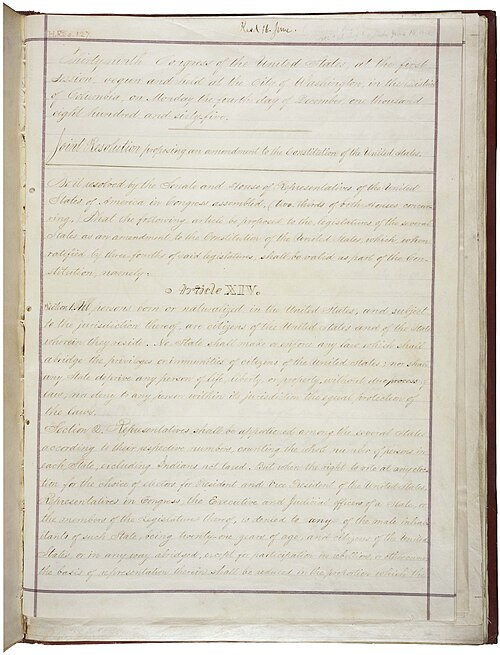
Page one of the Fourteenth Amendment as an enrolled constitutional document. Seeing the actual text underscores that the Due Process and Equal Protection Clauses are written constraints on state power that later Supreme Court doctrine applies and elaborates. Source
Its Due Process and Equal Protection Clauses became the main constitutional tools the Supreme Court uses to review—and sometimes invalidate—state and local laws.
Core Idea: National Protection of Rights Against States
Before the Fourteenth Amendment, most of the Bill of Rights limited only the national government. The Fourteenth Amendment created a constitutional basis for federal courts to police state action that threatens liberty or equality.
These clauses are enforced primarily through judicial review in state-law challenges.
Congress also has enforcement authority under Section 5 of the amendment, but courts define the amendment’s scope in practice.
The Due Process Clause
The Due Process Clause says no state shall “deprive any person of life, liberty, or property, without due process of law.”
Due process: Constitutional requirement that government follow fair procedures (procedural due process) and respect certain fundamental liberties (substantive due process).
Procedural Due Process (Fair Process)
Procedural due process focuses on how government acts when it takes away life, liberty, or property.
Typical requirements include notice, a meaningful hearing, and a neutral decision-maker.
The level of required procedure often depends on the importance of the interest at stake and the risk of error.
Substantive Due Process (Fundamental Liberties)
Substantive due process focuses on what government may do, even if procedures are fair.
The Court has treated some liberties as “fundamental,” meaning states need exceptionally strong reasons to restrict them.
The boundaries of substantive due process are controversial and shift with Supreme Court membership and interpretive approaches.
Selective Incorporation: Applying the Bill of Rights to States
A major Fourteenth Amendment development is selective incorporation, where the Court uses the Due Process Clause to apply many protections in the Bill of Rights to state governments.
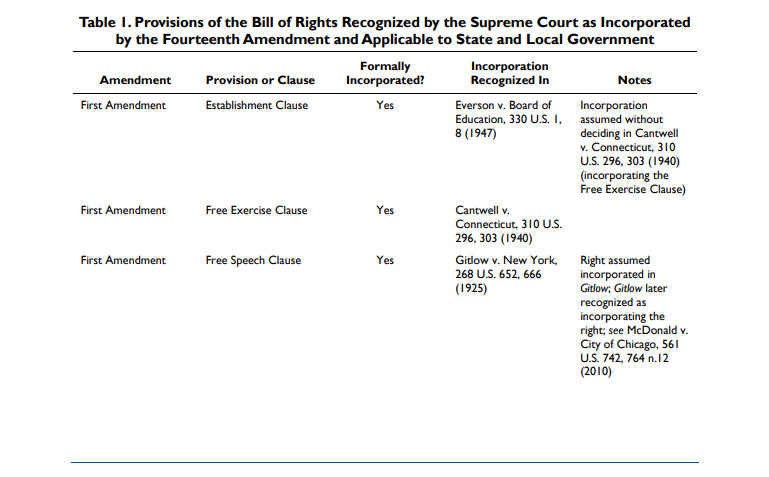
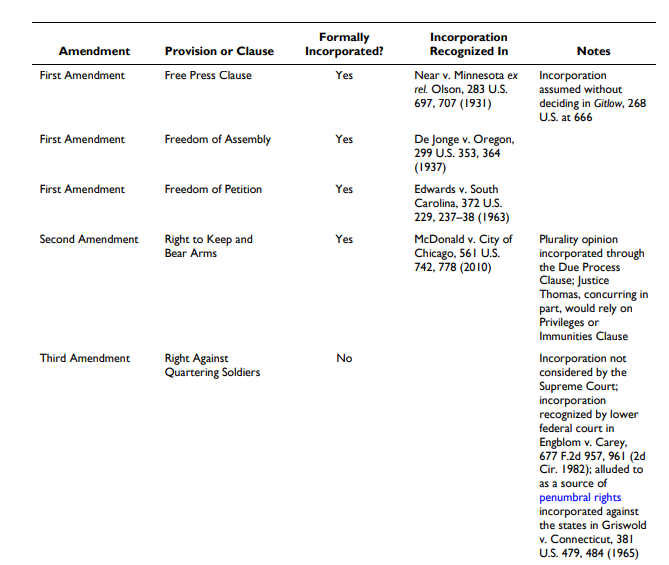
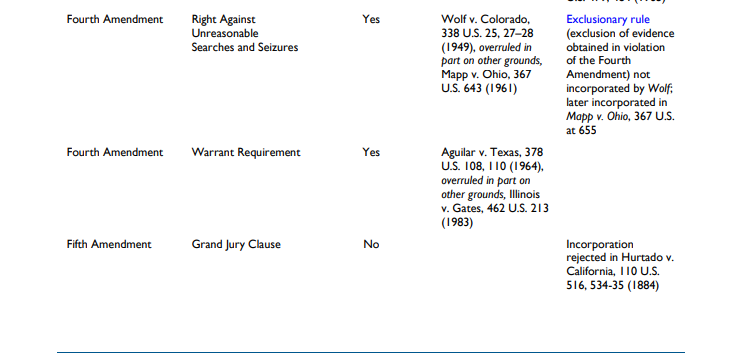
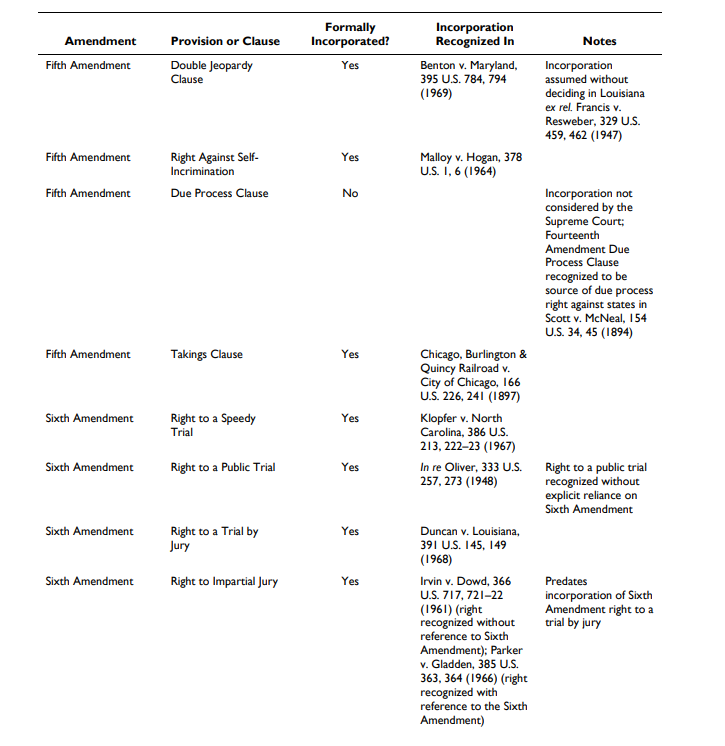
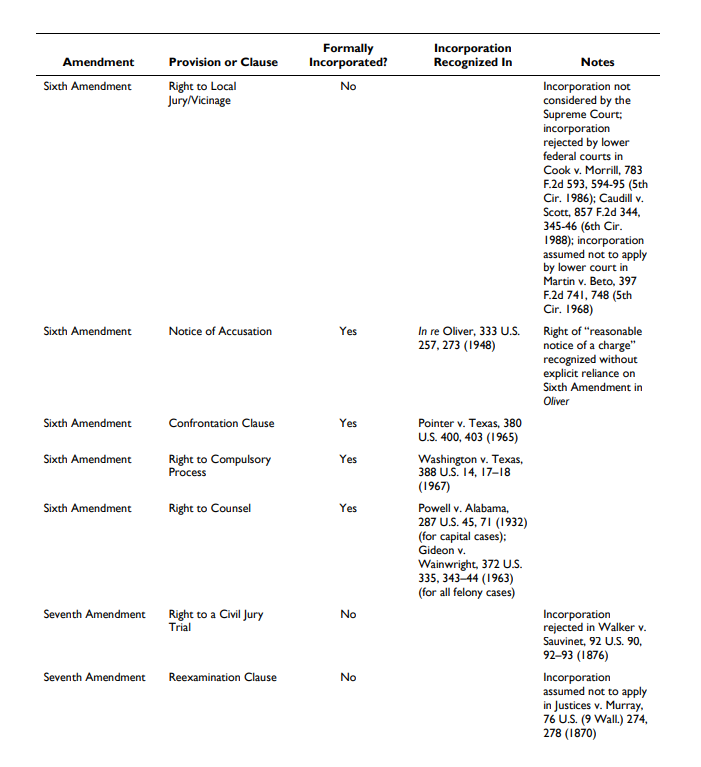
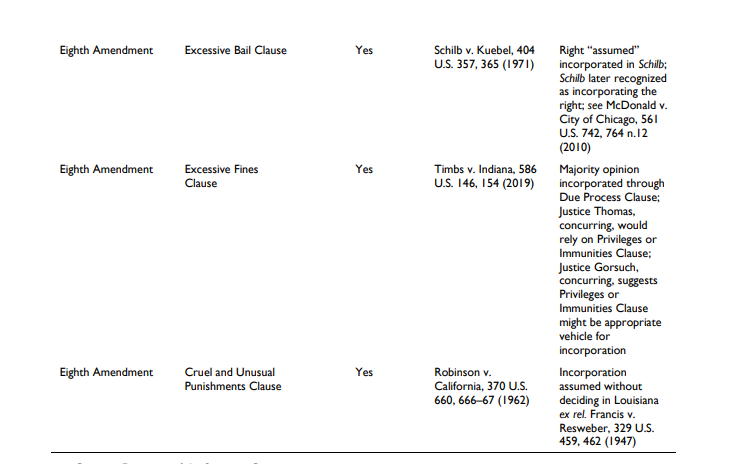
A Congressional Research Service table listing Bill of Rights provisions and whether (and in what case) the Supreme Court has recognized their incorporation against state and local government. This visual helps students treat selective incorporation as a case-by-case doctrine rather than a single all-at-once event. Source
Selective incorporation: Supreme Court doctrine applying specific Bill of Rights protections to the states through the Fourteenth Amendment’s Due Process Clause, case by case.
This doctrine emerged through Supreme Court rulings and is not explicitly spelled out in the constitutional text. Incorporation disputes often ask whether a right is “fundamental” to ordered liberty or deeply rooted in U.S. tradition.
The Equal Protection Clause
The Equal Protection Clause requires states to provide “equal protection of the laws,” limiting discriminatory laws and unequal administration of law.
Equal protection: Constitutional requirement that similarly situated people be treated similarly by government, unless differential treatment is adequately justified.
What Equal Protection Targets
Equal protection challenges commonly involve:
Facial classifications (the law explicitly distinguishes between groups)
Discriminatory intent (a neutral law adopted or applied with an intent to discriminate)
Unequal application by officials (selective or biased enforcement)
Supreme Court Standards of Review (Levels of Scrutiny)
Because the Court “shapes the extent” of Fourteenth Amendment protections, it has built tiers of review that determine how hard it is for a state to defend a challenged law.
Rational basis review: State action is upheld if it is rationally related to a legitimate government interest (most laws pass).
Intermediate scrutiny: State must show the law is substantially related to an important interest.
Strict scrutiny: State must show the law is narrowly tailored to achieve a compelling interest (most laws fail).
Which level applies depends on the type of classification or the kind of liberty implicated, making Supreme Court doctrine central to real-world outcomes.
Why Supreme Court Interpretation Matters
Fourteenth Amendment protections are stable in text but dynamic in application:
Incorporation expanded many individual rights claims against states.
Equal protection doctrine evolved from tolerating segregation to prohibiting many forms of state-sponsored discrimination.
Ongoing disputes concern how to define “fundamental” liberty, how to prove discriminatory intent, and how aggressively courts should police state policymaking.
Practice Questions
Explain how the Fourteenth Amendment’s Due Process Clause can be used to apply a right in the Bill of Rights to state governments.
1 mark: States that the Due Process Clause restricts state governments from depriving liberty without due process of law.
1 mark: Identifies the doctrine of selective incorporation (applied case by case via Supreme Court rulings).
1 mark: Explains that incorporated rights become enforceable against states through judicial review.
Using the Fourteenth Amendment, compare how the Supreme Court analyses (a) a claim that a state law violates a fundamental liberty and (b) a claim that a state law unconstitutionally discriminates between groups.
1 mark: Identifies that (a) is typically analysed under substantive due process; (b) under equal protection.
1 mark: Explains that levels of scrutiny guide both analyses.
1 mark: Links fundamental liberty claims to heightened review (e.g., strict scrutiny) depending on doctrine.
1 mark: Explains equal protection focuses on classifications/unequal treatment by the state.
1 mark: Correctly describes strict scrutiny (compelling interest + narrow tailoring) OR intermediate scrutiny (important interest + substantial relation) OR rational basis (legitimate interest + rational relation).
1 mark: Notes that outcomes depend heavily on Supreme Court interpretation of what counts as fundamental or which scrutiny applies.
FAQ
The Fourteenth Amendment constrains governments, not purely private conduct.
Courts look for government involvement such as enforcement by officials, delegation of public functions, or significant state support of the challenged conduct.
Tiered scrutiny operationalises constitutional values by varying the government’s burden.
It reflects the idea that some classifications and liberties pose higher risks of unfairness or political powerlessness, warranting closer judicial review.
Discriminatory impact means a policy affects groups differently; intent means decision-makers adopted it because of its adverse effect.
Equal protection claims often require proving intent, not impact alone.
Sometimes. Courts have allowed remedies that restructure institutions (e.g., certain desegregation orders) when necessary to cure proven constitutional violations.
However, the Court is often cautious about broad, ongoing judicial supervision.
Congress may legislate to enforce Fourteenth Amendment rights, but the Court polices the boundary.
Modern doctrine often requires a close fit between the constitutional harm identified and the legislative remedy (a proportionality-style constraint).