AP Syllabus focus:
‘The Necessary and Proper Clause supports laws needed to carry out enumerated powers; Supreme Court interpretations affect how far implied powers extend.’
The Necessary and Proper Clause is a core source of federal flexibility. It allows Congress to choose practical means to implement listed powers, while Supreme Court interpretation determines how expansively those implied powers can reach.
Constitutional Basis and Core Idea
Where it is and what it does
Article I, Section 8 ends by authorising Congress to make laws “necessary and proper” for carrying out its enumerated powers and other federal powers.
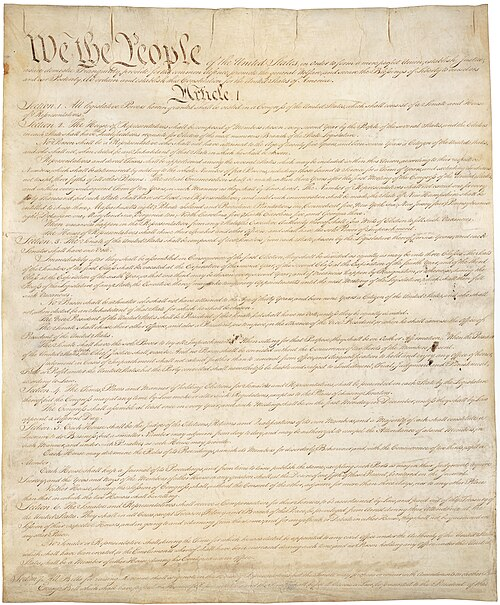
A high-resolution archival scan of the U.S. Constitution manuscript (Parchment), highlighting the Constitution as a primary source rather than a paraphrase. In study notes on the Necessary and Proper Clause, this kind of document image helps connect doctrinal debates about implied powers to the actual written constitutional framework the Court is interpreting. Source
Necessary and Proper Clause: A constitutional provision authorising Congress to pass laws that are useful for executing its enumerated powers and other powers vested in the national government.
This clause matters because the Constitution cannot anticipate every policy tool needed to run a modern state; it supplies operational authority while still tying Congress to a listed power.
Enumerated powers vs. tools to execute them
Congress’s enumerated powers include areas like taxing, borrowing, regulating aspects of the economy, national defence, and establishing courts. The Necessary and Proper Clause does not add a new subject area; it affects the methods Congress may use to reach legitimate constitutional ends.
Implied powers: Powers not expressly written in the Constitution but inferred as reasonably connected to executing enumerated powers.
In practice, implied powers often involve creating institutions, administrative procedures, penalties, and regulatory frameworks that make enumerated powers workable.
How the Clause Expands Enumerated Powers
The means–ends logic Congress relies on
When Congress legislates under the clause, the constitutional argument typically follows a chain:
Identify a valid enumerated power (the “end”).
Show the law is a reasonable instrument (the “means”) to carry out that end.
Defend the fit between means and end as practical rather than strictly indispensable.
This approach encourages broad national capacity, especially when national problems require uniform rules or coordinated enforcement.
Why Supreme Court interpretation is decisive
The syllabus emphasis is that the clause “supports laws needed to carry out enumerated powers,” but “Supreme Court interpretations affect how far implied powers extend.” Courts decide:
how close the connection must be between the law and an enumerated power
whether Congress may choose among many effective means
whether a claimed “means” is actually a disguised attempt to regulate beyond federal authority
Key Supreme Court Interpretations
McCulloch v. Maryland (1819): broad implied powers
In McCulloch v. Maryland, the Court upheld Congress’s power to create a national bank as a means to execute fiscal powers (such as taxing, borrowing, and managing national finances).
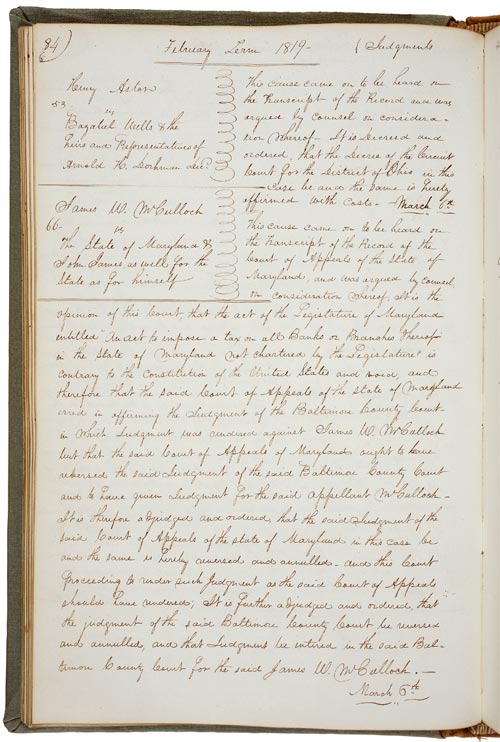
Handwritten Supreme Court minutes from McCulloch v. Maryland (1819), the landmark case that validated broad implied powers under the Necessary and Proper Clause. Using the national bank dispute as the test case, the decision illustrates the Court’s willingness to treat Congress’s chosen “means” as constitutional when they implement legitimate enumerated ends. Source
The Court rejected a cramped reading of “necessary,” reasoning it can mean convenient or useful, not only “absolutely required.” This case is foundational for understanding why implied powers can be expansive when linked to legitimate constitutional ends.
Ongoing boundaries: “proper” and judicially enforceable limits
Later Courts have sometimes emphasised that laws must be not only “necessary” but also “proper,” reinforcing that implied powers are not unlimited. When evaluating “how far implied powers extend,” the Court may scrutinise whether:
the law is genuinely tied to executing a federal power rather than creating a free-standing police power
the means chosen undermine constitutional structure (for example, by effectively eliminating meaningful limits on national authority)
Congress is using the clause to reach outcomes too attenuated from the enumerated power invoked
What Students Should Be Able to Do
Analyse a law’s constitutional justification under the clause
A strong analysis stays tightly focused on the clause’s function:
State the enumerated power being implemented.
Explain how the law operationalises that power (administration, enforcement, funding, institutions, penalties).
Address how Supreme Court interpretation can broaden or narrow the implied-power claim depending on the closeness of the fit.
Use precise vocabulary
Use enumerated powers, implied powers, means–ends reasoning, and judicial interpretation accurately. The essential learning target is recognising that the Necessary and Proper Clause expands national capacity through enumerated powers, with the Supreme Court policing the outer edge of that expansion.
Practice Questions
(2 marks) Explain what the Necessary and Proper Clause authorises Congress to do. Mark scheme:
1 mark: Identifies that it permits Congress to pass laws to carry out enumerated powers.
1 mark: Explains that these laws may be implied/functional tools (not explicitly listed) as long as linked to executing constitutional powers.
(5 marks) Using your knowledge of Supreme Court interpretation, explain how the Necessary and Proper Clause can expand federal power while still limiting Congress. Mark scheme:
1 mark: Defines or accurately describes implied powers arising from the clause.
1 mark: Explains means–ends reasoning (laws as instruments to execute enumerated powers).
1 mark: References a relevant Supreme Court interpretation (e.g., ) supporting broader implied powers.
1 mark: Explains that the Court can restrict reach by requiring a sufficient connection to an enumerated power.
1 mark: Explains that “proper”/structural limits prevent the clause from becoming an unlimited general power.
FAQ
Not necessarily.
In constitutional interpretation, “necessary” has often been read as “useful” or “convenient,” but courts may still require a non-trivial, evidence-based link to an enumerated power.
“Proper” can be used to test whether a law is an appropriate means within the constitutional structure.
It signals that even effective laws may be invalid if they effectively erase constitutional limits on federal authority.
Congress often builds a clearer record showing the connection between the law and an enumerated power, such as:
explicit statutory “findings”
detailed enforcement provisions
narrowly tailored administrative mechanisms
Yes, when the agency is a means to administer or enforce an enumerated power.
The key is whether the agency’s mission and tools are plausibly tied to executing that constitutional end.
Implied powers can effectively expand or contract over time.
Because the clause’s reach is interpretive, shifts in judicial philosophy can alter how close the means–ends fit must be for federal laws to stand.