AP Syllabus focus:
‘The balance of power between national and state governments changes over time; Supreme Court interpretations influence how constitutional clauses expand or limit federal authority.’
Supreme Court decisions constantly redefine federalism by interpreting constitutional text in new contexts. Over time, shifting judicial philosophies, political pressures, and changing national problems alter whether national or state governments hold practical governing power.
Core idea: the Court as an engine of federalism change
Federalism: A constitutional system that divides governing authority between a national government and state governments, with each possessing some independent powers.
Because the Constitution contains both broad grants of national power and protections for state authority, federalism is not self-executing. The Supreme Court shapes it through judicial review and constitutional interpretation, deciding:
whether Congress is acting within its enumerated powers
how far implied powers extend
when federal law displaces state law (preemption)
what limits the Constitution places on national coercion of states
Judicial review: The power of courts to declare governmental actions unconstitutional, thereby invalidating laws or executive actions that conflict with the Constitution.
How interpretation shifts the national–state balance
Broad vs. narrow readings of national power
Supreme Court interpretations can expand federal authority by reading national powers broadly, or limit federal authority by reading those powers narrowly. Key interpretive choices often turn on:
whether the Court treats constitutional clauses as flexible frameworks or strict boundaries
how much deference the Court gives to Congress’s judgment about what is “necessary” to achieve national objectives
whether the Court prioritises state autonomy as a constitutional value independent of specific textual limits
Doctrines the Court uses to protect state authority
Even when Congress legislates in an area with national implications, the Court may reinforce federalism by enforcing limits such as:
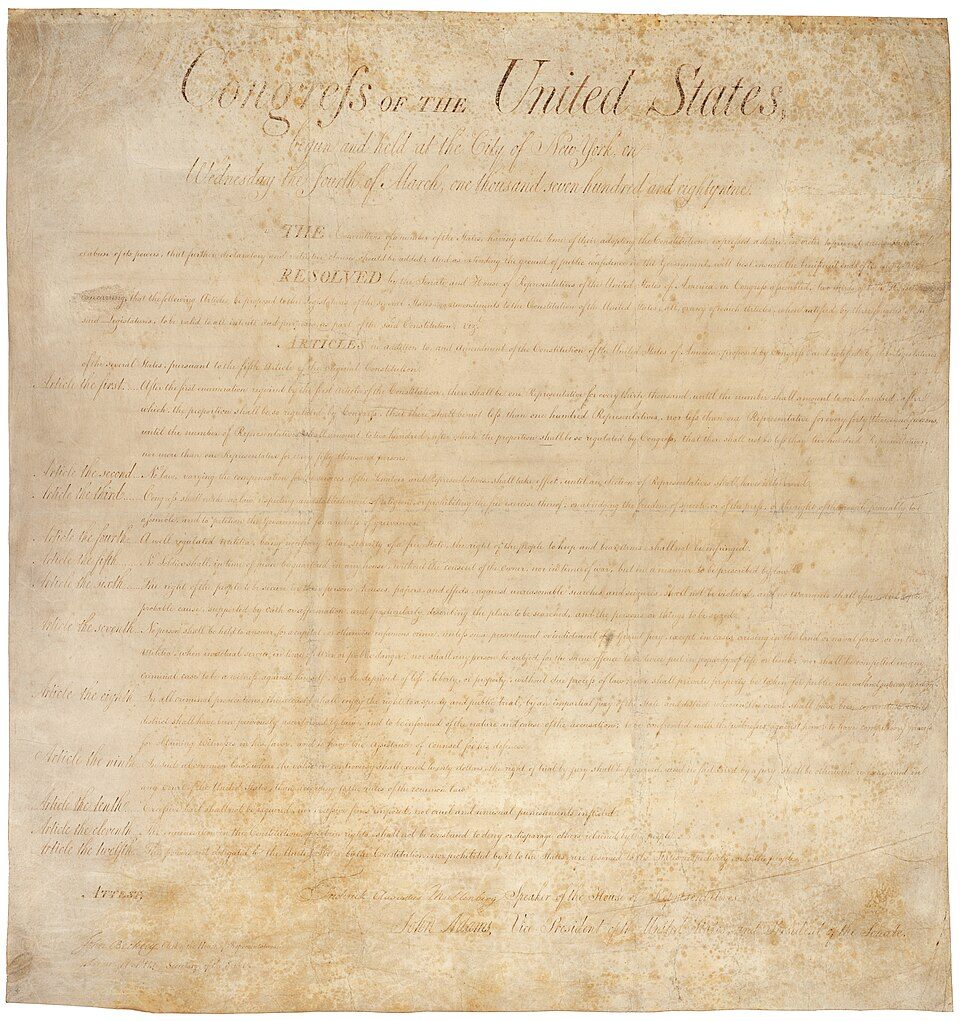
A high-resolution scan of the Tenth Amendment, part of the Bill of Rights. Seeing the text itself helps connect modern federalism doctrines (like anti-commandeering and sovereign immunity) to the Constitution’s explicit reservation of undelegated powers to the states and the people. Source
anti-commandeering (the national government cannot require states to administer or enforce federal regulatory programs)
state sovereign immunity (in some contexts, states are shielded from certain lawsuits)
tighter tests for when national laws are “truly” connected to constitutionally listed powers
These doctrinal moves can shift policymaking back toward the states without changing the constitutional text.
Federalism over time: patterns in Court eras
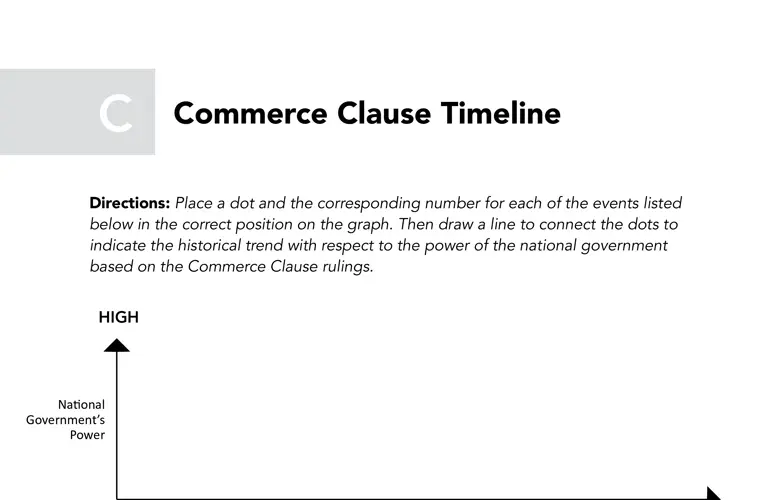
A timeline graphing exercise that prompts students to plot major Commerce Clause eras and cases and then draw the overall trend in national power. It reinforces the idea that federalism is dynamic, with the Court sometimes broadening and sometimes narrowing the practical reach of Congress. Source
Early nation: strengthening national capacity
In the early Republic, the Court often validated stronger national institutions to stabilise governance and markets. Decisions in this tradition typically:
upheld implied national power to implement enumerated powers
reduced barriers to national economic regulation
emphasised national supremacy when state policies interfered with national goals
Dual federalism era: sharper boundaries
At various points (especially late 19th to early 20th century), the Court sometimes enforced a more separate-spheres view—treating national and state authority as distinct and restricting Congress from entering areas seen as “local.” This could:
invalidate federal labour or manufacturing regulations
preserve state primacy over policing and social regulation
narrow the practical scope of federal economic power
New Deal to mid/late 20th century: expansion of federal reach
During and after the New Deal, the Court largely accepted broad national solutions to national economic and social problems, often deferring to Congress. This interpretive posture tended to:
allow wider national regulation of economic activity
support national standards implemented across states
increase uniformity in rights and regulatory policy nationwide
Modern limits: renewed attention to state sovereignty
From the late 20th century onward, the Court has sometimes placed renewed limits on Congress, signalling that federalism imposes enforceable boundaries. This has included:
narrowing when activity is sufficiently connected to interstate concerns
reinforcing anti-commandeering rules
scrutinising federal conditions attached to funding when they appear unduly coercive
Why the Supreme Court’s role produces change
Federalism shifts because constitutional clauses are applied to new realities (industrialisation, national markets, technology, emergencies). The Court’s membership and interpretive philosophy also change over time, meaning the same text can yield different boundaries between national and state power. As a result, the balance of power is dynamic: Supreme Court interpretations influence how constitutional clauses expand or limit federal authority in practice.
Practice Questions
(2 marks) Explain how Supreme Court interpretation can change the balance of power between the national government and state governments over time.
1 mark: Identifies that Supreme Court rulings interpret the Constitution and set binding precedent affecting federal/state power.
1 mark: Explains that broad or narrow readings of federal power (or state protections) can expand or limit national authority.
(5 marks) Analyse two ways in which Supreme Court decisions can limit federal power and strengthen state authority.
1 mark: Identifies a valid limiting mechanism (e.g., narrowing scope of an enumerated power; anti-commandeering; limiting preemption; restricting coercive spending conditions).
1 mark: Correctly explains how that mechanism constrains federal action.
1 mark: Identifies a second valid limiting mechanism.
1 mark: Correctly explains how the second mechanism constrains federal action.
1 mark: Analysis explicitly links both mechanisms to shifting federalism “over time” through precedent and changing interpretive approaches.
FAQ
Stare decisis promotes continuity, but the Court can distinguish earlier cases, narrow their reach, or overrule them.
Shifts often occur incrementally through new tests and exceptions rather than sudden reversals.
Preemption is when valid federal law overrides conflicting state law.
It matters because the Court decides whether Congress intended to displace state regulation, which can centralise or preserve state policymaking.
Approaches like textualism, originalism, and living constitutionalism prioritise different sources of meaning.
That affects whether the Court reads national power expansively (flexible) or confines it (fixed boundaries).
Yes. It can uphold a law while narrowing its interpretation, setting limits for future cases.
It can also craft doctrines (like anti-commandeering) that reshape implementation while leaving statutes intact.
National problems evolve (economy, technology, security), creating fresh conflicts over who should regulate.
Because the Constitution uses broad language, new contexts generate repeated disputes requiring judicial interpretation.