AP Syllabus focus:
‘European nations explored and conquered the New World in search of new sources of wealth.’
European exploration in the fifteenth and sixteenth centuries was fundamentally driven by the pursuit of wealth, as expanding global trade networks offered unprecedented opportunities for profit and power.
The Economic Imperatives Behind European Expansion
The search for wealth was the central catalyst for European exploration during the period leading to contact with the Americas. As European kingdoms emerged from the Middle Ages, rising populations, expanding urban markets, and increased commercial activity stimulated demand for luxury goods such as spices, silk, and precious metals. These goods flowed through overland routes dominated by intermediary powers, especially Muslim states and Italian city-states, making them scarce and expensive. European rulers recognized that direct access to trade routes and new markets would unlock enormous economic potential.
Rising Demand and Scarce Resources
A key driver of exploration was the difficulty Europeans faced in acquiring desired products from Asia and Africa. Overland routes like the Silk Road became increasingly unreliable due to political instability and high transport costs. Portuguese and Spanish monarchies thus invested heavily in maritime voyages to circumvent established land-based trade networks.
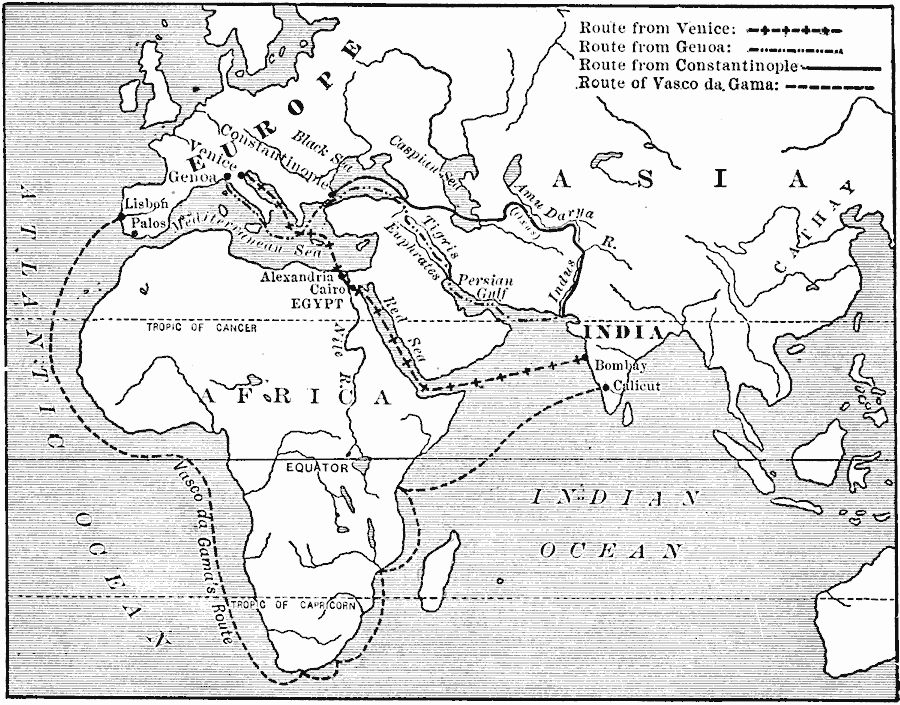
This map illustrates major premodern trade routes linking Europe to India, including overland connections through the eastern Mediterranean and the new Portuguese maritime route around Africa. It emphasizes why Europeans sought direct sea access to Asian luxuries and minerals. Some routes predate the AP period but provide necessary context for understanding European exploration strategies. Source.
Precious metals such as gold held particular significance because they were essential for minting currency and financing growing state bureaucracies and armies. The inability to mine substantial quantities within Europe made overseas exploration appear especially attractive. Monarchs consistently prioritized expeditions that promised access to gold-rich regions or new commercial relationships.
Trade Routes and the Search for Direct Access
Control over trade routes shaped much of early European maritime strategy. Portugal pioneered Atlantic navigation and established a foothold along the West African coast to secure direct access to gold and to participate in expanding markets tied to coastal African polities.
Innovation and Profit
As Portuguese sailors pushed further south, they gained knowledge of Atlantic currents and winds, enabling more ambitious voyages. Their navigational achievements revealed possibilities for extending routes beyond Africa to the Indian Ocean. The profits gained from African gold and later from the spice trade reinforced the logic of exploration as a lucrative enterprise. King Manuel I of Portugal celebrated these voyages as essential for strengthening the kingdom’s global commercial reach.
Spain, observing Portuguese successes, accelerated its own investment in exploration. Unable to compete along the African route due to Portuguese control, Spain supported westward voyages that sought access to Asian markets by crossing the Atlantic.
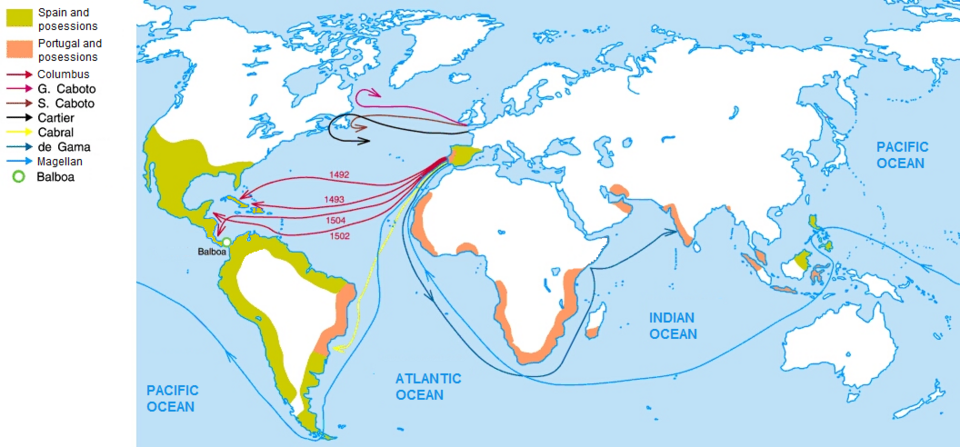
This world map highlights major fifteenth- and sixteenth-century voyages, including Portuguese expeditions around Africa and Spanish crossings of the Atlantic. It visually connects European rivalry over sea routes with the search for new markets, gold, and trade access. Some depicted routes extend beyond 1607 but clearly illustrate the broader economic motivations of the Age of Discovery. Source.
Gold, Silver, and the Allure of Mineral Wealth
European explorers consistently prioritized regions rumored to possess abundant gold. Many expeditions were financed under the promise that the discovery of new gold deposits would enrich monarchs and investors. After 1492, Spain’s encounters in the Caribbean and later in mainland Central and South America revealed mineral wealth on a previously unimaginable scale. Although the large influx of American silver would occur later in the sixteenth century, the initial expectation of gold shaped early exploratory motivations.
Economic Culture of Conquest
European expansion occurred in an era of intensifying mercantilism, a system in which states sought to maximize wealth through controlling trade and accumulating precious metals. Because wealth was viewed as finite, monarchies believed they had to acquire gold and silver before rival nations did. This mindset fueled urgency, competition, and rapid exploration of unknown regions.
Mercantilism: An economic theory emphasizing state control of trade and accumulation of wealth, primarily through precious metals, to strengthen national power.
European political leaders understood that commanding overseas resources would provide advantage in the increasingly competitive global system. This belief aligned economic ambition with political and military strategy.
New Markets and Expanding Commercial Networks
Beyond precious metals, European nations also sought profitable trade relationships and new consumer markets. As production increased within Europe, economic leaders recognized that reaching new buyers could stimulate industries and support population growth.
Commodities and Global Exchange
Early explorers anticipated finding regions where they could acquire exotic goods at lower costs or establish trading posts. Although the Americas did not initially provide the direct route to Asia that Spain hoped for, they soon proved economically valuable through their potential for cultivating cash crops and accessing indigenous trade networks.
The discovery of new regions also allowed European powers to diversify their commercial interests. While Asia remained important for spices and textiles, the Americas offered new markets for European manufactured goods and access to unfamiliar raw materials.
Cash crops: Agricultural products grown primarily for sale rather than subsistence, often requiring significant labor and generating high profits.
These commercial opportunities strengthened the rationale for continued exploration and settlement. As investors realized the economic potential of plantations, mining, and trade in newly acquired territories, European support for exploration expanded further.
Competition Among European States
Economic competition drove European powers to sponsor increasingly ambitious expeditions. Spain, Portugal, France, and England each sought to outmaneuver rivals by claiming strategic territories and establishing lucrative trade relationships. Monarchs viewed overseas wealth as a means of financing armies, reducing reliance on foreign imports, and securing geopolitical influence.
Ambition, Rivalry, and Long-Term Transformations
This competitive environment shaped the broader trajectory of Atlantic exploration. Pursuit of trade routes, gold, and new markets laid the economic foundations for European empires in the Americas, initiating patterns of economic extraction, global trade integration, and interstate rivalry that would define the early modern Atlantic world.
FAQ
Growing urban populations and rising consumer demand in the fifteenth century increased pressure on European rulers to secure new sources of profitable goods.
At the same time, limited natural resources within Europe, especially precious metals, pushed monarchies to look outward for wealth needed to fund state-building, military expansion, and administrative growth.
These internal pressures made maritime exploration appear both necessary and economically strategic.
Spices such as pepper, cinnamon, and cloves had exceptionally high profit margins due to scarcity and the long, costly routes required to transport them.
They were also associated with status, medicine, and food preservation, making them valuable commodities among Europe’s elites.
Controlling the supply of spices offered monarchies the possibility of transforming state revenues without needing large-scale territorial expansion.
Portuguese encounters with wealthy coastal states like Mali and Benin revealed that regions outside Europe possessed significant quantities of gold.
This encouraged further expeditions because:
• African polities were active participants in complex trade systems.
• Europeans believed even richer markets lay further south or east.
• Success along the African coast validated the idea that exploration would yield measurable financial returns.
Financing shipbuilding, navigation training, and port infrastructure required consistent state funding, indicating that exploration had become an extension of national economic policy rather than a purely private endeavour.
This investment allowed monarchies to:
• Claim and defend trade routes.
• Centralise profits through taxation.
• Build fleets capable of long-distance commercial competition.
Gold provided immediate financial gain, but new markets created long-term economic stability by giving merchants and producers access to buyers outside Europe.
New markets allowed states to:
• Sell surplus goods, raising domestic wealth.
• Cultivate economic ties that could evolve into political influence.
• Reduce dependency on rival European powers for trade.
These benefits made market expansion central to the broader economic logic of exploration.
Practice Questions
Question 1 (1–3 marks)
Explain one economic reason why European states sought new trade routes to Asia in the late fifteenth century.
Question 1
• 1 mark: Identifies a relevant economic reason (e.g., desire for direct access to Asian luxury goods, avoidance of intermediaries, need for precious metals).
• 2 marks: Provides a brief explanation of how this economic reason motivated exploration.
• 3 marks: Gives a developed explanation showing clear linkage between the economic motive and the push for maritime exploration.
Question 2 (4–6 marks)
Analyse how the search for wealth shaped both Portuguese and Spanish approaches to exploration between the fifteenth and early sixteenth centuries. In your answer, consider differences as well as similarities.
Question 2
• 1–2 marks: Identifies relevant features of Portuguese and/or Spanish exploration linked to the pursuit of wealth.
• 3–4 marks: Explains how the search for wealth shaped each nation’s approach (e.g., Portuguese focus on African coastal routes; Spanish westward voyages to access Asian markets).
• 5–6 marks: Offers analysis of both similarities and differences, showing clear understanding of how competition, trade ambitions, mineral wealth, and access to new markets influenced their exploration strategies.