AP Syllabus focus:
‘In the Northwest and present-day California, societies relied on hunting and gathering and sometimes formed settled communities supported by abundant ocean resources.’
Coastal Indigenous societies of the Northwest and California developed distinctive cultures shaped by abundant marine environments, sustaining complex communities through fishing, gathering, and regionally varied settlement patterns.
Environmental Foundations of Northwest and California Societies
Diverse Ecological Zones
The coastal regions of the Pacific Northwest and California encompassed temperate rainforests, river deltas, rugged coastlines, and rich estuaries. These landscapes supported exceptionally high biodiversity and predictable seasonal cycles that shaped Indigenous subsistence practices. Communities adapted to these environments through a blend of hunting, gathering, and intensive use of marine resources, aligning directly with the syllabus focus on ecological abundance.
Abundant Ocean Resources
The Pacific coastline offered access to salmon, sea mammals, shellfish, and diverse plant species. Because these resources were renewable and concentrated in specific locales, many groups lived in semi-sedentary or fully sedentary settlements, a pattern distinct from the mobility required in more arid regions.
Sedentary community: A society whose population remains in a permanent or near-permanent settlement rather than moving cyclically across the landscape.
These ecological conditions enabled population growth, cultural complexity, and long-term stability within coastal villages.
Subsistence Strategies and Resource Management
Salmon-Centered Economies in the Northwest
Many Northwest peoples—including the Chinook, Tlingit, Haida, and Nuu-chah-nulth—built entire economic and cultural systems around the seasonal salmon runs.
Key features included:
Weirs and traps, which guided salmon into capture structures.
Smoking and drying techniques enabling long-term storage of fish.
Ceremonial practices surrounding first-salmon rituals, reinforcing social cohesion and spiritual relationships with the natural world.
These strategies illustrate how ecological abundance shaped stable and often prosperous settlements.
Hunting and Gathering in California
California societies benefited from environments rich in vegetation and small game. Groups such as the Pomo, Chumash, and Miwok used a broad-spectrum foraging economy, relying on:
Acorns, processed through leaching to remove tannins.
Seed and root crops from grasslands and wetlands.
Marine resources along the Southern California coast, including fish and shellfish.
Because acorns were predictable and abundant, many California communities maintained stable village sites near oak groves.
Settlement Patterns and Social Organization
Variability Across the Region
Although the syllabus notes that these societies “sometimes formed settled communities,” settlement forms varied by subregion.
Northwest societies often developed permanent plank-house villages along rivers or bays.
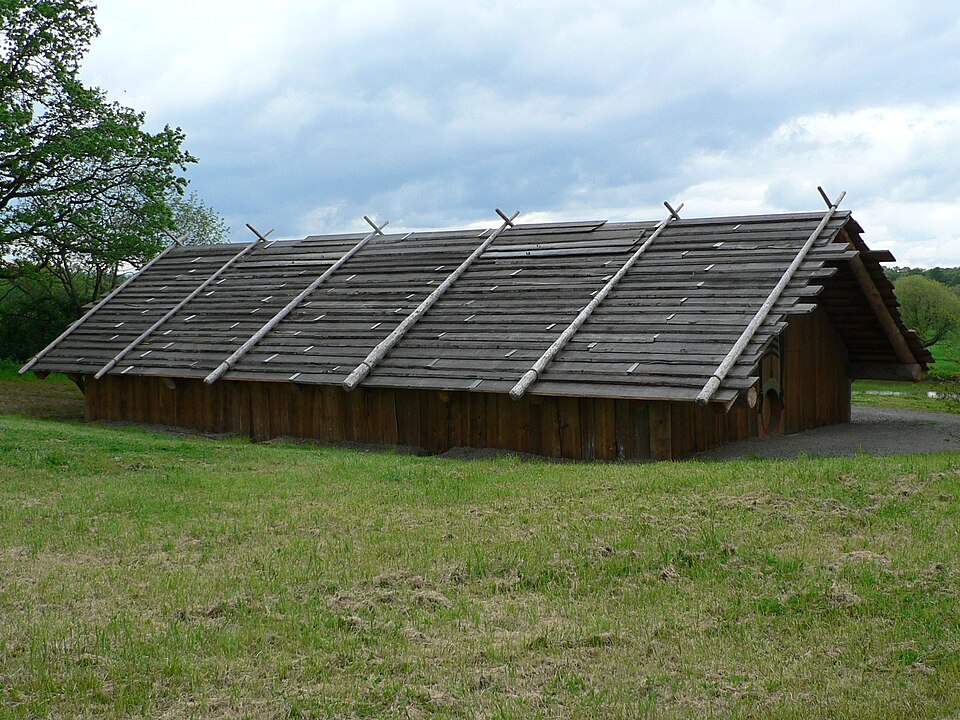
A reconstructed Chinookan cedar plankhouse at the Cathlapotle site illustrates the large, permanent homes of Pacific Northwest coastal peoples. Heavy cedar planks and a low, wide roof reflect a design adapted to cool, wet conditions and reliance on timber resources. The structure is a carefully researched replica and represents a generalized village household rather than a specific original dwelling. Source.
These structures, built from massive cedar planks, reflected both environmental availability and social hierarchy.
California societies tended to form smaller, semi-sedentary villages, but some coastal groups—particularly the Chumash—exhibited more permanent settlement patterns due to maritime specialization.
Social Stratification
The high productivity of coastal environments supported populations large enough to develop intricate social hierarchies, especially in the Northwest. Communities there often organized around:
Elite lineages, who controlled access to certain fishing sites.
Ceremonial leadership connected to resource stewardship.
Prestige goods, including carved masks, canoes, and totem poles.
In California, social organization was generally less stratified but still featured specialized roles such as boat builders, ritual specialists, and skilled foragers.
Technology, Craft Production, and Environmental Knowledge
Maritime Innovation
The abundance of ocean resources encouraged technological advancement. Northwest groups mastered the construction of dugout cedar canoes, some capable of long-distance travel and heavy cargo transport. These vessels supported inter-community trade and warfare.
Similarly, the Chumash tomol, a planked canoe, stands as a significant technological achievement.
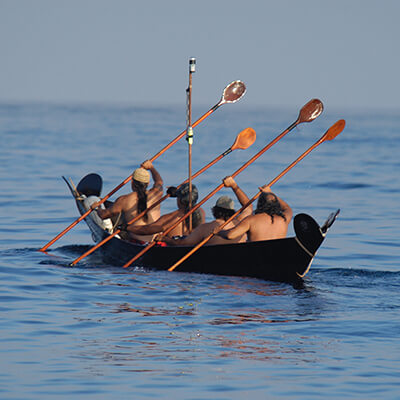
Chumash paddlers navigate a traditional tomol plank canoe across the Santa Barbara Channel, demonstrating the sophisticated maritime technology developed by coastal California societies. The sleek hull and coordinated paddling enabled transport of people and goods between the mainland and the Channel Islands. This modern photograph includes contemporary safety gear not covered in the syllabus but accurately represents the traditional vessel’s design and cultural significance. Source.
Its design required sophisticated woodworking, plant-based adhesives, and cooperative labor systems.
Craft Specialization
Abundant materials fostered distinctive artistic and practical crafts:
Cedar carving in the Northwest, producing monumental architecture and ceremonial objects.
Basketry in California, where groups such as the Pomo created highly intricate woven vessels for storage, cooking, and ceremony.
Stone and bone tools tailored to fishing, shellfish harvesting, and woodworking.
Environmental Stewardship
Deep knowledge of ecological cycles guided sustainable practices:
Rotational harvesting prevented overuse of shellfish beds.
Controlled burning in some California regions enhanced seed and game yields.
Spiritual frameworks linked human behavior to ecological balance, reinforcing conservation ethics.
These practices reveal the sophisticated environmental management systems Indigenous societies developed long before European contact.
Trade, Exchange Networks, and Regional Interaction
Intercommunity Exchange
Coastal abundance facilitated long-distance exchange networks that linked Northwest and California regions to inland peoples.
Key products included:
Dried fish, a lightweight, high-calorie item ideal for trade.
Obsidian and shells, which served as tools, ornaments, and symbols of prestige.
Canoes, enabling mobility and intergroup alliances.
Cultural and Political Relationships
Trade supported diplomacy, intermarriage, and ceremonial exchange. In the Northwest, the potlatch ceremony functioned as a central institution for redistributing wealth, displaying status, and strengthening social bonds.
These networks demonstrate that coastal societies were deeply interconnected and culturally dynamic, not isolated or static.
Long-Term Continuity and Adaptation
Indigenous groups of the Northwest and California successfully adapted to their environments through ecological knowledge, maritime innovation, and complex social systems. Their reliance on hunting, gathering, and abundant marine resources fostered stable, sometimes permanently settled communities that thrived long before European arrival.
FAQ
Seasonal cycles dictated when key resources were available, shaping communal labour patterns throughout the year.
In the Northwest, summer and early autumn salmon runs required coordinated fishing, processing, and storage efforts, often involving large sections of the community. Winter months were used for craft production and ceremonial activities.
In California, autumn acorn harvesting and leaching coincided with the ripening of oak crops, while spring and summer encouraged coastal foraging, fishing, and small-game hunting. These shifting rhythms helped reinforce social cooperation and environmental awareness.
Both regions exhibited gendered labour systems, but the specifics varied by community and ecological needs.
In many Northwest groups, men typically engaged in salmon fishing, sea-mammal hunting, and canoe construction, while women handled preservation, drying, and domestic work. Women also produced specialised crafts, such as cedar bark textiles.
In California, women often processed acorns and gathered plant foods, while men fished, hunted, or built maritime equipment. These roles were complementary and essential to community sustainability.
Some California groups used controlled burning to maintain productive landscapes.
Fires helped clear underbrush, promoting the growth of seed-bearing grasses, encouraging new shoots attractive to deer, and protecting oak woodlands from overgrowth. This increased the availability of key food sources.
Such practices also reduced wildfire intensity by managing fuel loads, demonstrating sophisticated ecological knowledge and long-term environmental stewardship.
Canoe-building traditions reflected regional materials and maritime needs.
Northwest groups typically carved dugout canoes from massive cedar trunks. These vessels were durable, large, and capable of traversing open seas and carrying heavy loads, supporting trade, warfare, and long-distance travel.
California’s Chumash crafted plank canoes (tomols) using sewn-plank construction and plant-based adhesives. These lighter, agile vessels were suited for the Santa Barbara Channel, facilitating inter-island travel and advanced maritime exchange.
Artistic expression was shaped by local resources and cultural beliefs.
Northwest communities produced highly stylised carvings, masks, and totemic figures made from cedar. These works often represented clan identities, spiritual beings, or ecological relationships, reinforcing social hierarchy.
California groups excelled in basketry, using willow, sedge, and other regional plants. Their baskets served practical and ceremonial functions, with designs reflecting environmental patterns, community stories, or group status.
Practice Questions
Question 1 (1–3 marks):
Identify and briefly explain one way in which abundant coastal resources shaped the settlement patterns of Indigenous societies in the Pacific Northwest before European contact.
Mark scheme:
1 mark for identifying a valid feature (e.g., permanent plank-house villages, sedentary settlements, reliance on salmon).
1 mark for explaining how the resource contributed to this feature (e.g., predictable salmon runs allowed stable food supplies).
1 mark for linking the resource directly to settlement stability or population growth.
Question 2 (4–6 marks):
Analyse how environmental conditions influenced the economic and social structures of Indigenous societies in the Pacific Northwest and California before European arrival.
Mark scheme:
1–2 marks for describing relevant environmental features (e.g., rich coastal marine environments, abundant forests, acorn-rich oak woodlands).
1–2 marks for explaining economic adaptations (e.g., salmon-based economies, acorn processing, development of maritime technologies such as canoes or the Chumash tomol).
1–2 marks for linking environmental abundance to social structures (e.g., emergence of social hierarchies in the Northwest, craft specialisation, formation of stable villages).