AP Syllabus focus:
‘Many European leaders supported exploration to spread Christianity through conquest, settlement, and missionary efforts.’
European exploration in the Western Hemisphere was profoundly shaped by religious motives, as Christian rulers, missionaries, and settlers sought converts, expanded influence, and justified conquest in the name of faith.
The Religious Context Behind Exploration
European expansion during the late 15th and early 16th centuries occurred amid significant religious change in Europe. The Catholic Church, dominant across much of the continent, viewed overseas exploration as an opportunity to counter the spread of Islam, reinforce Catholic authority, and expand Christendom. Monarchs such as Ferdinand and Isabella of Spain saw the Americas as a field for religious triumph following the completion of the Reconquista in 1492.
Christianity as a Motivating Force
The desire to spread Christianity was one of the core ideological drivers of transatlantic expansion. While economic and political motives were central to European exploration, religious goals helped justify imperial competition and provided a moral framework for conquest.
Religious duty: Many Europeans believed they had a divine responsibility to convert non-Christians.
Prestige and legitimacy: Monarchs strengthened their authority by aligning with the Church’s mission.
Moral justification: Conversion was used to rationalize territorial domination and forced labor systems.
Missionary Efforts in the New World
Missionary activity played a critical role in shaping early colonial societies. Orders such as the Franciscans, Dominicans, and later the Jesuits established missions across the Caribbean, Mexico, and the American Southwest to convert Indigenous peoples.
Methods of Conversion
Missionaries employed a combination of persuasion, instruction, and coercion to spread Christianity.
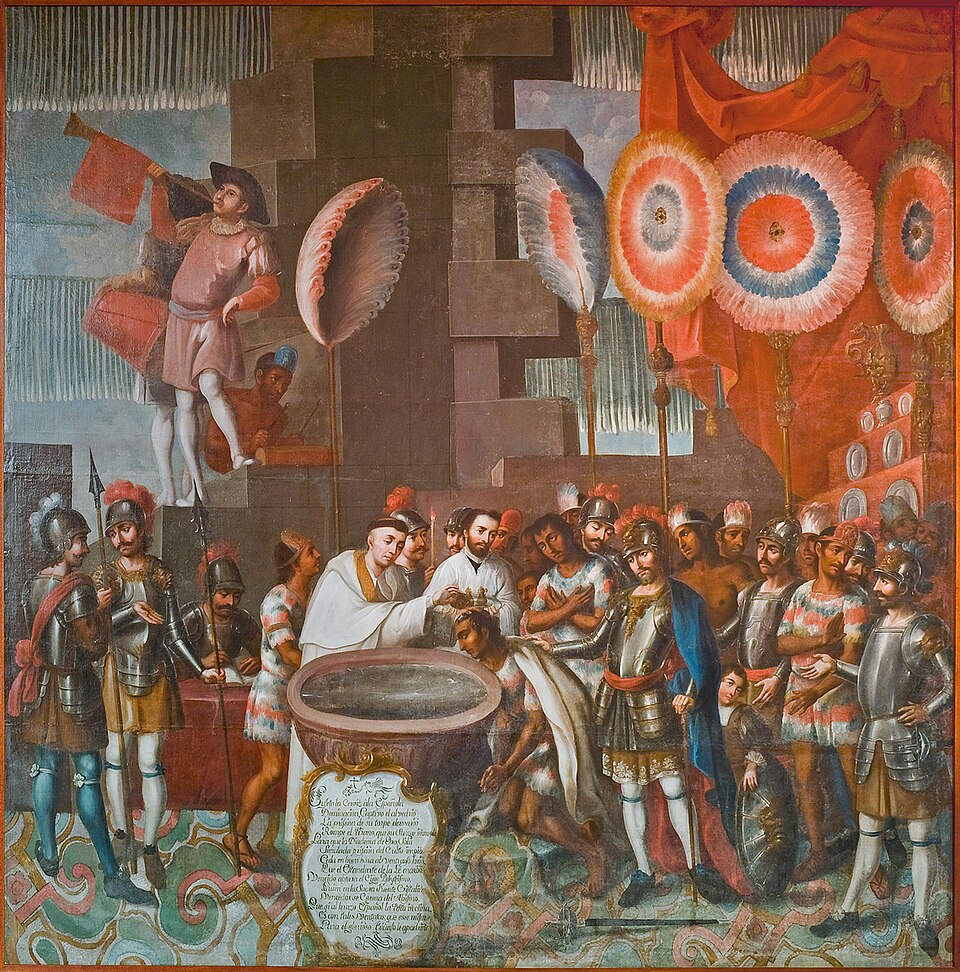
This colonial Mexican painting depicts the baptism of an Indigenous elite by Catholic clergy, illustrating how sacramental rituals marked conversion to Christianity. The presence of European clergy, Indigenous onlookers, and formal ceremony highlights the unequal power dynamics embedded in religious encounters. The scene comes from a later colonial context but accurately reflects patterns of mission-led conversion initiated during the early periods of Spanish expansion. Source.
Teaching Catholic doctrine through sermons, catechisms, and religious rituals
Establishing mission communities to organize Indigenous labor and religious training
Translating prayers and scripture into local languages
Creating schools to educate Indigenous children in European customs and beliefs
Mission System: A network of religious settlements established by Catholic orders to convert Indigenous peoples and integrate them into colonial society.
Missionaries aimed to reshape Indigenous cultural practices, often targeting religious ceremonies, gender roles, and social structures. These efforts produced significant cultural change but also generated resistance.
European missionaries expected the peoples they encountered to abandon traditional belief systems and embrace Catholic norms. However, many Indigenous communities maintained or blended longstanding spiritual traditions.
Christianity, Conquest, and Imperial Power
Religious goals were closely linked to the political and military objectives of colonizing powers. Conquistadors often carried official approval to convert Indigenous peoples and claimed that military actions were justified when communities rejected Christianity.
The Requerimiento
Spanish authorities created the Requerimiento, a statement read to Indigenous peoples declaring Spain’s divine right to rule and demanding acceptance of Christianity.
Requerimiento: A legal declaration used by Spanish conquerors to assert sovereignty and justify military action if Indigenous peoples refused conversion or submission.
Although the Requerimiento claimed to offer a peaceful path to Christianization, it was typically read in Spanish to uncomprehending audiences and served as a pretext for conquest. This fusion of religion and force demonstrated how Christianity became intertwined with imperial expansion.
Following the Conquest of the Aztec and Inca Empires, Spanish authorities attempted to reorganize Indigenous societies in ways that facilitated both religious conversion and economic exploitation.
Missionary Debates and Ethics of Conversion
The spread of Christianity sparked serious debates within Europe about the treatment of Indigenous peoples. Bartolomé de las Casas argued that forced conversion and brutal labor systems contradicted Christian morals, while others defended coercive methods.
Competing Views
Some religious thinkers supported peaceful evangelization, emphasizing persuasion and education.
Others believed that violence and domination were acceptable tools to advance Christianity.
Critics charged that the exploitation of Indigenous labor undermined the Church’s mission.
These debates influenced Spanish policy, including the passage of the New Laws of 1542, which attempted—though unevenly—to reduce Indigenous enslavement and limit abuses within the encomienda system.
Cultural Blending and Religious Adaptation
Conversion was rarely a straightforward or uniform process. Many Indigenous communities adopted certain aspects of Christianity while retaining key elements of their own belief systems, creating syncretic religious practices that blended spiritual traditions.
Syncretism: The blending of different religious or cultural traditions into a cohesive practice.
Examples included integrating saints into pre-existing spiritual hierarchies or merging Christian festivals with seasonal rituals.

This museum display shows a traditional shrine where Catholic symbols coexist with Indigenous ritual objects, illustrating the blending of belief systems that followed missionary efforts. It helps students visualize how conversion often produced hybrid religious practices rather than complete replacement of preexisting faiths. The exhibit represents later and more developed forms of syncretism than the AP period alone, but accurately captures the long-term cultural consequences of early mission and conversion campaigns. Source.
Missionaries sometimes tolerated selective adaptation, while others viewed syncretism as evidence of incomplete conversion.
Indigenous responses ranged from acceptance and adaptation to resistance. Some communities strategically embraced Christianity to secure alliances or avoid persecution, while others maintained clandestine traditional practices.
Christianity’s Legacy in Early Colonial Society
Religion shaped colonial governance, cultural hierarchies, and daily life in Spanish America. The Catholic Church became one of the most powerful institutions in the colonies, influencing law, education, and social organization.
Key Effects
Establishment of mission towns that reorganized Indigenous settlement patterns
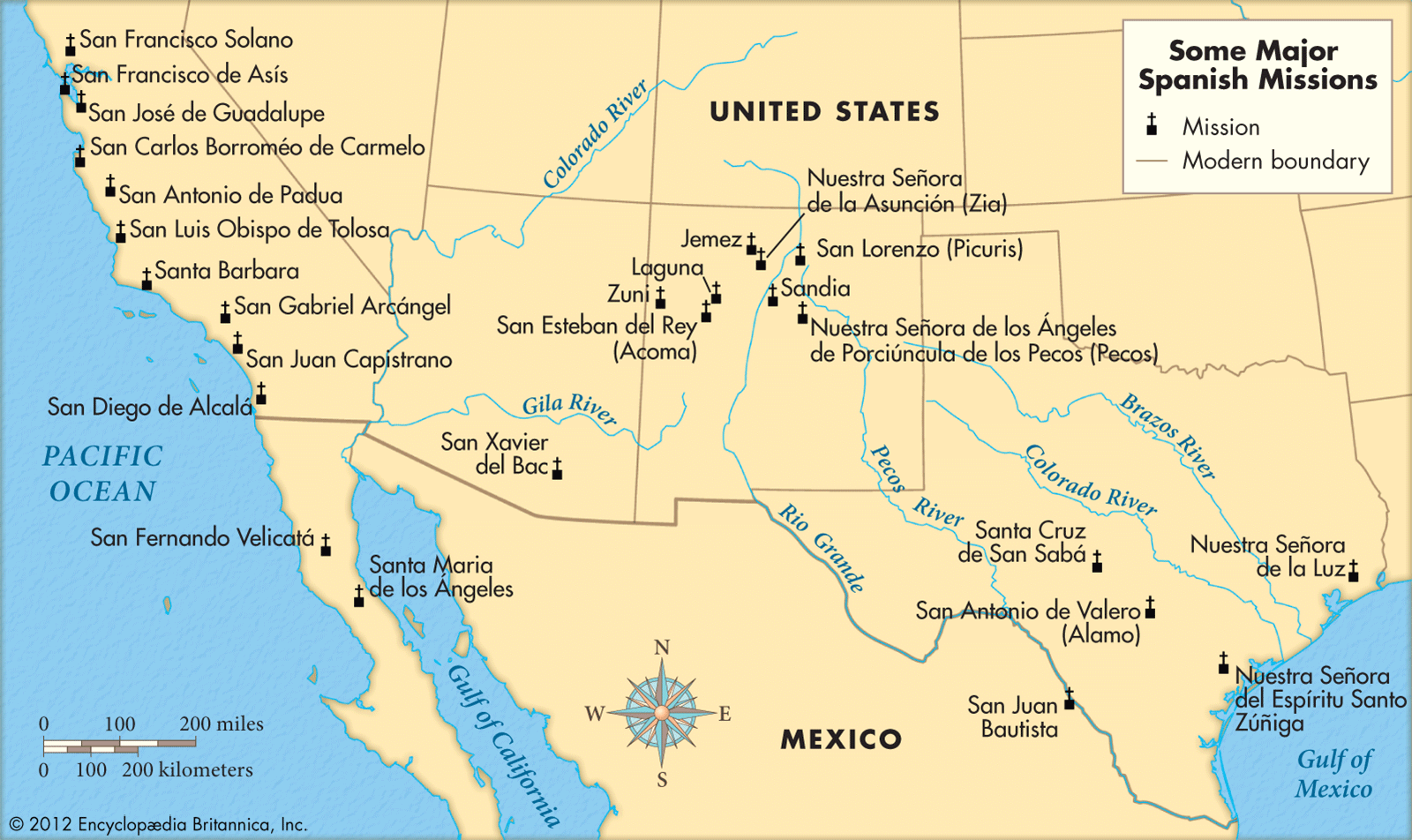
This map shows the locations of key Spanish missions across parts of North America, illustrating how mission settlements formed a network used to convert and control Indigenous populations. It helps students see that religious conversion was tied to specific places and routes, not just abstract policies. Many of the missions shown, particularly in California, were founded slightly later than 1607, but the map accurately reflects how the mission model that began in earlier periods expanded across the region. Source.
Growth of Church authority through land ownership and control of institutions
Reinforcement of colonial hierarchies linking ethnicity, religion, and political power
Long-term cultural transformation through language, ritual, and community life
The effort to spread Christianity did not merely accompany European expansion; it structured how empires operated, justified conquest, and shaped the societies that emerged from early encounters in the Americas.
FAQ
Mendicant orders such as the Franciscans and Dominicans adapted their European preaching traditions to Indigenous contexts by emphasising face-to-face instruction and community organisation.
They often learned local languages, produced early catechisms, and created teaching tools such as visual aids to communicate doctrine to non-literate audiences.
Their approaches could differ:
• Franciscans tended to prioritise rapid mass conversion.
• Dominicans emphasised moral instruction and sometimes advocated for Indigenous rights.
These variations shaped regional differences in missionary practice.
Indigenous elites often adopted Christianity strategically to preserve political authority and secure favourable relations with Spanish officials.
They sometimes used baptism and alliances with missionaries to maintain influence during periods of upheaval.
Non-elite communities tended to experience more coercive pressures, including relocation to mission settlements or forced participation in Christian rituals.
As a result, patterns of conversion and cultural change varied along social lines within Indigenous societies.
Mission settlements were organised to support both religious instruction and economic production.
Common features included:
• A central church or chapel
• Residences for clergy and Indigenous families
• Workshops and fields for agricultural labour
• Strict daily schedules combining prayer, work, and instruction
Traditional Indigenous settlements were more varied, often allowing flexible social organisation, ritual autonomy, and seasonal mobility—features that missions sought to restrict.
Many missionaries believed that sincere conversion required persuasion rather than coercion, arguing that forced baptism undermined Christian doctrine.
They also feared that brutality harmed missionary credibility and encouraged resistance rather than acceptance.
Some, including Bartolomé de las Casas, framed their objections in moral terms, while others feared that violence reduced labour supplies or destabilised mission communities.
These disagreements contributed to broader debates about the ethics of empire.
Christian festivals were often reinterpreted through Indigenous cultural frameworks.
Adaptations included:
• Integrating dances, songs, or symbols from pre-existing rituals
• Aligning Christian celebrations with traditional seasonal cycles
• Reimagining saints’ days using local cosmologies
These blended practices helped make Christianity more acceptable to Indigenous communities while creating distinct regional forms of worship that differed from European traditions.
Practice Questions
Question 1 (1–3 marks)
Explain one way in which European missionary activity influenced Indigenous societies in the early period of Spanish colonisation.
Question 1
Award marks for any of the following, up to a maximum of 3:
1 mark:
• Identifies a valid influence (e.g., changes to religious practices, restructuring of communities into missions, suppression of traditional beliefs).
2 marks:
• Provides a brief explanation of how missionary activity produced this influence (e.g., through conversion efforts, religious instruction, or coercion).
3 marks:
• Offers specific detail or an example, such as reference to Franciscan or Dominican missions, the mission system, or cultural blending/syncretism.
Question 2 (4–6 marks)
Assess the extent to which the spread of Christianity shaped Spanish imperial policy in the Americas between 1491 and 1607. Use specific historical evidence to support your answer
Question 2
Award marks for the following elements:
1–2 marks:
• Demonstrates a basic understanding that Christianity played a role in Spanish imperial policy, with limited or generalised explanation.
3–4 marks:
• Provides a more developed explanation, referencing specific policies or practices, such as the Requerimiento, the establishment of missions, or the justification of conquest through religious arguments.
• Shows some analysis of the extent of Christianity’s influence.
5–6 marks:
• Presents a well-structured argument assessing the extent to which Christianity shaped imperial policy compared with other motives (e.g., economic or political).
• Uses accurate and specific evidence, such as missionary orders (Franciscans, Dominicans), the New Laws of 1542, or examples of Indigenous conversion efforts and resistance.
• Demonstrates clear analytical judgement on the extent of Christianity’s impact.