AP Syllabus focus:
‘European traders partnered with some West African groups who practiced slavery; the Spanish imported enslaved Africans to labor in plantation agriculture and mining.’
The Atlantic slave trade reshaped Spanish America by supplying coerced African labor for plantations and mines, reinforcing colonial economies, racial hierarchies, and transatlantic systems of exchange and exploitation.
The Atlantic Slave Trade and the Reshaping of Spanish America
West African Context and the Origins of Atlantic Slavery
Spanish participation in the Atlantic slave trade emerged from earlier African systems of enslavement and the expanding commercial networks linking Europe and West Africa. Some West African states practiced forms of slavery before European arrival, often involving war captives or debtors who retained limited rights or pathways to assimilation.
Slavery (in West African contexts): A system in which individuals were held in servitude, often as war captives or dependents, with varied degrees of social integration.
European demand for plantation and mining labor in the Americas dramatically transformed the scale and character of enslavement. Portuguese and later Spanish traders purchased enslaved people from African intermediaries, who captured or traded individuals from inland regions.
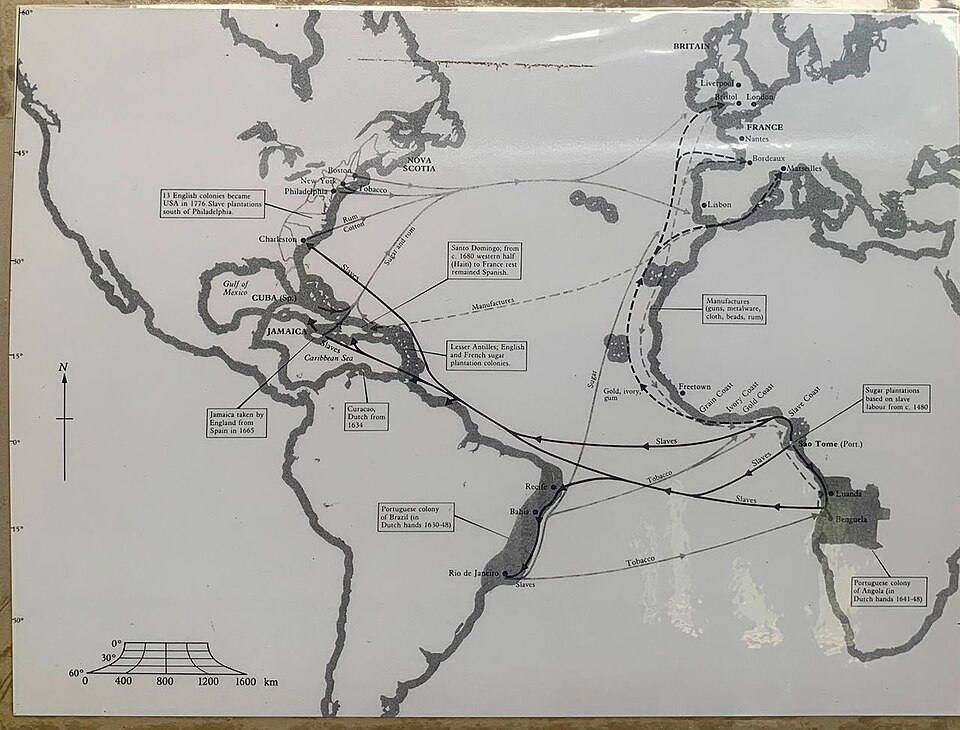
A map showing the major routes of the transatlantic slave trade linking European ports, West African embarkation regions, and American destinations. Arrows illustrate the triangular movement of goods, enslaved Africans, and plantation commodities across the Atlantic. Some routes extend beyond Spanish America, but the overall pattern reflects the trading system that supplied enslaved labor to Spanish plantations and mines. Source.
Spanish imperial authorities initially relied on enslaved Indigenous labor, but catastrophic population decline caused by disease, warfare, and overwork forced them to seek alternative labor sources. African captives became central to sustaining the economic structure of Spanish America.
Why the Spanish Turned to African Labor
Several factors encouraged Spain to import enslaved Africans into the Caribbean, Mexico, and parts of South America.
Demographic collapse of Native populations, reducing the viability of the encomienda system.
European beliefs that Africans possessed greater resistance to tropical diseases, making them “suitable” for plantation and mining labor.
The expanding profitability of sugar plantations, which required constant, intensive labor under harsh conditions.
Royal policies such as the asiento, a contract granting merchants the right to supply enslaved Africans to Spanish territories.
Asiento: A royal license that permitted private merchants, often foreign, to transport enslaved Africans to Spanish colonies in exchange for taxes and fees.
The asiento system integrated the Spanish Empire into a broader, competitive Atlantic slave-trading economy dominated at different times by Portugal, the Netherlands, and England.
Plantation Agriculture and Mining in Spanish America
Enslaved Africans became indispensable to two major sectors of the Spanish colonial economy:
Plantation Agriculture
Sugar plantations in the Caribbean—particularly in Cuba, Hispaniola, and Puerto Rico—relied on grueling labor regimens.
Mining
Mining centers such as Zacatecas in New Spain and Potosí in the Viceroyalty of Peru also used enslaved African labor, though Indigenous labor through systems like the mita remained more common in the Andes.
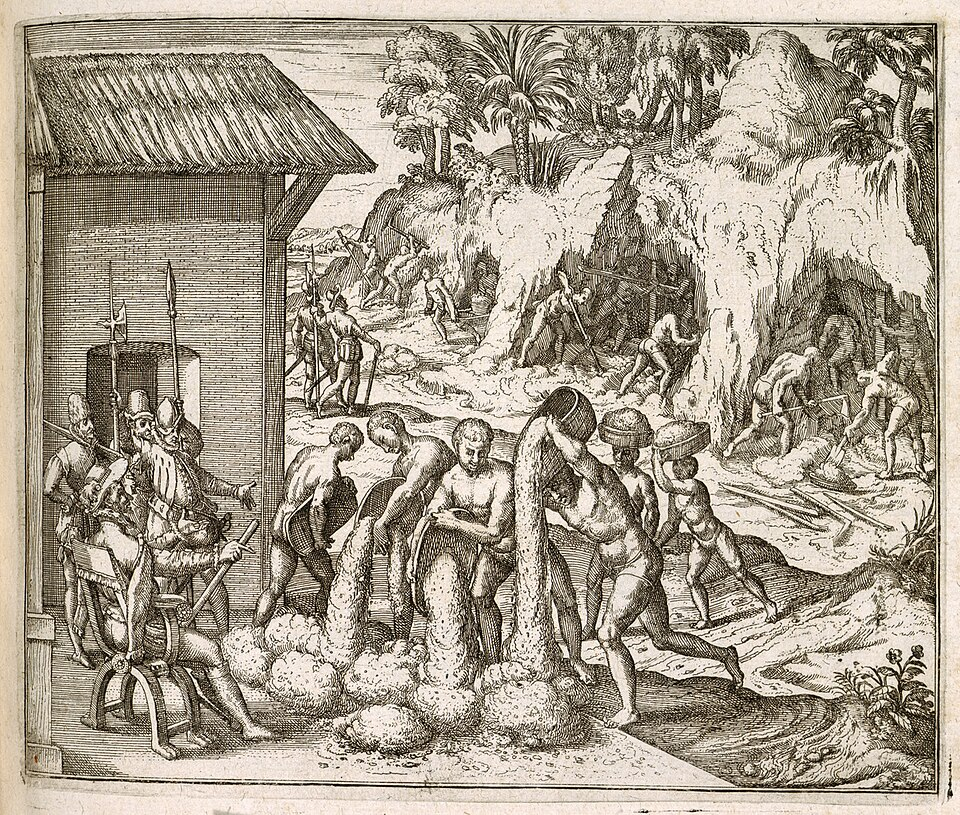
An early colonial engraving depicting Africans forced to mine gold and silver in Spanish-controlled Hispaniola. The tightly packed figures, simple tools, and overseers emphasize the coercive and dangerous conditions of early mining operations. While the scene predates large silver centers like Zacatecas and Potosí, it illustrates the same reliance on African labor within Spanish American extractive economies. Source.
Africans often performed skilled or dangerous work, including operating refining machinery or transporting heavy loads.
Their presence helped maintain silver output, which financed Spanish imperial ambitions in Europe and the Americas.
Cultural, Social, and Demographic Effects
The sustained arrival of Africans reshaped Spanish American societies.
Enslaved Africans brought diverse languages, religions, and cultural practices, contributing to the formation of Afro-Latin American cultures.
Practices such as drumming, spiritual healing, and communal celebrations blended with Indigenous and European traditions, producing syncretic cultural forms.
African knowledge about rice cultivation, metallurgy, and cattle ranching influenced regional economies and technologies.
Syncretism: The blending of distinct cultural, religious, or social traditions into new practices or beliefs.
Spanish colonial society developed complex racial hierarchies, with Africans and their descendants occupying lower social positions than Europeans. Enslaved and free Africans contributed to the formation of casta categories, shaping the legal and social identities of colonial populations.
Resistance, Agency, and Community Formation
Despite brutal conditions, enslaved Africans resisted exploitation through both subtle and overt means.
Day-to-day resistance included work slowdowns, sabotage, feigned illness, and maintaining cultural traditions.
Runaway communities, known as palenques or quilombos, formed in remote areas and defended autonomy through diplomacy or armed resistance.
Some enslaved people gained freedom through purchase, royal decrees, or service in colonial militias.
African agency played a critical role in shaping the social landscape of Spanish America, demonstrating resilience in the face of systemic oppression.
Long-Term Consequences for the Atlantic World
The Atlantic slave trade integrated Spanish America into a global economy driven by coerced labor, capital accumulation, and imperial rivalry.
Silver from the Americas and plantation goods such as sugar fueled European markets and strengthened global trade networks.
Demographic changes created societies with enduring African, Indigenous, and European influences.
The racial ideologies developed to justify slavery shaped colonial governance and persisted into later periods of Latin American history.
The Atlantic slave trade thus stood at the center of Spain’s colonial project, linking Indigenous demographic collapse, African coerced labor, and evolving economic systems across the Atlantic world.
Practice Questions
Question 1 (1–3 marks)
Explain one reason why Spanish colonists increasingly relied on enslaved Africans rather than Indigenous peoples for labour in the sixteenth century.
Mark scheme:
1 mark for identifying a valid reason (e.g., demographic collapse of Indigenous populations).
1 mark for explaining why this shift occurred (e.g., disease and overwork reduced Indigenous labour availability).
1 mark for linking this reason to Spanish economic needs (e.g., the growth of sugar plantations and mining required a stable labour force).
Question 2 (4–6 marks)
Assess the extent to which the Atlantic slave trade shaped the economic development of Spanish America in the period 1500–1600.
Mark scheme:
1–2 marks for identifying relevant economic developments (e.g., expansion of sugar plantations, continuation of mining output).
1–2 marks for explaining how enslaved African labour contributed to these developments (e.g., labour-intensive sugar cultivation required a continuous supply of enslaved workers).
1–2 marks for assessing the extent of impact (e.g., arguing that enslaved Africans were essential in some regions but less dominant in Andean mining centres where Indigenous labour persisted).
FAQ
The Crown imposed taxes, inspection requirements, and documentation rules to track each shipment of enslaved Africans entering Spanish America. These measures ensured revenue for the monarchy and attempted to limit unauthorised trading.
Officials at major ports such as Veracruz and Cartagena examined cargo lists, verified sellers’ licences, and recorded demographic information about captives.
Smuggling nevertheless remained widespread, as foreign traders and colonial merchants sought to bypass regulations for profit.
Distribution depended on regional labour demands and existing economic priorities.
Key determinants included:
The proximity of plantations or mining centres to major ports.
Local population decline, which created urgent labour shortages.
The specialisation of different regions, such as sugar in the Caribbean or ranching and mining on the mainland.
Colonial officials and merchants often redirected shipments to areas experiencing economic expansion.
Yes. Many captives arrived in Spanish America in ethnolinguistic groups, often labelled by Europeans according to broad regional identities such as Wolof, Mandinga, or Congo.
These shared origins helped create early community bonds, influencing music, dance, spiritual practices, and naming traditions.
Over time, cultural mixing with Indigenous and European populations transformed these traditions into distinct Afro-Latin American identities.
Spanish colonial law, including the Siete Partidas, recognised enslaved people as property but also granted limited rights—more than in some other European empires.
These included:
The right to marry with an owner’s permission.
The possibility of purchasing freedom (coartación).
Certain protections against extreme cruelty.
In practice, enforcement depended heavily on local officials, meaning treatment varied widely across the empire.
Enslaved Africans carried out a range of skilled and semi-skilled tasks essential to colonial economies.
Examples include:
Metalworking, masonry, carpentry, and construction in urban centres.
Operating machinery in sugar mills and refining operations.
Livestock management and ranching, particularly in northern New Spain.
Such skills made many enslaved Africans economically valuable beyond field labour, contributing to the growth of colonial infrastructure.