AP Syllabus focus:
‘The Spanish developed a caste system that defined the status of Europeans, Africans, and Native Americans within their empire.’
The Spanish colonial casta system emerged as a rigid social hierarchy designed to organize diverse peoples in the Americas, shaping identity, labor, and political power across Spain’s empire.
Origins and Purpose of the Casta System
The casta system was a socially constructed hierarchy created by Spanish officials in the Americas to categorize people based on ancestry and racial mixture. It developed during the 16th and 17th centuries as Spain’s empire expanded, bringing together Europeans, Indigenous peoples, and Africans in new social relationships.
Colonial administrators used this system to maintain political control, regulate access to economic resources, and justify unequal distribution of power. The framework became deeply embedded in everyday life, influencing taxation, marriage decisions, land ownership, and legal rights.
Social Control and Colonial Governance
The crown implemented the hierarchy to support the broader goals of empire building. By assigning status through ancestry, Spanish officials could:
Strengthen Spanish authority across racially diverse populations.
Restrict Native and African power through legal and social boundaries.
Elevate Spaniards at the top of social and political institutions.
Justify forced labor, tribute, and unequal treatment by linking status to supposed cultural or biological superiority.
The system also worked ideologically, reinforcing Spanish claims that they brought order and civilization to the Americas.
Structure of the Casta Hierarchy
The casta hierarchy was layered, complex, and often recorded visually through casta paintings, which depicted families of different racial mixtures and labeled each category. Although the system varied by region, several major categories remained central. These paintings usually combined sixteen labeled family scenes that moved from ‘pure’ Spaniards at the top to mixtures involving Indigenous and African ancestry at the bottom to visualize the logic of the casta system.
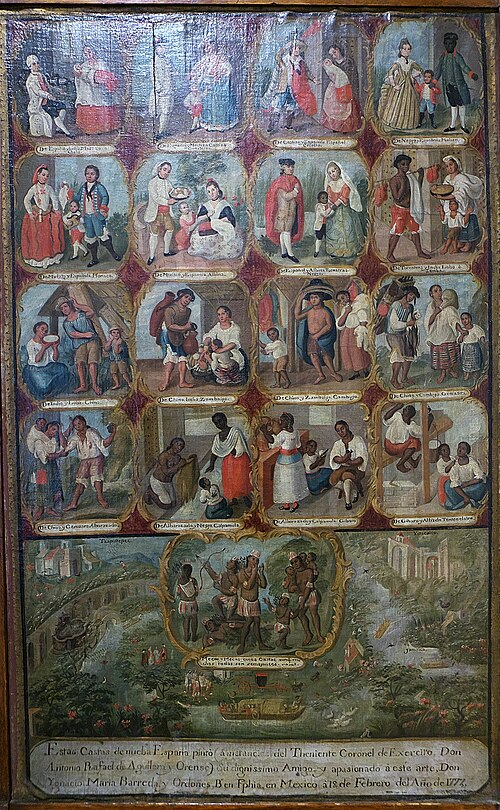
This eighteenth-century casta painting by Ignacio María Barreda presents sixteen labeled family groupings that chart the supposed “dilution” of Spanish, Indigenous, and African ancestry. The arrangement reinforces a hierarchical vision of society, with Spanish elites and lighter-skinned mixtures visually privileged. Additional background elements go beyond the AP syllabus but help contextualize elite colonial culture. Source.
Peninsulares and Creoles
At the top stood peninsulares—people born in Spain—who occupied the highest governmental, ecclesiastical, and economic positions. Directly below them were creoles, Spaniards born in the Americas. Although creoles were fully European by ancestry, they were excluded from some elite posts because the crown trusted peninsulares more deeply.
Peninsulares: Spaniards born in Spain who held the highest authority in colonial administration.
Creoles’ frustration with limited advancement later contributed to the emergence of independence movements, illustrating how the hierarchy shaped long-term political developments.
Mestizos, Mulattoes, and Other Mixed Groups
As population mixing grew, Spanish authorities created numerous categories to describe combinations of European, Indigenous, and African ancestry. These included:
Mestizos: People of mixed European and Indigenous ancestry.
Mulattoes: Individuals of European and African ancestry.
Zambos: Those of Indigenous and African ancestry.
Additional subcategories such as castizos, morenos, and pardos, reflecting degrees of mixture.
These categories were fluid at times, but they broadly guided access to land ownership, guild membership, and legal privileges. Higher categories generally received lighter taxation, better employment, and more substantial legal protections.
A typical casta panel might show a Spanish father, an Indigenous mother, and their child labeled mestizo, making the connection between family lineage and social status immediately legible.
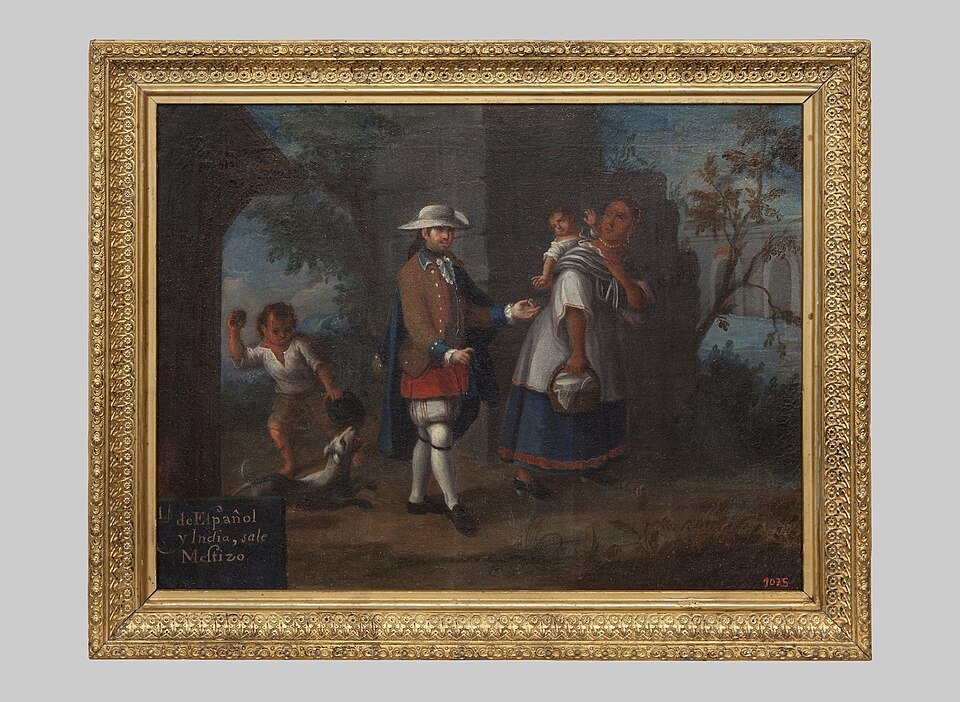
This casta panel visually links a specific family combination—Spanish father, Indigenous mother—to the label “mestizo.” The painting demonstrates how artists made ancestry legible through clothing, posture, and domestic objects. Extra details such as furniture and textiles extend beyond the AP syllabus but illuminate how race intersected with everyday material life. Source.
Indigenous and African Peoples
At the lower end of the hierarchy were Indigenous peoples and Africans, both of whom faced legal discrimination and social marginalization. Although Indigenous communities maintained some autonomy under colonial law, they were heavily taxed, forced into labor drafts, and confined to certain settlements. Enslaved Africans and their descendants experienced the harshest conditions under colonial plantation and mining economies.
Cultural Consequences of the Casta System
The casta system shaped not only institutions but also cultural perceptions of identity, status, and morality. Spanish culture tied “purity of blood” (limpieza de sangre) to honor and legitimacy, transferring Iberian ideas about ancestry into the colonial setting. Individuals sought to improve their status through marriage, patronage, or claims of European ancestry, leading to a practice known as “gracias al sacar”, in which people purchased legal whiteness from the crown.
Family, Gender, and Social Expectations
Family structure and gender norms were strongly influenced by the hierarchy. Spanish men often occupied public and economic roles, while Spanish women were seen as guardians of family honor whose marriages could consolidate status. Mixed-ancestry women faced limited opportunities and heightened social scrutiny.
Marriage for strategic social advancement became common, as unions with people of higher status could reshape a family’s standing.
Economic and Legal Implications
The casta system deeply influenced economic life. Those closer to Spanish ancestry often had access to:
Encomienda grants and landholdings.
Positions in trade networks.
Skilled occupations and guild memberships.
Education and religious roles within mission systems.
Meanwhile, Indigenous and African peoples were confined to coerced labor, tribute payments, and enslaved or semi-enslaved conditions. The system justified these inequalities by framing them as natural consequences of racial difference.
Administrative Records and Identity
Spanish officials documented caste categories in baptismal, marriage, and census records. Although these labels were meant to be strict, individuals sometimes manipulated them to improve their social placement. Local communities also shaped meanings, and in practice, social behavior, reputation, and wealth could outweigh strict ancestry.
Long-Term Impact
The casta system left a lasting imprint on the Americas by institutionalizing racial categories and legitimizing inequality. Even after formal caste labels disappeared, their logic continued to shape social relations, regional cultures, and political developments throughout Latin America.
Practice Questions
Question 1 (1–3 marks)
Explain one way in which the Spanish casta system shaped social relations in the colonies.
Mark scheme
1 mark for identifying a basic feature of the casta system (e.g., ranking people by ancestry).
1 mark for explaining how this affected social relations (e.g., limiting interactions between groups or encouraging strategic marriages).
1 mark for providing a clear, accurate consequence (e.g., reinforcing Spanish dominance or restricting Indigenous and African social mobility).
Question 2 (4–6 marks)
Analyse how the Spanish casta system supported Spanish political and economic control in the Americas between the sixteenth and eighteenth centuries.
Mark scheme
1 mark for identifying the purpose of the casta system in organising colonial society.
1 mark for describing how higher-status groups (e.g., Peninsulares, Creoles) gained access to political power or key administrative positions.
1 mark for explaining how lower-status groups (e.g., Indigenous peoples, Africans, mixed-ancestry groups) were restricted or coerced into labour systems.
1 mark for analysing how these restrictions reinforced Spanish political authority.
1 mark for analysing how these restrictions supported the colonial economy (e.g., tribute, mining, plantation labour).
1 mark for making a clear, historically accurate link to broader patterns of imperial control or hierarchy.
FAQ
Although the system appeared rigid, people could alter their perceived status through wealth, reputation, or strategic marriage. Local officials often recorded caste labels based on appearance or social standing rather than strict ancestry.
Economic success also encouraged reclassification. A mixed-ancestry individual with property or political influence might be labelled more favourably over time.
Urban areas tended to show more fluidity than rural ones, as diverse populations and economic roles blurred clear racial boundaries.
Courts frequently assigned credibility, punishment severity, or legal rights based on caste. Spaniards and lighter castas generally received reduced penalties or greater legal protections.
Local councils and municipal offices were often restricted to Spaniards or high-status castas, preventing others from influencing policy or community resources.
Indigenous and African individuals, including mixed groups, faced disadvantages in disputes over land, labour obligations, and contractual agreements.
Dress functioned as a social marker. Elite castas wore European-style garments made from imported fabrics, signalling status and respectability.
Lower-status groups were associated with more economical or regional clothing traditions. These visible distinctions allowed authorities and neighbours to judge caste identities at a glance.
Accessories, such as jewellery, riding gear, and religious items, also reflected one’s social tier and contributed to maintaining the hierarchy.
The Church operated within the hierarchy but also shaped it through baptismal, marriage, and burial records that documented caste categories.
Clergy often favoured Spaniards and Creoles for higher offices, while Indigenous and African peoples were encouraged into subordinate roles.
Certain sacraments, such as marriage, could influence caste perceptions, especially when unions were seen to raise or lower the status of entire families.
Resistance often took subtle forms. People ignored official labels, adopted new identities when moving to different towns, or contested caste classifications in local courts.
Some communities protected members by collectively asserting higher status, while others forged networks that circumvented discriminatory labour demands.
Occasionally, rebellions or riots expressed frustration with racial hierarchies, though these were usually tied to local grievances rather than an explicit attack on the system itself.