AP Syllabus focus:
‘Explain the effects of transatlantic voyages from 1491 to 1607, including changes driven by contact, exchange, and empire-building.’
Transatlantic voyages between 1491 and 1607 reshaped societies across the Atlantic by initiating sustained contact, driving economic transformation, enabling empire-building, and accelerating profound demographic, cultural, and environmental change.
Key Effects of Transatlantic Voyages, 1491–1607
Transforming the Atlantic World Through First Sustained Contact
European voyages to the Americas after 1492 connected previously isolated continents, initiating a new era of global interaction. This contact set in motion long-term changes in population patterns, resource distribution, and political structures. Early encounters involved Europeans, Native Americans, and Africans, each contributing to a dynamic Atlantic system shaped by migration, conquest, and exchange. These voyages formed the foundation of European imperial expansion and permanently altered Indigenous ways of life through warfare, forced labor, and disrupted ecological systems.
The Columbian Exchange: Biological and Ecological Consequences
The most immediate and far-reaching effect of early transatlantic voyages was the Columbian Exchange, the transfer of plants, animals, microbes, and people across the Atlantic.
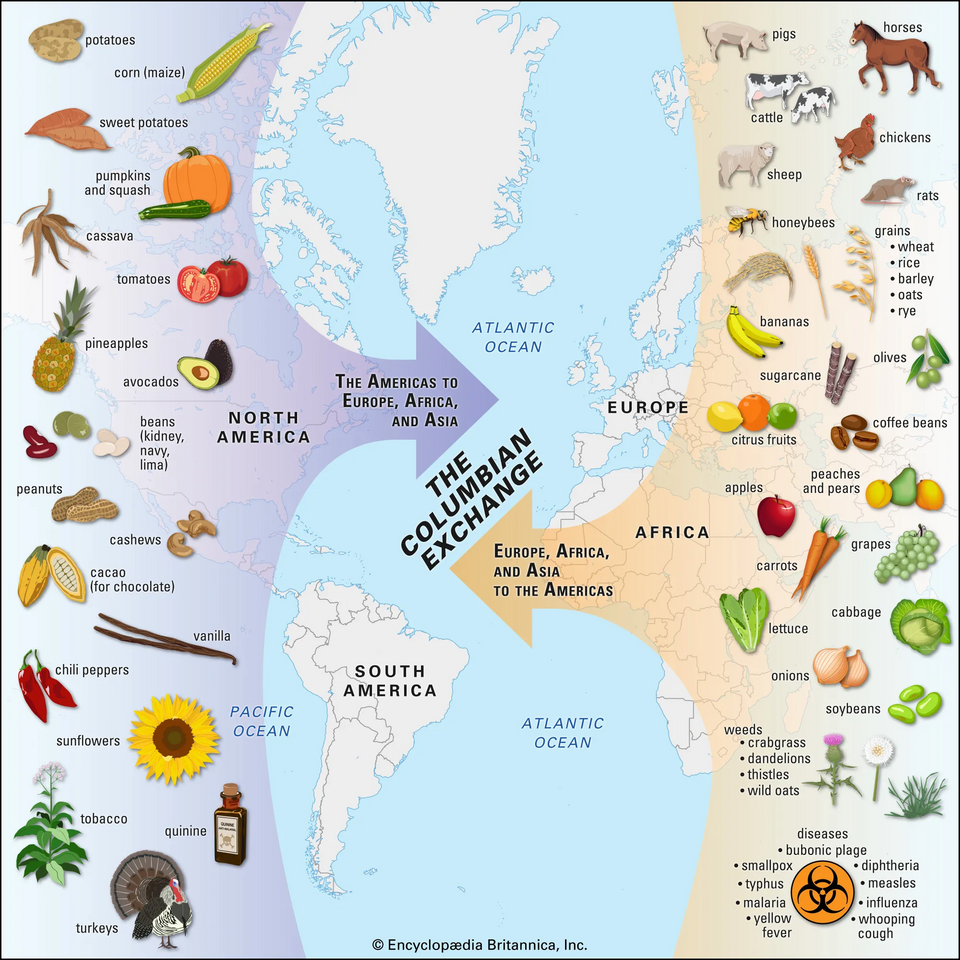
Diagram illustrating the Columbian Exchange, showing the movement of crops, animals, and diseases between Europe, Africa, and the Americas. It visually reinforces how transatlantic voyages created new biological and ecological linkages across hemispheres. The diagram includes additional examples of exchanged species beyond those mentioned in the notes. Source.
Columbian Exchange: The widespread transfer of plants, animals, pathogens, and peoples between the Eastern and Western Hemispheres beginning in 1492.
The introduction of Old World pathogens—including smallpox, measles, and influenza—had catastrophic consequences for Native populations. Mortality rates in many regions exceeded 80–90%, profoundly weakening Indigenous societies and making resistance to European conquest more difficult. Meanwhile, New World crops such as maize, potatoes, and tomatoes dramatically altered European agriculture and nutrition. European environmental practices also reshaped American landscapes:
Livestock introduction (horses, cattle, pigs) expanded European settlement patterns.
New weeds and invasive species altered Indigenous soil management.
Deforestation and soil depletion followed plantation development in the Caribbean and parts of North America.
These ecological shifts restructured social and economic systems across both hemispheres.
Economic Change and the Rise of a New Atlantic Economy
Transatlantic voyages rapidly expanded European access to American resources and helped drive Europe’s transition from feudal structures toward early capitalism.
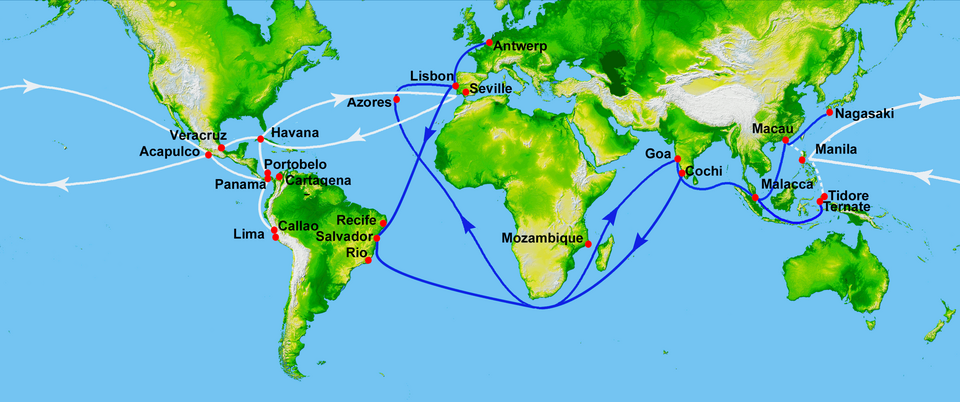
World map showing 16th-century Portuguese and Spanish maritime routes, including Atlantic crossings linking Iberia and the Americas. The map highlights how expanding sea networks supported long-distance trade and imperial expansion during the era of transatlantic voyages. It also shows routes in the Pacific and Indian Oceans, which extend beyond the AP U.S. History focus but provide broader Age of Discovery context. Source.
Precious metals, especially silver from Spanish America, fueled European monetary expansion.
Lucrative plantation products—notably sugar—stimulated investment and commercial networks.
Joint-stock companies emerged to pool capital and reduce risks, enabling more sustained colonization efforts.
Joint-Stock Company: A business structure in which investors share profits and losses, allowing large-scale funding of overseas ventures.
Merchants, monarchs, and investors saw new opportunities for profit, intensifying competition among European states. The Atlantic economy developed into an interconnected commercial system, linking European markets with American raw materials and African labor.
Empire-Building and Expanding Political Power
Voyages between 1491 and 1607 allowed European states—especially Spain, Portugal, France, and England—to project political and military power across the Atlantic. Spanish conquest in the Caribbean, Mexico, and the Andes produced some of the earliest large-scale colonial systems. Empire-building involved:
Establishing military garrisons and forts
Introducing administrative structures based on viceroyalties
Imposing tribute and labor systems such as the encomienda
Using Christian missionary activity to justify conquest and reshape Indigenous cultures
These changes reinforced European political hierarchies while destabilizing Indigenous governance networks. The emergence of colonial bureaucracies created new social orders, often structured by racial and ethnic distinctions.
Labor Systems and Demographic Shifts
As Native populations declined due to epidemic disease and exploitation, European colonies sought alternative labor sources.
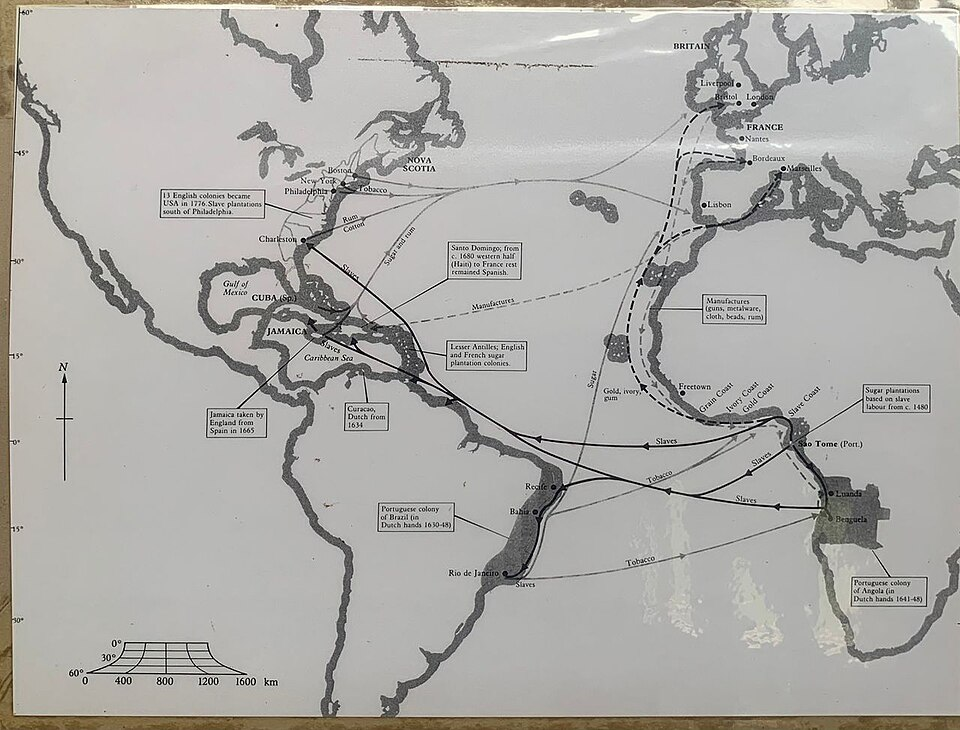
Map of the transatlantic slave trade showing triangular routes linking Europe, West Africa, and the Americas. It depicts the forced movement of enslaved Africans and the return flow of plantation goods to Europe, illustrating a key component of the emerging Atlantic economy. The map includes additional details such as specific ports and plantation regions beyond the scope of the syllabus but useful for geographic context. Source.
Enslaved Africans were transported primarily to the Caribbean and South America.
Africans brought agricultural, metallurgical, and cultural knowledge that shaped colonial economies.
Racialized labor systems entrenched long-lasting social and economic inequalities.
Atlantic Slave Trade: The forced transport of enslaved Africans across the Atlantic to labor in the Americas, beginning in the 1500s and expanding over time.
These demographic changes permanently altered the cultural and ethnic composition of the Americas, contributing to emerging mestizo, mulatto, and other mixed-heritage populations in colonial societies.
Cultural and Intellectual Effects of Transatlantic Encounters
Transatlantic voyages encouraged cultural blending, adaptation, and conflict. Indigenous peoples adopted European tools, animals, and sometimes religious ideas, while Europeans relied on Native agricultural knowledge and geographic expertise. Missionaries, colonists, and political leaders debated the treatment of Native peoples, sparking early European discussions about human rights, sovereignty, and the moral implications of empire.
Key cultural effects included:
Syncretic religious practices, blending Indigenous and Christian traditions
Hybrid languages and mixed cultural communities
European debates about natural rights and the legitimacy of conquest
Shifts in gender relations as European patriarchal norms interacted with Indigenous social systems
These transformations reflected the deep and enduring impact of early transatlantic contact on societies across the Atlantic basin.
Long-Term Patterns and Historical Significance
By 1607, transatlantic voyages had fundamentally reshaped the Americas, Europe, and Africa. Patterns of migration, conquest, coerced labor, religious expansion, and economic globalization established during this period formed the structural foundations of the modern Atlantic world.
FAQ
Europeans gained a clearer sense of global geography as reports from the Americas challenged older classical and medieval ideas about the world’s size and composition.
These voyages encouraged:
The refinement of mapmaking techniques
Recognition that entirely new continents existed beyond Asia
Growing acceptance of a more interconnected global system
They also contributed to shifts in political thinking, as monarchies increasingly viewed overseas expansion as essential to power and prestige.
Although Europeans brought advanced maritime technology, Indigenous guides, mapmaking traditions, and environmental knowledge helped Europeans navigate unfamiliar coastlines and interior regions.
Indigenous expertise influenced:
Route selection for expeditions
Identification of safe harbours and river networks
Understanding of seasonal weather patterns
This assistance enabled some of the earliest inland forays and facilitated European claims to territory.
Opposition emerged for moral, religious, and economic reasons. Some theologians argued that forced conversion and violent conquest contradicted Christian principles.
Others resisted because:
Exploitation of Indigenous peoples threatened to provoke conflict
Wealth from the Americas risked destabilising domestic economies
Imperial expansion strengthened rival European states
These debates signalled the beginnings of European discourse on rights, empire, and global responsibility.
American silver increased the volume of global trade, raising demand for goods sourced from Africa, such as gold, ivory, and enslaved labour.
Indirect consequences included:
Intensification of regional competition among African states
Expansion of trade networks linking Africa more closely to Atlantic markets
Increased political centralisation in some areas due to wealth accumulation
These developments illustrate how transatlantic voyages affected regions far beyond Europe and the Americas.
Many Europeans misinterpreted Indigenous social structures, spiritual systems, and political authority. They often assumed societies lacking European-style institutions were less organised or less legitimate.
These misconceptions influenced:
Justifications for conquest and land seizure
European expectations about labour availability and social hierarchy
Assumptions that Indigenous peoples would readily convert or adopt European customs
Such distorted understandings framed early colonial policy and shaped long-term patterns of interaction.
Practice Questions
Question 2 (4–6 marks)
Explain how the early transatlantic voyages contributed to the development of a new Atlantic economy between 1491 and 1607. In your response, consider economic, demographic, or political factors as appropriate.
Mark Scheme (6 marks total)
Up to 2 marks for describing economic changes (e.g., silver extraction, plantation economies, emergence of joint-stock companies).
Up to 2 marks for explaining demographic developments (e.g., decline of Indigenous populations, growth of African slave labour).
Up to 1 mark for discussing political or imperial factors (e.g., expansion of Spanish and Portuguese colonial administration).
Up to 1 mark for overall coherence, clarity, and accurate use of evidence connected to the period.
Question 1 (1–3 marks)
Identify one major ecological effect of the transatlantic voyages between 1491 and 1607 and briefly explain how it affected Indigenous societies in the Americas.
Mark Scheme (3 marks total)
1 mark for identifying a valid ecological effect (e.g., introduction of Old World diseases, introduction of livestock, spread of invasive species).
1 mark for linking the effect to a specific consequence for Indigenous societies (e.g., population decline, disruption of agriculture).
1 mark for demonstrating accurate historical context or detail.