AP Syllabus focus:
‘Extended contact sparked European debates over how non-Europeans should be treated and fostered evolving religious, cultural, and racial justifications for subjugation.’
European encounters with Native Americans and Africans generated intense debate about morality, governance, and human difference, shaping early modern thought and producing new racial ideologies that justified conquest and coerced labor systems.
European Intellectual Debate After First Contact
As contact intensified in the sixteenth century, Europeans questioned how to interpret the peoples they encountered and how imperial powers should treat them. These debates were not abstract; they influenced colonial governance, missionary activity, legal systems, and the development of racial theories that endured for centuries. Thinkers, clerics, monarchs, and imperial administrators weighed the moral and political implications of expansion, often using religious, cultural, and eventually racial reasoning to legitimize or challenge subjugation.
Religious Foundations of Early Arguments
Christian theology framed the earliest European interpretations of Indigenous and African peoples. Many Europeans believed that all humans possessed immortal souls and were therefore theoretically convertible to Christianity. However, others argued that non-Christian peoples were naturally inferior or divinely destined for domination.
Some theologians believed Indigenous peoples could be peacefully converted and deserved legal protections.
Others viewed conquest and forced labor as acceptable tools for spreading Christianity and “civilizing” non-Europeans.
The doctrine of natural law—the belief that all humans share certain rights and rational capacities—became central to these debates.
Natural Law: A philosophical belief that all humans possess inherent rights and moral capacities derived from universal human nature rather than from specific cultural or political systems.
The Valladolid Debate: A Landmark Controversy
The most famous European dispute over Indigenous rights was the Valladolid Debate (1550–1551) in Spain. It represented the first major moral and legal discussion in European history questioning the legitimacy of imperial conquest.
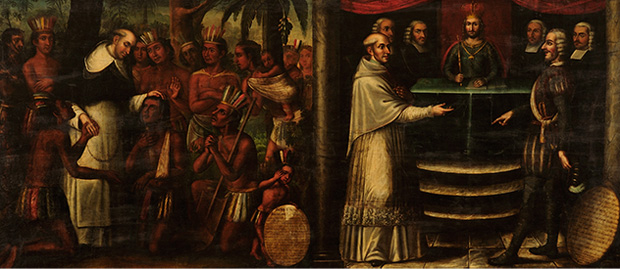
This painting presents Bartolomé de las Casas as a defender of Indigenous peoples during the controversies surrounding Spanish rule, including the Valladolid debate. It visually highlights the brutality faced by Native communities and the efforts of some European clerics to condemn such abuses. The image includes dramatic contrasts between Spanish power and Indigenous suffering, which extend beyond the syllabus but help clarify the stakes of the debate. Source.
Key Figures
Bartolomé de las Casas, a Dominican friar, argued that Native Americans were fully rational humans capable of adopting Christianity through peaceful persuasion.
Juan Ginés de Sepúlveda, a humanist scholar, claimed that Indigenous peoples were “natural slaves” and could be justly ruled through force due to their supposed barbarity.
Though the debate ended without an official decision, it shaped policy discussions and reflected broader tensions regarding empire, morality, and human difference.
The Rise of Cultural Hierarchies
As contact expanded, many Europeans defined Indigenous and African peoples through cultural difference:
unfamiliar religious practices
gender roles differing from European norms
agricultural and land-use systems interpreted as “underdeveloped”
political structures not matching European models of monarchy or centralized authority
These cultural differences were often misinterpreted as evidence of inherent inferiority. Such interpretations provided justification for imposing European authority, missionary control, and systems of coerced labor.
From Cultural to Racial Justifications
Over time, European thought shifted from cultural explanations toward proto-racial theories that emphasized biological and hereditary difference. While not yet modern scientific racism, these ideas laid crucial foundations for it.
Proto-racial Theory: Early systems of belief that ascribed fixed, inheritable differences to human groups, often linking physical traits to moral or intellectual qualities.
This shift allowed Europeans to argue that Indigenous and African peoples were not only culturally different but also naturally suited to subordination. A normal sentence is required here, emphasizing that these emerging racial theories intertwined with economic and political interests of the expanding Atlantic world.
Justifying Subjugation Across the Atlantic World
Economic incentives—particularly plantation agriculture, mining, and the Atlantic slave trade—heightened the need for ideological systems that legitimized exploitation.
Religious Justifications
Claims that conquest spread Christianity and “saved souls.”
Arguments that non-Christians could be legitimately enslaved until conversion.
Beliefs that Europeans acted as divine agents bringing order to supposedly “pagan” societies.
Cultural Justifications
Assertions that Europeans represented “civilization” while Native Americans and Africans represented savagery.
Use of gender norms—such as the prominence of Indigenous women in agriculture—to label Native societies as disordered or inferior.
Depictions of Indigenous land-use practices as evidence they did not “truly” own land, enabling European seizure.
Racial Justifications
By the late sixteenth and early seventeenth centuries, many Europeans increasingly linked physical appearance with character and capability.
Descriptions of Africans emphasizing skin color and assumed traits.
Claims that Indigenous peoples were childlike, primitive, or incapable of self-rule.
Early attempts to categorize human populations into hierarchies based on supposed biological difference.
These racial arguments hardened over time, providing ideological support for both the expansion of slavery and the continued marginalization of Native populations.
Impact on Colonial Policy
Debates and justifications influenced Spanish, Portuguese, French, and English approaches to colonial governance:
Systems such as the encomienda and later repartimiento were shaped by arguments about Indigenous capacity and rights.
Missionary strategies varied between peaceful persuasion and coercive conversion.
Legal codes increasingly reflected assumptions of European superiority.
Ideas about race structured colonial social orders, including caste hierarchies in Spanish America.
Together, these evolving debates created the ideological environment in which European empires expanded, rationalizing domination through intertwined religious, cultural, and racial beliefs.
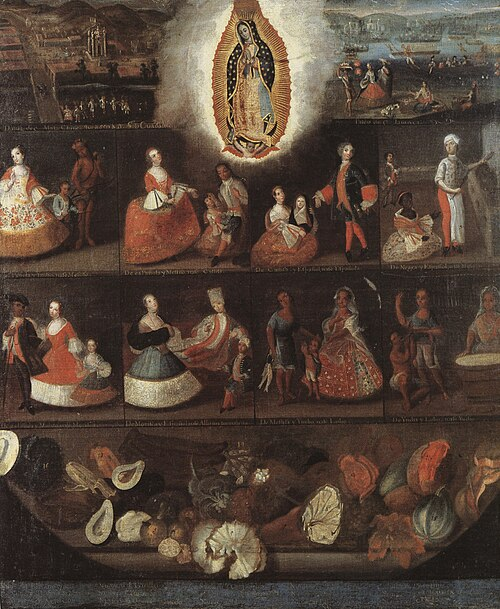
This eighteenth-century casta painting by Luis de Mena shows labeled family groupings arranged to illustrate colonial racial hierarchy. It also includes religious and economic symbolism—such as the Virgin of Guadalupe and New World produce—which exceeds the AP focus but helps contextualize how racial ideology permeated colonial society. The structured arrangement visually demonstrates how race became an organizing principle of social status in Spanish America. Source.
FAQ
Although the debate had no official outcome, it created a precedent for evaluating imperial actions through moral and legal frameworks rather than solely through conquest.
It encouraged later theologians and philosophers to question whether imperial rule could be justified without the consent or welfare of Indigenous peoples.
Its longer-term significance lies in showing that empire required ideological defence, laying the groundwork for later Enlightenment discussions about rights, sovereignty, and human nature.
These ideas offered convenient explanations for labour exploitation, territorial expansion, and social hierarchy, making them attractive to imperial powers.
They simplified diverse cultures into fixed categories, which:
Justified unequal treatment
Reinforced European authority
Reduced the moral burden of conquest
The absence of scientific backing mattered little in a context where economic and political interests benefited from racial categorisation.
European debates about Indigenous peoples often focused on whether they were rational beings capable of conversion and self-governance.
Discussions about Africans were more closely tied to emerging justifications for enslavement, with Europeans increasingly associating African identity with permanent, inheritable servitude.
These distinctions contributed to differential systems of labour, status, and social hierarchy that developed later in colonial societies.
Yes, some religious orders—especially Dominicans and later Jesuits—regularly opposed coercive labour systems.
Their opposition stemmed from:
Religious concern for the salvation and moral integrity of Indigenous peoples
Critiques of colonial greed and abuse
A belief that true conversion required voluntary participation
While influential in certain regions, their impact was limited by the strong economic interests of colonial elites.
Rival states, especially England and the Netherlands, highlighted Spanish brutality to present themselves as more moral or civilised imperial actors.
This tactic, known as the Black Legend, served diplomatic and propagandistic purposes by portraying Spanish rule as exceptionally cruel.
Such arguments allowed other European powers to justify their own expansion by claiming to offer better governance while often engaging in similar exploitative practices.
Practice Questions
Question 1 (1–3 marks)
Briefly explain one way in which European debates about the treatment of Indigenous peoples influenced colonial policy in the sixteenth century.
Mark Scheme for Question 1
Award up to 3 marks:
1 mark for identifying a relevant debate (e.g., arguments by Las Casas or Sepúlveda).
1 mark for explaining a direct influence on policy (e.g., reforms such as the New Laws of 1542).
1 mark for linking the debate to changes in colonial governance or treatment of Indigenous peoples (e.g., attempts to limit the worst abuses of the encomienda system).
Question 2 (4–6 marks)
Analyse how religious, cultural, and early racial justifications shaped European arguments for the subjugation of Native American and African peoples during the period 1491–1607.
Mark Scheme for Question 2
Award up to 6 marks:
1 mark for describing a religious justification (e.g., belief in spreading Christianity or classifying non-Christians as suitable for coercion).
1 mark for describing a cultural justification (e.g., claims of European superiority based on governance, gender roles, or land use).
1 mark for identifying the emergence of racial thinking (e.g., proto-racial ideas linking physical traits to moral or intellectual qualities).
1 mark for explaining how these justifications supported systems of labour or conquest (e.g., defending forced conversion, land seizure, or enslavement).
1 mark for analysing the interplay between ideology and economic interests (e.g., plantation agriculture, mining).
1 mark for connecting these justifications to broader imperial aims or the structure of colonial society.