AP Syllabus focus:
‘Connect the effects of transatlantic voyages to AP U.S. History themes and support a clear thesis with specific examples.’
Organizing a thesis for Period 1 requires linking transatlantic voyages to major AP U.S. History themes, using clear evidence that situates early contact within long-term historical developments.
Structuring a Period 1 Thesis with AP Themes
A strong Period 1 thesis must present a historically defensible claim that connects the effects of transatlantic voyages—cultural exchange, economic change, demographic shifts, and imperial competition—to broader AP U.S. History (APUSH) themes.
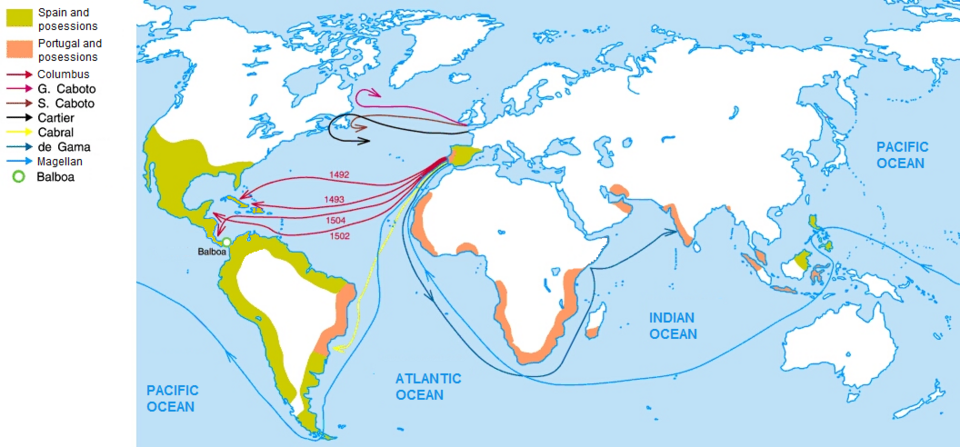
This map shows major European voyages during the Age of Discovery, illustrating the development of long-distance maritime routes that connected Europe, Africa, and the Americas. It highlights the geographic scope of early exploration, reinforcing the WXT, GEO, and MIG themes discussed in the notes. Some voyages extend beyond 1607 and outside the Atlantic, offering broader context than the syllabus strictly requires. Source.
This approach helps students frame early Atlantic interactions not as isolated events, but as foundational forces shaping later American history.
Understanding the Role of Themes in APUSH
Themes provide conceptual categories that allow historians to interpret causes and consequences across time. Incorporating themes into a thesis clarifies the significance of evidence and ensures analytical depth.
Thesis Statement: A historically defensible claim that responds to a prompt and establishes a line of reasoning supported by specific evidence.
A thematic thesis is especially important for Period 1, where relatively few events must be connected to very large historical processes. Students should therefore use themes to show how transatlantic voyages produced enduring transformations in the Atlantic world.
APUSH Themes Most Relevant to Transatlantic Voyages
Although multiple themes may apply, four are most commonly used for Period 1 thesis development.
Theme 1: American and National Identity (NAT)
This theme highlights how European, Native American, and African interactions contributed to developing ideas about identity. Early contact shaped concepts of power, civilization, race, and belonging.
Key points students may highlight:
European assumptions about Christianity, civilization, and authority influenced policies toward indigenous peoples.
Early racial hierarchies emerging from colonization laid foundations for later social stratification.
The blending and clashing of cultures contributed to early ideas about the uniqueness of the Americas.
Theme 2: Work, Exchange, and Technology (WXT)
This theme emphasizes how economic interactions and technological innovations shaped societies. Transatlantic voyages were rooted in economic motives and fueled new global exchange systems.
Useful connections include:
Maritime technologies such as the caravel, astrolabe, and improved cartography enabled long-distance exploration.
European demand for American natural resources encouraged extractive labor systems, including the encomienda and the early importation of enslaved Africans.
Circulation of goods through the Columbian Exchange reshaped global economic networks.
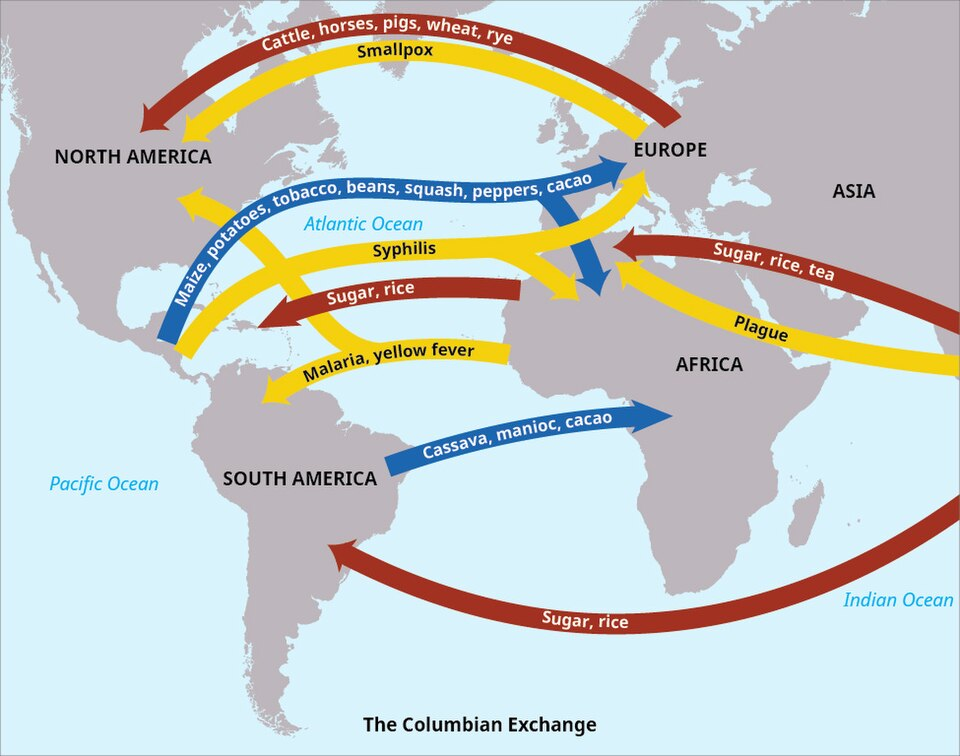
This diagram depicts the Columbian Exchange, illustrating ecological and economic transformations generated by transatlantic contact. It visually reinforces how exchanges of crops, animals, and diseases shaped the environments and economies of Europe, Africa, and the Americas, supporting WXT and GEO thematic analysis. Some listed items extend beyond the narrow chronological scope of 1491–1607, adding contextual detail. Source.
Theme 3: Geography and the Environment (GEO)
Environmental factors significantly influenced early contact, as Europeans, Native Americans, and Africans interacted with unfamiliar ecosystems.
Students may incorporate:
The spread of Old World plants and animals, which transformed indigenous agriculture, mobility, and land use.
The role of American staples such as maize in fueling population growth in Europe.
Environmental disruptions caused by disease and ecological change.
Theme 4: Migration and Settlement (MIG)
Early contact triggered massive population movements across continents.
Connections include:
Voluntary European migration for wealth and religious motives.
Forced migration of Africans through the Atlantic slave trade.
Native American displacement due to disease, warfare, and Spanish expansion.
A sentence of analysis should explicitly tie these patterns to the broader significance of early European arrival.
Writing a Thematically Organized Thesis for Period 1
To organize a thesis effectively, students should construct an argument that links major effects of transatlantic voyages to one or more APUSH themes. This structure strengthens analytical clarity and ensures the argument addresses both the prompt and historical significance.
Step-by-Step Organizational Strategies
Identify the prompt’s core cause-and-effect task. Many Period 1 prompts ask how transatlantic voyages reshaped societies or produced major changes.
Choose relevant themes that help frame these effects (e.g., WXT for economic impacts, GEO for ecological transformations).
Select two to three specific examples directly connected to these themes, such as smallpox epidemics, mining economies, or the introduction of horses.
Establish a clear line of reasoning showing how these examples demonstrate a broader pattern of change.
Line of Reasoning: The logical structure connecting evidence to a thesis, showing how and why historical developments support the argument.
A strong thesis typically includes both a claim and a brief preview of the themes or categories the argument will develop.
Model Structure for Thematic Thesis Writing
While not providing sample theses, students can rely on the following organizational principles:
Begin with a broad claim about the impact of transatlantic voyages.
Anchor the claim in at least one APUSH theme.
Reference specific historical developments that illustrate the theme’s significance.
Avoid simple descriptions—emphasize interpretation and consequence.
Using Themes to Strengthen Evidence and Analysis
Themes are not only useful for writing the thesis; they also structure the body paragraphs that follow. By aligning evidence with themes, students ensure their argument remains focused, coherent, and analytical.
Ways themes strengthen analysis include:
Clarifying causal relationships, such as linking European demand for silver (WXT) to intensified labor exploitation in the Americas.
Highlighting continuity and change, such as showing how preexisting Native American trade networks adapted to European goods (GEO, WXT).
Connecting local developments to broader global patterns, reinforcing significance and complexity.
This thematic approach helps students show how the effects of early transatlantic voyages reverberated across societies and centuries, fulfilling the APUSH expectation for contextual, evidence-based argumentation.
FAQ
Most strong theses use two themes, allowing students to demonstrate analytical depth while maintaining clear focus.
Choosing too many themes can weaken the argument by spreading evidence too thin.
Selecting a pair that naturally supports the prompt—such as Work, Exchange, and Technology alongside Geography and the Environment—usually produces the clearest reasoning.
Themes force students to explain significance rather than simply recount events.
By organising arguments around themes, students must show:
Why developments occurred
What larger patterns they illustrate
How they shaped communities across time
This thematic framing strengthens causation or change-over-time analysis.
Students often choose a correct theme but fail to link it explicitly to evidence.
A theme alone is not analysis.
A strong thesis must clearly show how a theme illuminates the impact of a specific development, such as ecological transformation or shifts in labour systems.
Themes provide natural organisational categories, helping arguments progress logically.
They allow students to:
Group related evidence cohesively
Connect short-term effects to broader historical patterns
Demonstrate why certain developments mattered beyond immediate outcomes
This results in a clearer, more compelling argument.
The most commonly effective themes are:
Work, Exchange, and Technology (economic motives and systems)
Geography and the Environment (ecological and biological change)
Migration and Settlement (population movements and displacement)
These themes capture the main forces that shaped early Atlantic interactions and allow students to build well-structured analytical arguments.
Practice Questions
Question 1 (1–3 marks)
Explain one way in which using an AP US History theme can strengthen a thesis about the effects of transatlantic voyages between 1491 and 1607.
Mark scheme:
1 mark: Identifies a relevant APUSH theme (e.g., Work, Exchange, and Technology; Geography and the Environment; Migration and Settlement; American and National Identity).
1 mark: States a valid point about how that theme can be applied to a thesis.
1 mark: Clearly explains how the theme strengthens the thesis by providing an analytical framework or linking evidence to broader developments.
Question 2 (4–6 marks)
Using examples from the period 1491 to 1607, analyse how organising a thesis around AP US History themes can help explain the major effects of transatlantic voyages on societies in the Americas and Europe.
Mark scheme:
1–2 marks: Identifies at least one appropriate APUSH theme relevant to transatlantic voyages.
1–2 marks: Provides specific historical evidence from the period (e.g., Columbian Exchange, introduction of European livestock, the spread of epidemic diseases, development of coerced labour systems).
1–2 marks: Explains how structuring a thesis around themes clarifies the significance of the evidence—showing patterns of change, continuity, causation, or broader consequences for multiple societies.