AP Syllabus focus:
‘Europeans developed varied colonization and migration patterns shaped by imperial goals, cultures, and the different North American environments where they settled.’
European colonizers arrived in North America with diverse ambitions, cultural traditions, and settlement strategies, producing contrasting migration patterns that shaped distinctive regional societies and long-term historical trajectories across the continent.
Varied Imperial Goals in European Colonization
European powers did not approach colonization with uniform intentions. Instead, each empire pursued specific economic, religious, and strategic goals that influenced where they settled and how they interacted with Native populations. These imperial models created distinct clusters of settlements across the continent rather than a single unified colonial pattern.
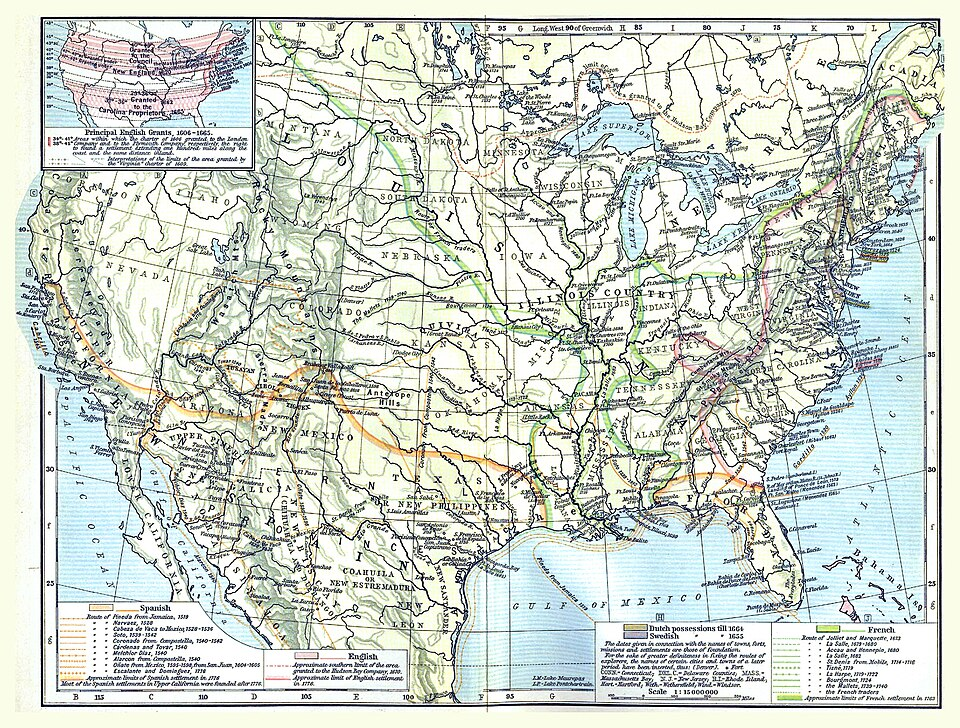
Map of European settlements in North America from 1513 to 1776, distinguishing Spanish, French, British, and Dutch regions. The map illustrates how each empire concentrated its settlements along specific coasts, rivers, and interior corridors. It includes additional areas beyond the AP Period 2 scope, but these provide helpful broader context for understanding colonial patterns. Source.
Economic Motivations
Most European empires sought to exploit North America’s resources to build imperial wealth.
Spain aimed to extract precious metals and establish profitable agricultural and mining systems.
France and the Dutch Republic targeted commercial opportunities, particularly the fur trade, forming economic alliances with Indigenous groups.
England emphasized agricultural settlement, land ownership, and the development of export crops, especially as population pressures and economic shifts encouraged migration.
Because the English crown permitted private investors, joint-stock companies, and religious groups to found colonies, English settlement patterns varied widely, unlike the more centralized Spanish and French systems.
Religious and Cultural Objectives
Religious motives shaped colonization for several European groups.
Spanish colonizers, aligned with the Catholic Church, sought to convert Native peoples to Christianity as part of a broader imperial mission.
French Jesuit missionaries also pursued conversion, but generally with greater cultural accommodation.
English Protestant migrants, including Puritans and other dissenting groups, sought religious freedom, often creating tightly knit communities built around shared beliefs.
Conversion: The process of adopting a new religion, often through missionary activity.
These motives shaped social structures, from Spanish mission systems to English congregational towns.
Migration Patterns Across European Colonies
The scale, composition, and purpose of migration differed sharply among the Spanish, French, Dutch, and English empires, resulting in distinct demographic and settlement outcomes.
Scale and Demographics of Migrant Populations
Spanish migration consisted mostly of soldiers, administrators, clergy, and male settlers, leading to substantial intermarriage with Native peoples and the creation of mestizo populations.
French migration remained limited, with relatively few European women and a stronger reliance on alliances with Indigenous communities.
Dutch migration was commercial and often temporary, as many Dutch colonists prioritized trade rather than agricultural permanence.
English migration was the largest and most gender-balanced, promoting population growth, family formation, and permanent settlements.
Mestizo: A person of mixed European and Indigenous ancestry, especially common in regions of Spanish colonization.
These demographic structures influenced cultural blending, labor systems, and political development.
Settlement Patterns and Environmental Adaptation
European colonizers established settlements adapted to the environmental conditions they encountered.
In Spanish territories, centralized towns, missions, and presidios were built to control territory and labor.
French settlements clustered along river systems, enabling transportation and trade networks.
The Dutch founded compact, commercially oriented ports such as New Amsterdam.
English colonists created dispersed agricultural communities or compact religious towns depending on regional context.
Environmental factors—forests, rivers, soil quality, and climate—shaped regional economies and encouraged different social structures.
Interactions with Indigenous Peoples
European colonization goals and migration patterns strongly influenced relationships with Native communities, which in turn shaped the success or failure of various colonial enterprises.
Trade, Diplomacy, and Alliance Formation
France and the Dutch Republic relied heavily on Indigenous partnerships.
These alliances were critical for managing the fur trade, accessing long-distance trade routes, and securing military support.
Diplomatic relationships often required cultural negotiation, intermarriage, and mutual economic benefit.
In contrast, English colonists, driven by land acquisition, more frequently displaced Native communities as settlements expanded into interior regions.
Labor Systems and Territorial Ambitions
Spanish colonizers implemented systems such as encomienda and later repartimiento, designed to extract labor and tribute from Native populations. English settlers, lacking similar systems, turned increasingly to indentured servitude and later racialized chattel slavery as labor-intensive plantation agriculture developed.
Indentured Servitude: A labor system in which individuals worked for a set number of years in exchange for passage to the colonies or other benefits.
Because labor models differed sharply across empires, colonial societies developed contrasting economic institutions and social hierarchies.
Cultural Exchanges and Adaptations
European migration patterns led not only to demographic change but also to profound cultural intermixing, borrowing, and resistance.
Transfer of Ideas, Practices, and Technologies
Europeans adopted Native agricultural techniques, geographic knowledge, and trade networks.
Indigenous communities incorporated European tools, weapons, and goods into existing social and economic systems.
Cultural blending occurred most prominently in regions of Spanish and French colonization, where intermarriage and linguistic mixing were common.
In English colonies, cultural boundaries tended to be more rigid, though everyday exchanges remained important for survival in unfamiliar environments.
Long-Term Significance of Colonization Goals and Migration Patterns
The varied ambitions and settlement strategies of European empires shaped the foundations of early North American societies. Distinct migration patterns, demographic structures, and relationships with Native peoples produced contrasting regional cultures and economies. These differences ultimately influenced political development, colonial rivalries, and the emerging identities that would define later periods of American history.
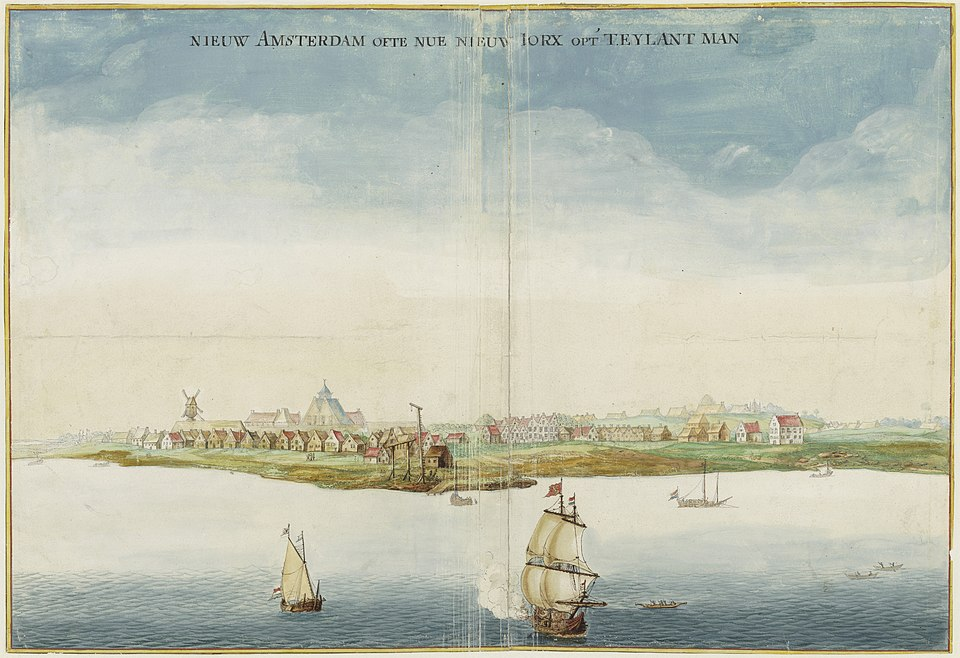
Watercolor view of New Amsterdam in the mid-1600s, showing a dense Dutch colonial town and a busy harbor filled with trading vessels. The scene illustrates how Dutch colonization emphasized commerce, fortified port settlements, and maritime trade. It includes artistic details beyond the AP syllabus, but these elements help students visualize a commercial colonial model distinct from Spanish and English patterns. Source.
FAQ
European empires approached land with assumptions rooted in their legal and cultural traditions. Most Europeans viewed land as a commodity that could be owned, fenced, and inherited, which contrasted sharply with many Indigenous understandings of land as shared or collectively stewarded.
These ideas influenced migration patterns:
• English settlers were particularly motivated by the prospect of owning private farmland.
• Spanish colonisers emphasised territorial claims supporting imperial authority.
• French migrants focused less on settlement and more on access to trade routes rather than landholding.
Because both France and the Dutch Republic sent relatively few settlers, intermarriage created strong diplomatic and commercial ties that advanced their imperial aims without large-scale migration.
This encouraged:
• Reliance on Indigenous partners in the fur trade.
• Flexible settlement patterns focused on trade posts rather than towns.
• Cultural blending that provided linguistic and diplomatic advantages in unfamiliar regions.
Competition on the European continent influenced where empires chose to settle as each sought to block rivals from strategic locations.
This meant:
• Spain emphasised controlling the Gulf of Mexico and the Caribbean approaches.
• France prioritised river systems to create inland access that bypassed British coastal claims.
• England expanded along the Atlantic coast to prevent French and Dutch dominance in valuable harbours.
These choices reflected not only North American geography but also long-standing European conflicts.
European migrants often encountered unfamiliar climates and crops, and success depended on how quickly they adapted or learned from Indigenous communities.
Key differences included:
• English colonists adopted Indigenous crops such as maize and relied on Native expertise for survival.
• French traders required less agricultural adaptation because they focused on mobile trade networks.
• Spanish settlers imported Iberian crops and livestock but also incorporated Indigenous farming traditions into mission communities.
Adaptation strongly influenced which settlements endured and which collapsed.
When colonies attracted mainly male settlers, as in many Spanish and French regions, intermarriage with Indigenous women became essential for creating stable communities.
This produced:
• Mixed-ancestry populations that blended cultural practices.
• Linguistic adaptation that facilitated trade and diplomacy.
• Flexible social structures that differed sharply from the family-oriented English colonies.
In contrast, more balanced English migration fostered replicable social institutions, such as town governance and Protestant congregations, reinforcing cultural separation from Indigenous groups.
Practice Questions
(1–3 marks)
Identify one key difference between English and French migration patterns to North America during the seventeenth century, and briefly explain how this difference influenced colonial development.
(1–3 marks)
Award up to 3 marks:
• 1 mark for identifying a clear difference in migration patterns (e.g., English migration was larger and more family-based, while French migration was smaller and predominantly male).
• 1 mark for linking this difference to a consequence for colonial development (e.g., English colonies grew rapidly with stable communities; French colonies relied on alliances and intermarriage).
• 1 mark for further elaboration or use of specific evidence (e.g., New England’s town-based settlement versus French riverine trading settlements).
(4–6 marks)
Explain how the imperial goals of Spain, France, and England shaped their respective patterns of settlement and interactions with Indigenous peoples in North America between 1607 and 1754. In your answer, use specific evidence to support your analysis.
(4–6 marks)
Award up to 6 marks:
• 1–2 marks for addressing each empire’s core imperial goals (Spain: wealth extraction and conversion; France: trade and alliances; England: land acquisition and agriculture).
• 1–2 marks for explaining how these goals shaped settlement patterns (e.g., Spanish missions and presidios; French trading posts along waterways; English agricultural towns and plantations).
• 1–2 marks for explaining how these goals shaped interactions with Indigenous peoples (e.g., Spanish labour systems, French alliances, English displacement of Native communities).
• Answers at the top of the mark range should be well structured, use specific evidence, and directly answer how goals shaped both settlement and interactions.