AP Syllabus focus:
‘Spanish efforts to extract wealth led to institutions that subjugated Native peoples, promoted conversion to Christianity, and incorporated Native and African labor into colonial society.’
Spain’s colonization of the Americas centered on extracting wealth through coerced labor, reshaping Indigenous societies while extending imperial authority, Christianity, and hierarchical social systems across vast territories.
Spanish Imperial Goals and Strategies
Spain’s colonial project in North America was driven by a desire to enrich the monarchy, expand political influence, and spread Catholicism. These interlinked aims shaped every aspect of Spanish settlement and governance. Officials, missionaries, and settlers operated within a rigid imperial hierarchy that emphasized centralized control and economic exploitation. Wealth acquisition—especially through mining, tribute, and forced labor—remained the foundation of Spanish policy across the 16th and 17th centuries.
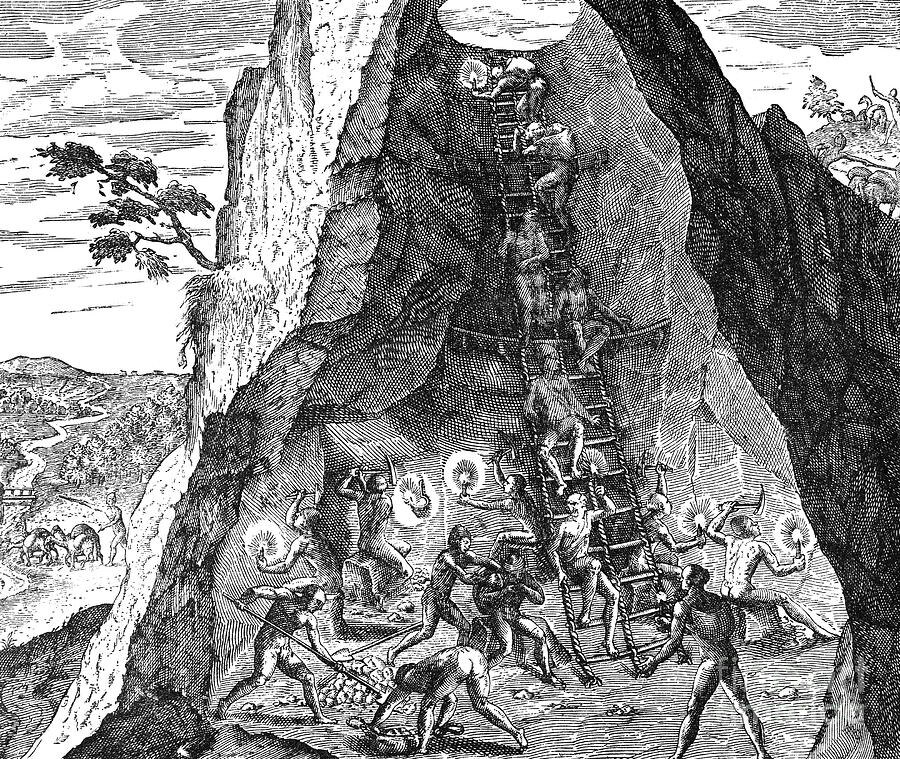
This engraving shows Indigenous workers laboring inside the Spanish-controlled silver mines of Potosí under dangerous and exhausting conditions. It highlights how colonial authorities depended on coerced Native labor to turn mineral wealth into imperial revenue. While the scene comes from present-day Bolivia rather than North America, it exemplifies the same extractive logic and human costs that shaped Spanish colonization across the Americas. Source.
The Central Role of Resource Extraction
The pursuit of mineral wealth, especially silver, underpinned Spanish expansion into areas such as New Mexico and Florida. Colonial administrators sought to integrate Indigenous populations into labor systems that supported imperial revenue. Efforts to secure consistent access to land, labor, and natural resources often prompted the establishment of presidios (military forts) and missions, forming a network that maintained Spanish dominance and guarded against European rivals.
Labor Systems and Native Subjugation
Spanish colonizers created several systems to organize Indigenous labor and enforce imperial authority. These systems aimed both to control local populations and to generate profit for the Crown and settlers.
Encomienda, the earliest major labor institution, reflected Spain’s intention to command Native labor and tribute.
Encomienda: A grant empowering Spanish colonists to demand labor and tribute from specific Indigenous communities in exchange for supposed protection and Christian instruction.
Although the Crown expected encomenderos (grant holders) to care for Indigenous workers, coercion and physical abuse were widespread. Demands for labor in fields, workshops, and mines destabilized local economies and contributed to population decline.
After growing criticism—especially from reformers like Bartolomé de las Casas—the Crown implemented the New Laws of 1542, limiting the inheritance of encomiendas. Nonetheless, economic exploitation persisted through other systems such as repartimiento, which rotated Indigenous laborers, and later through coerced wage labor. These evolving structures ensured continued access to Native labor even as the Crown attempted to regulate abuses.
Missionary Activity and Religious Transformation
Catholic conversion was a core element of Spanish colonization. Missionaries, especially Franciscans, worked to restructure Indigenous spiritual life while integrating local societies into Spanish political control. Conversion efforts were intertwined with labor arrangements, as many missions relied on Native labor to sustain agricultural production and craftwork.
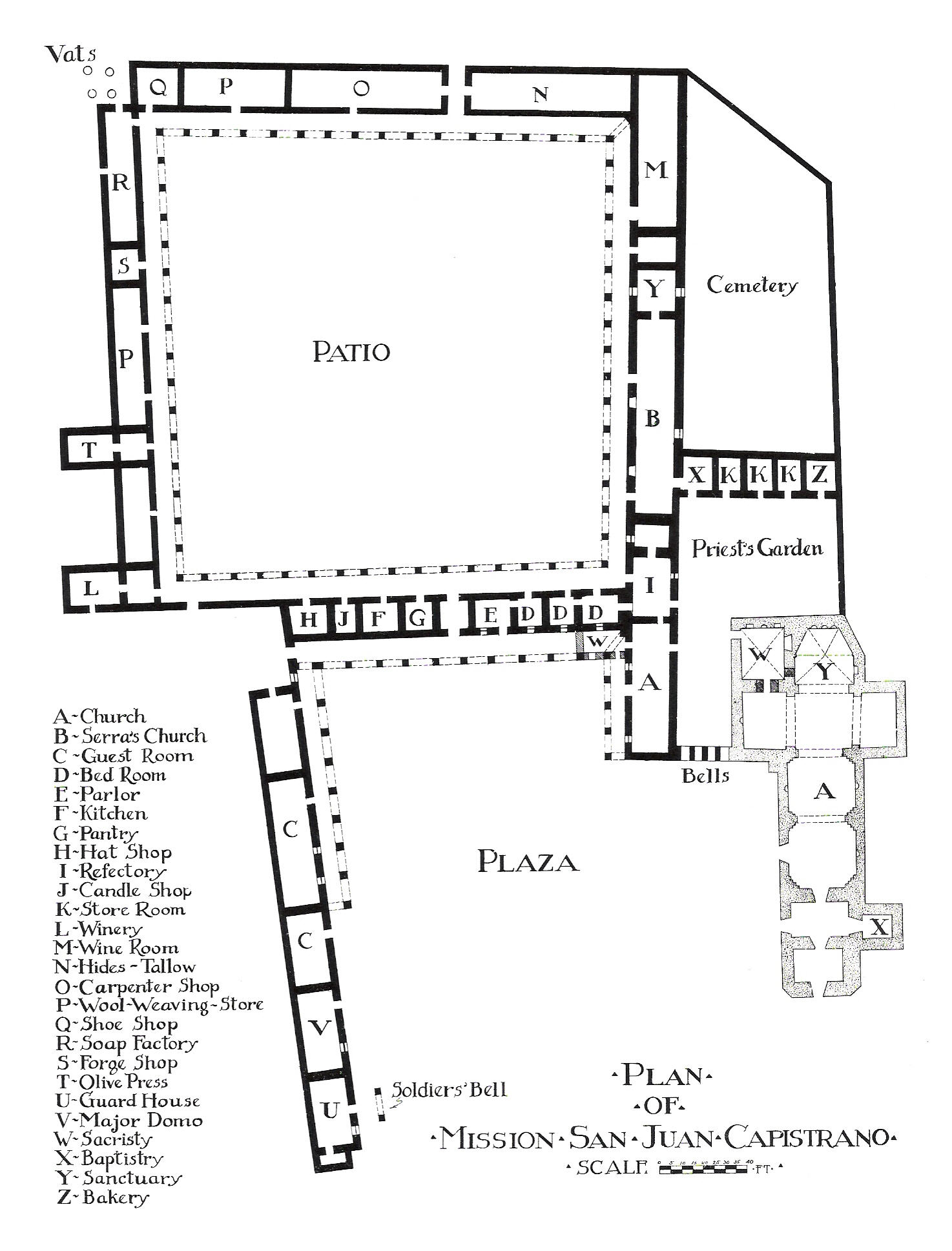
This plan of Mission San Juan Capistrano highlights the typical mission layout: an enclosed patio, church, priest’s quarters, cemetery, and workspaces clustered inside a walled compound. It illustrates how religious life, housing, and production facilities were concentrated under Spanish supervision, helping to organize Native labor and daily routines. The drawing includes additional labeled rooms not required by the syllabus but still useful for understanding the missions’ economic functions. Source.
Methods of Religious and Cultural Control
Missionaries sought to replace Indigenous belief systems with Christianity by:
Establishing mission settlements that reorganized Native communities under church supervision
Teaching doctrine, agricultural skills, and European gender norms
Discouraging traditional spiritual practices through coercion, surveillance, and punishment
Despite missionary intent, Indigenous communities selectively adapted or resisted Christian teachings. Syncretic religious practices emerged, blending Native and Christian traditions, demonstrating the complex cultural negotiations underway.
Incorporation of African Labor
As demographic collapse reduced the Indigenous labor supply, Spanish colonists increasingly turned to enslaved Africans. African labor became crucial in regions like the Caribbean and parts of Spanish Florida, where plantation agriculture demanded a stable workforce. This integration of African labor broadened the colonial system’s reliance on racial hierarchy and coerced labor. Spanish legal codes recognized enslaved Africans as property, reinforcing distinctions based on lineage and race that shaped colonial society.
Normal colonial settlements mixed Native, African, and Spanish populations, producing a diverse social order governed by the casta system.
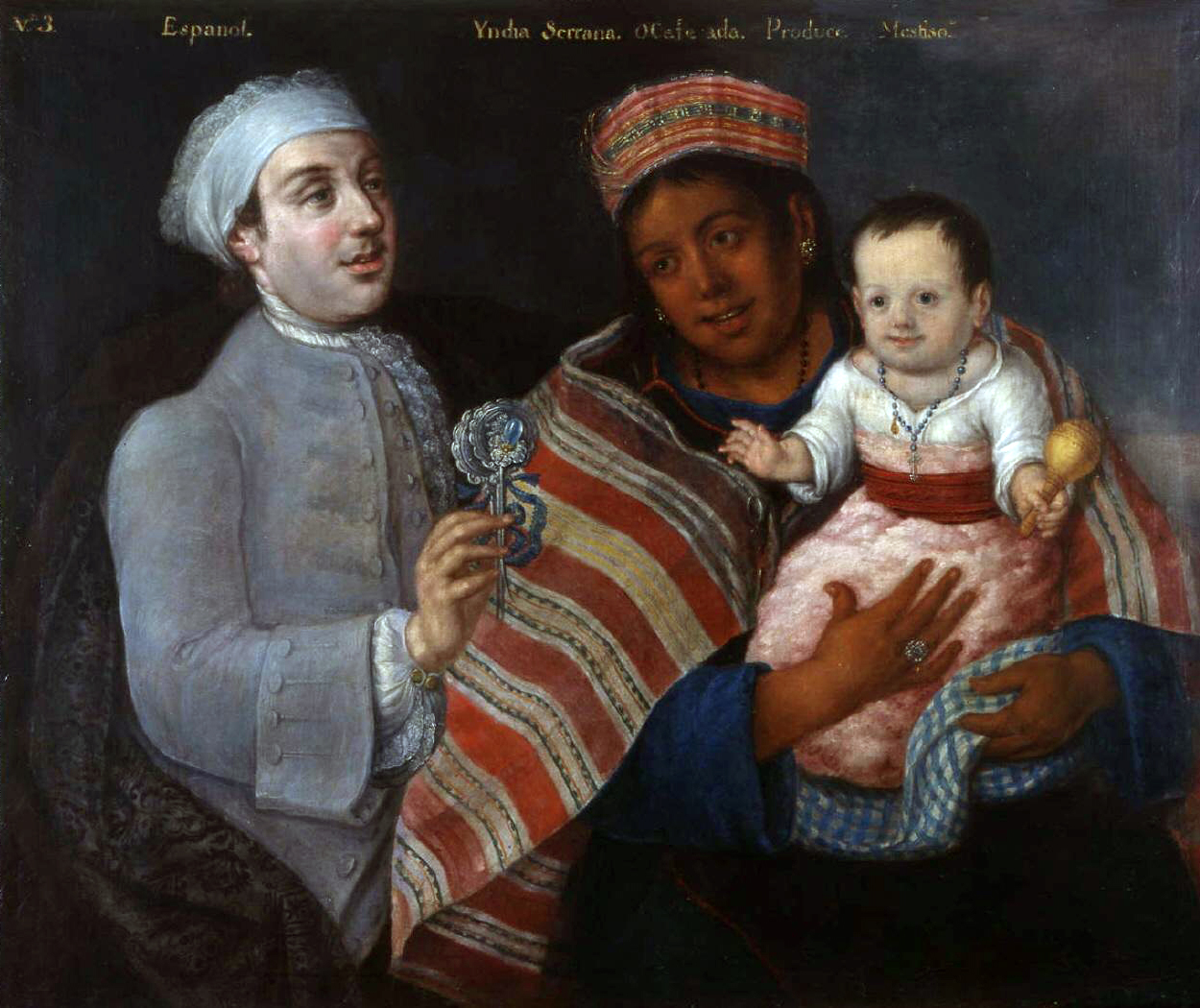
This painting, titled “Español e india produce mestizo,” portrays a Spanish father, an Indigenous mother, and their child classified as mestizo, embodying the logic of casta categories. Clothing, pose, and setting emphasize the family’s position within a racialized, status-conscious colonial society. Although created in Peru, it reflects the same hierarchical racial system described in the syllabus. Source.
Institutions of Control and Colonial Administration
Spanish colonization depended on centralized administration supported by military presence. Viceroys, governors, and local officials enforced Crown policies to maintain stability and revenue flow. The mission-presidio system worked jointly to protect settlers, oversee labor, and suppress resistance.
Mechanisms of Authority
Key tools in maintaining colonial control included:
Presidios to protect missions and enforce order
Audiencias (high courts) to regulate legal disputes and monitor officials
Tribute requirements placed on Native communities to meet economic targets
Forced resettlement into reducciones, where Native people lived under direct Spanish supervision
These mechanisms facilitated the consolidation of imperial authority while intensifying Indigenous subjugation.
Indigenous Responses: Adaptation and Resistance
Indigenous peoples responded in varied ways to Spanish domination. Some groups forged alliances, negotiated labor burdens, or embraced selective aspects of Christianity to preserve autonomy. Others resisted through open revolt, flight, or subtle acts of noncompliance.
Resistance movements—such as the Pueblo Revolt of 1680—demonstrated the limits of Spanish control and forced accommodations. After uprisings, Spanish officials sometimes eased labor demands or tolerated certain Indigenous customs to secure stability. Such negotiations reveal the dynamic interplay between colonial power and Indigenous agency.
Legacy of Spanish Colonization
Spanish colonization left enduring marks on the American Southwest and Florida, including long-standing Catholic institutions, multilingual communities, and hybrid cultural traditions. The systems of labor extraction, racial classification, and missionization shaped political and social structures that persisted long after Spanish rule ended.
FAQ
Spanish officials often relied on existing Indigenous leadership structures to secure labour, using diplomacy, incentives, or pressure to gain compliance. Agreements with local leaders helped stabilise labour supplies without immediate military force.
However, when Indigenous leaders resisted or refused cooperation, labour extraction often collapsed, leading to harsher coercion or violent retaliation. These dynamics varied widely between regions and over time.
Massive demographic decline caused by Eurasian diseases undermined Indigenous communities’ ability to resist Spanish control, making labour systems easier to impose.
At the same time, falling populations created labour shortages that pushed Spaniards to modify or diversify labour structures, sometimes shifting from Indigenous labour to African enslaved labour. This contributed to long-term changes in the colonial economy and social hierarchy.
Some groups sought protection from rival Indigenous nations or access to Spanish goods such as metal tools, cloth, or livestock. Living near missions could also provide limited political leverage by forming alliances with Spanish officials.
In other cases, communities hoped to secure more predictable food supplies during drought or instability, even though relocation often resulted in tighter Spanish control over daily life.
Missionaries attempted to replace Indigenous gender norms with European models by restructuring labour roles, family organisation, and sexual expectations.
• Women were encouraged to focus on domestic labour, weaving, and child-rearing.
• Men were steered toward agriculture and building trades.
• Marriage and sexual behaviour were regulated through Christian doctrine.
These efforts often clashed with Indigenous traditions, leading to subtle forms of resistance.
Resistance tended to be strongest where labour demands were heaviest, such as in mining or densely supervised mission areas. Harsh punishment and cultural suppression also escalated tensions.
Geography also mattered: regions with remote settlements or difficult terrain made it easier for Indigenous groups to flee, hide, or coordinate rebellion. Differences in pre-existing political alliances further shaped whether communities resisted collectively or individually.
Practice Questions
Question 1 (1–3 marks)
Identify and briefly explain one way in which Spanish colonisation led to the subjugation of Indigenous peoples in North America.
Mark scheme:
1 mark for identifying a valid example of Spanish subjugation (e.g., encomienda, forced labour, mission system).
1 mark for explaining how the practice functioned (e.g., demanded tribute, required labour rotations, imposed religious control).
1 mark for linking the practice to Spanish colonial goals (e.g., wealth extraction, conversion, imperial authority).
Question 2 (4–6 marks)
Explain how Spanish economic and religious objectives shaped their treatment of Indigenous peoples in the early colonial period. Provide specific evidence in your response.
Mark scheme:
1–2 marks for describing Spanish economic aims (e.g., acquiring silver, securing tribute, maintaining labour systems).
1–2 marks for describing religious aims (e.g., promoting Catholic conversion, restructuring Indigenous spiritual life).
1–2 marks for using specific, relevant evidence (e.g., encomienda, repartimiento, Franciscan missions, presidio–mission system, forced resettlement).