AP Syllabus focus:
‘The English colonies developed systems of slavery shaped by each colony’s economic, demographic, and geographic characteristics within the wider Atlantic slave trade.’
Atlantic slavery became central to early British America as economic, demographic, and geographic forces shaped labor systems, plantation growth, and colonial society across the world.
Atlantic Slavery in Early British America
The Emergence of Racialized Chattel Slavery
British North America did not begin with a fully formed system of racialized chattel slavery. Instead, slavery evolved unevenly across regions as colonists adapted labor practices to local conditions. The term chattel slavery (a system in which people are treated as property and denied personal freedom) became the dominant labor system in plantation zones by the late 17th century.
Chattel Slavery: A hereditary, race-based system in which enslaved people were legally defined as property that could be bought, sold, and forced to labor for life.
As this system developed, colonial governments formalized strict racial categories in slave codes that hardened distinctions between Europeans, Africans, and American Indians. These laws both reflected and reinforced the plantation economy’s dependence on enslaved labor.
The Atlantic Slave Trade as a Transregional System
The growth of slavery in early British America was inseparable from the broader Atlantic slave trade, an interconnected commercial system linking Africa, the Americas, and Europe.
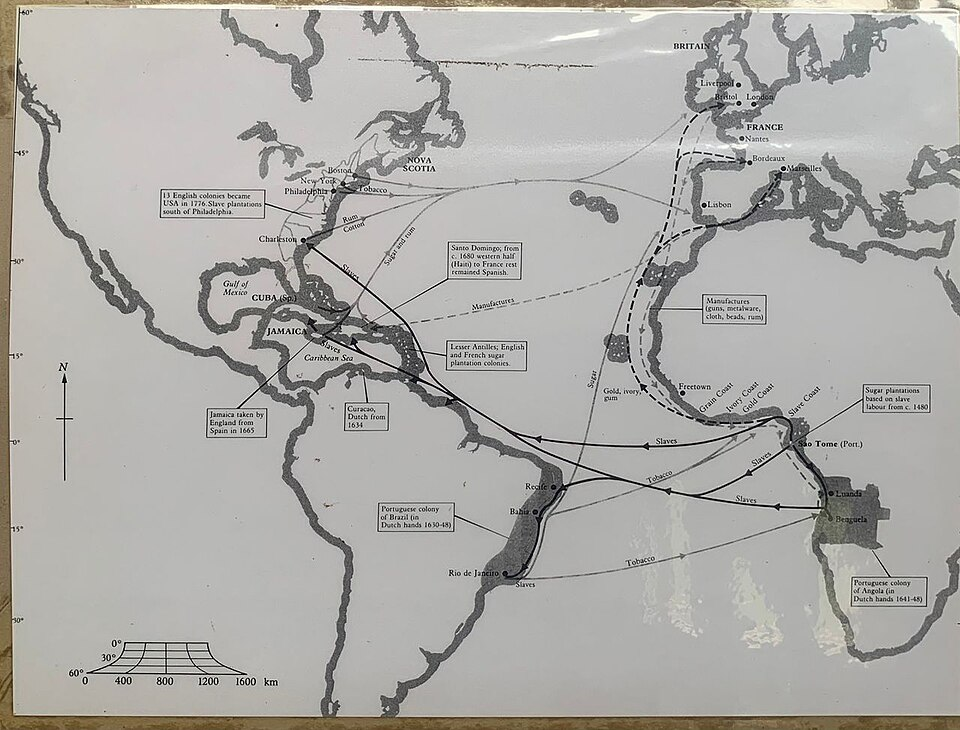
A map of the transatlantic slave trade illustrating triangular trade routes linking Europe, West Africa, and the Americas. Arrows depict the flow of manufactured goods, enslaved Africans, and plantation commodities across the Atlantic world. The map includes additional colonial regions beyond British America, but these details help contextualize the broader Atlantic system connected to early British American slavery. Source.
Key characteristics included:
Triangular trade routes connecting European manufactured goods, African captives, and American agricultural products
A rising demand for tobacco, rice, indigo, and later sugar, which heightened the need for labor
European and African merchant networks that sold captives to colonial planters
High mortality aboard Middle Passage voyages, which created constant demand for new imports
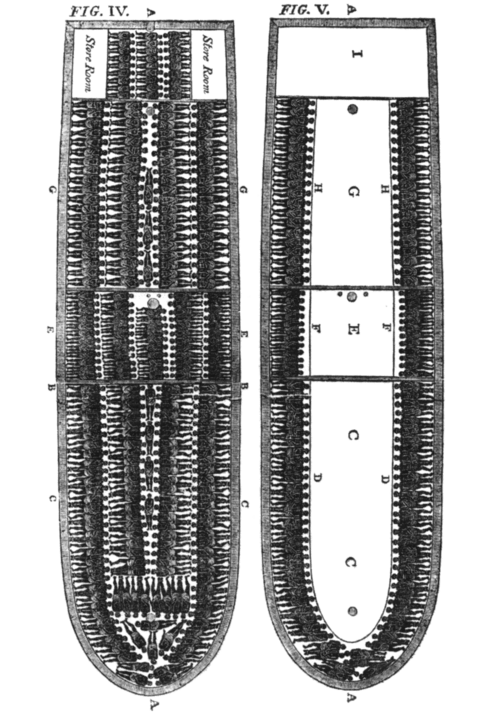
A British slave ship diagram showing the spatial organization of enslaved Africans forced into cramped decks during the Middle Passage. The structured arrangement of bodies reveals why disease and mortality were widespread on such voyages. Although the diagram originates from the late eighteenth century, it accurately represents shipboard practices established earlier in the colonial era. Source.
These exchanges ensured that English colonies were deeply embedded in Atlantic economic structures and dependent on forced African labor from an early stage.
Regional Variation in Slavery
The AP syllabus emphasizes that slavery in British America developed differently across colonies. Local conditions—particularly economics, demography, and geography—determined the nature and scale of enslaved labor.
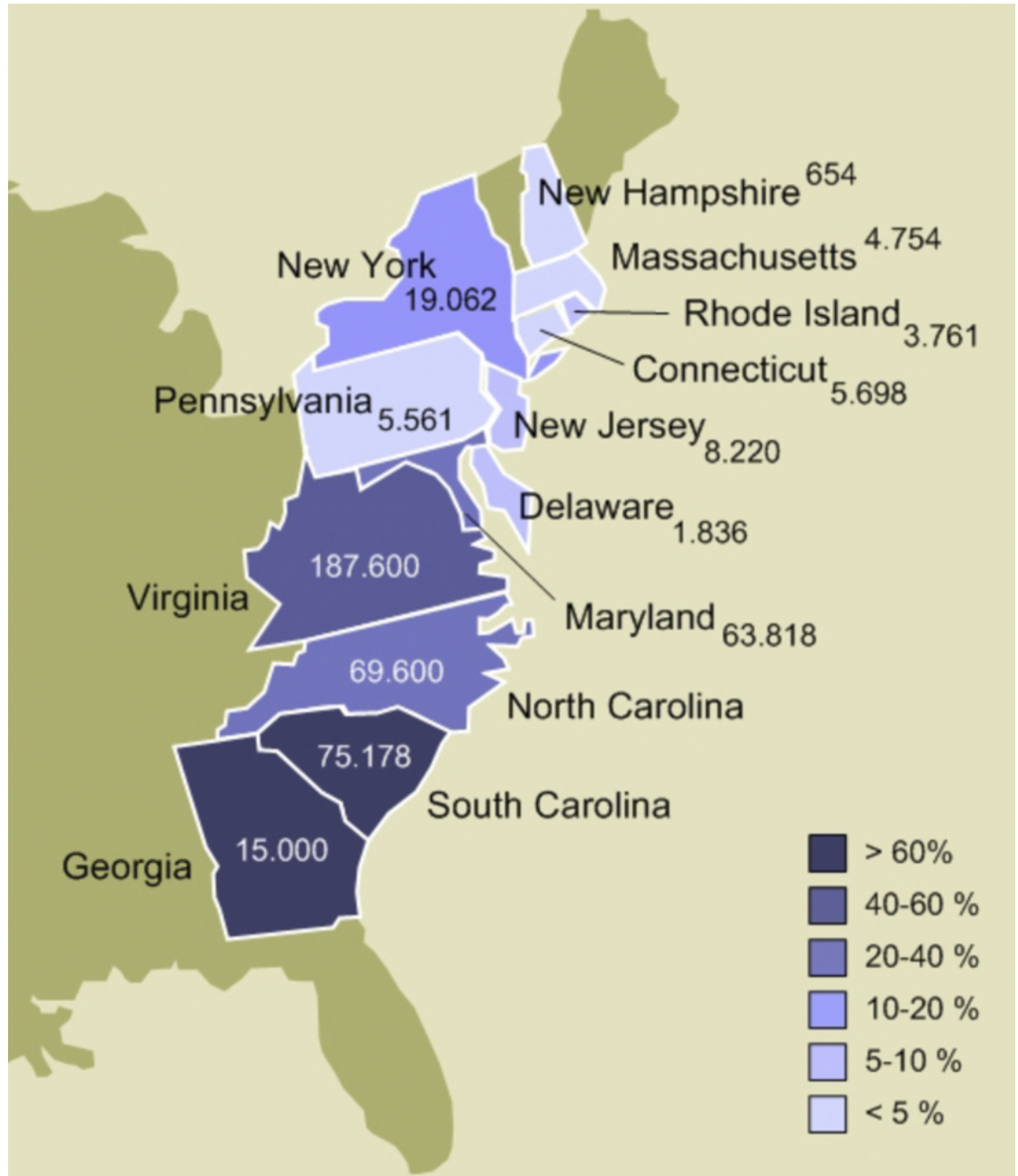
A map of the Thirteen Colonies in 1770 showing estimated numbers and percentages of enslaved people in each colony. Darker shading marks regions with higher concentrations of enslaved populations, especially in the Lower South. Although dated slightly after Period 2, the map reflects patterns established earlier in British America. Source.
The Chesapeake
The Chesapeake colonies (Virginia and Maryland) relied heavily on enslaved labor by the late 17th century as tobacco production expanded.
Key regional features:
Tobacco monoculture required intensive, year-round labor
Plantations varied in size, fostering both large estates and smaller farms
A growing enslaved population gradually reduced dependence on indentured servants
Population growth among enslaved people eventually allowed for family formation
This region represents the earliest large-scale shift toward a self-sustaining enslaved community in British North America.
The Lower South
The lower South (South Carolina and later Georgia) developed a distinct plantation system shaped by geography and African agricultural expertise.
Important characteristics:
Rice and indigo thrived in the region’s wetlands and subtropical climate
These crops demanded collective labor and specialized knowledge
Enslaved Africans from West and Central Africa contributed crucial expertise in rice cultivation
Low-lying, disease-prone environments led planters to adopt the task system, granting enslaved people limited autonomy after daily quotas were met
The lower South consequently developed some of the highest proportions of enslaved people in British America.
The Northern Colonies
Although slavery was less central to the economy of New England and the Middle Colonies, it still played an important role.
Distinctive features:
Smaller-scale slavery on farms, in shipyards, and in urban households
Enslaved people comprised significant minorities in port cities such as Boston, New York, and Philadelphia
Northern merchants profited heavily from the Atlantic economy, financing slave voyages and transporting plantation goods
While the scale differed, northern involvement linked the entire British colonial system to slavery’s expansion.
Economic and Demographic Drivers of Growth
The spread of slavery was closely tied to market forces and demographic pressures. Colonists increasingly saw enslaved Africans as:
A permanent, inheritable labor force
Less likely to escape successfully than Indigenous captives
Vital to high-value cash-crop production
Central to the rise of plantation capitalism, which enriched colonial elites
The legal doctrine of partus sequitur ventrem—the principle that a child’s status followed that of the mother—ensured hereditary slavery and provided economic incentives to enslavers.
Partus Sequitur Ventrem: A legal principle establishing that children of enslaved mothers were legally enslaved from birth.
This doctrine, combined with increasingly strict racial boundaries, made slavery perpetual and self-reinforcing across generations.
Social and Cultural Effects of Slavery
The entrenchment of slavery reshaped British American society:
Rigid racial hierarchies defined legal rights and social status
Planter elites consolidated wealth and political power
African cultural traditions—including language patterns, religious practices, and kinship structures—were maintained and adapted
Enslaved communities engaged in covert resistance, such as work slowdowns and cultural preservation, and overt resistance, including uprisings and escape
These dynamics created a society deeply influenced by African diasporic cultures even as colonial governments sought to suppress them.
Slavery’s Place in the British Empire
By the early 18th century, slavery was foundational to Britain’s imperial wealth.
Major imperial connections included:
Colonial exports that enriched British merchants
Tax revenues and customs duties fueling state power
Plantation profits reinvested in British manufacturing, banks, and shipping
The development of a racialized worldview that justified imperial expansion
Slavery thus became a defining feature of British colonial development, shaping economic structures and social relations across North America.
Practice Questions
(1–3 marks)
Explain one way in which the Atlantic slave trade shaped labour systems in early British America.
Question 1 (1–3 marks)
Award marks for the following:
1 mark for identifying a valid effect of the Atlantic slave trade on labour systems (e.g., growth of plantation labour, shift from indentured servitude).
1 mark for explaining how the availability of enslaved Africans contributed to that change (e.g., planters sought permanent, inheritable labour).
1 mark for adding specific historical detail (e.g., tobacco in the Chesapeake, plantation expansion, hereditary slavery laws).
(4–6 marks)
Assess the extent to which regional differences in British American colonies influenced the development of slavery between 1607 and 1754. Use specific evidence to support your answer.
Question 2 (4–6 marks)
Award marks for the following:
1–2 marks for describing regional differences (e.g., tobacco in the Chesapeake, rice in the Lower South, mixed economies in the North).
1–2 marks for explaining how these differences shaped slavery’s development (e.g., task system in South Carolina, smaller-scale urban slavery in the North, plantation concentration in the Chesapeake).
1–2 marks for accurate supporting evidence drawn from the period (e.g., African expertise in rice cultivation, population ratios in the Lower South, transition from indentured servants to enslaved labour).
FAQ
British demand for plantation goods such as tobacco, rice and sugar encouraged colonial planters to expand production, increasing reliance on enslaved labour.
Parliamentary policies that favoured imperial trade, including preferential duties and protective measures for colonial goods, made plantation exports profitable and sustained labour-intensive agriculture.
British investors, insurers and shipping companies financed slaving voyages, creating a commercial infrastructure that supported the continuous importation of enslaved Africans.
Colonists regarded Indigenous groups as difficult to control due to familiarity with the land, mobility and ongoing conflict.
Indentured servants became less reliable as labour sources once economic prospects in England improved, reducing migration.
Enslaved Africans provided a long-term, inheritable labour force, which planters increasingly preferred as agricultural demands rose.
In the Lower South, Africans from rice-growing regions carried expertise in irrigation, bund construction and field systems that planters adapted to Carolina rice cultivation.
Their agricultural knowledge enabled high yields in challenging environments, reinforcing the colony’s commitment to enslaved labour.
Cultural resilience also emerged in these regions, where shared languages and traditions supported community-building and continuity.
Port cities such as Boston, Newport and Philadelphia were hubs in the Atlantic commercial network.
Key contributions included:
Shipbuilding for slaving and merchant vessels
Warehousing of plantation goods
Financial services such as insurance, credit and auctioning of enslaved people
Urban households also used enslaved labour in skilled and domestic roles, embedding slavery into northern economic life.
Slave codes varied according to each colony’s economic priorities, population ratios and security concerns.
For example, South Carolina developed highly restrictive laws due to its large enslaved majority, emphasising surveillance and punishment.
In contrast, northern codes focused more on regulating mobility and labour, reflecting smaller enslaved populations.
These differing legal systems helped shape region-specific racial hierarchies and social structures.