AP Syllabus focus:
‘An Atlantic economy emerged where goods and enslaved people were exchanged among Europe, Africa, and the Americas through extensive trade networks, supplying commodities and new labor sources.’
The Atlantic economy linked Europe, Africa, and the Americas in expansive trade networks that transformed regional economies, reshaped labor systems, and stimulated commodity production essential to early British colonial development.
The Emergence of an Interconnected Atlantic Economy
The growth of the Atlantic economy in the seventeenth and eighteenth centuries created a dynamic commercial system uniting multiple continents through recurring exchanges of goods, labor, and capital. These networks reflected imperial ambitions and economic demands in Europe and its colonies, while also shaping demographic and cultural patterns throughout the Atlantic world. Colonists, European merchants, African political leaders, and Caribbean plantation owners all contributed to a commercial web increasingly defined by interdependence.
Defining the Atlantic World’s Trade Networks
The term Atlantic World refers to the interconnected regions bordering the Atlantic Ocean—Europe, West and Central Africa, the Caribbean, and the American mainland—that became linked by commerce, migration, and imperial rivalry. As economic relationships deepened, each region played specialized roles within trade systems that expanded the scope and scale of early modern globalization.
Atlantic World: A term describing the interconnected regions of Europe, Africa, and the Americas that were linked through trade, migration, and imperial expansion in the early modern era.
These linkages became especially pronounced as European powers sought wealth through commodities such as sugar, tobacco, and later rice and indigo, which required vast labor forces and encouraged increasingly sophisticated commercial networks.
Core Components of the Atlantic Economy
The Atlantic economy functioned through a set of routes and commercial relationships that facilitated production, transport, and exchange. Each region developed economic specializations that supported the larger system.
European Demand and Manufactured Goods
Europe served as the primary market for colonial goods and supplied the manufactured materials essential for sustaining colonial societies and African trade relations. European merchants financed voyages, organized shipping, and sold finished goods such as textiles, metal tools, firearms, and alcohol.
Key characteristics included:
Rising consumer demand for sugar, tobacco, and rum in Britain and continental Europe.
Investment capital from European financial centers supporting long-distance trade ventures.
Merchant networks connecting port cities like London, Bristol, and Liverpool to Africa and the Americas.
African Labor Systems and Enslavement
West and Central African societies became central to the Atlantic economy through the forced exportation of millions of enslaved people. African leaders and merchants participated in selective trading relationships, exchanging captives for European goods.
The exchange of enslaved labor formed the foundation of plantation systems across the Caribbean and mainland British America. Most captives were transported to Caribbean sugar colonies, but significant numbers arrived in the Chesapeake, Carolinas, and later the Lower South.
The Role of the Americas in Atlantic Trade
The American colonies produced agricultural staples and raw materials essential to imperial commerce. Their economic systems depended on reliable labor supplies and access to global markets.
Plantation Production and Export Markets
Plantation agriculture shaped the economy of British America’s southern colonies and the Caribbean. Large-scale production of staple crops generated wealth for planters and tax revenue for the empire.
Major exports included:
Sugar and molasses from the British West Indies
Tobacco from the Chesapeake
Rice and indigo from the Carolinas and Georgia
Furs, timber, and fish from northern colonies
Plantations relied heavily on enslaved Africans, whose labor supported high-demand commodities essential to European consumption.
Northern Colonies and Maritime Commercial Activity
New England and the Middle Colonies developed commercial economies tied to Atlantic trade. Their merchants conducted shipping operations, processed raw materials, and supplied agricultural products to plantation regions.
In these colonies:
Shipbuilding thrived due to abundant timber resources.
Merchants transported enslaved people, crops, and European goods along coastal and transatlantic routes.
Flour, fish, and livestock supported Caribbean plantations unable to produce their own food.
Patterns and Processes of Exchange
Trade operated within recurring cycles shaped by imperial priorities and regional needs. Although often described in simplified triangular form, real Atlantic trade was multidirectional and flexible.
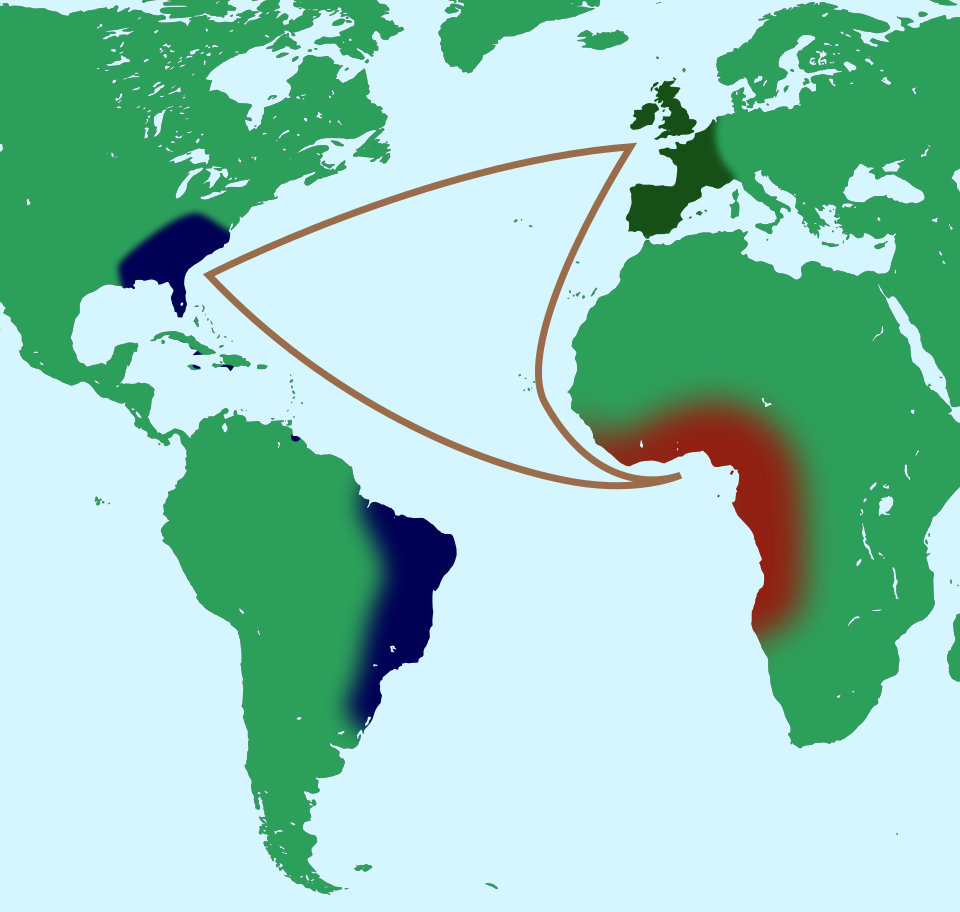
A simplified map of the triangular trade linking Europe, West Africa, and the Americas. Arrows show the broad movement of manufactured goods, enslaved Africans, and colonial commodities. The diagram highlights the essential structure of Atlantic exchange while omitting smaller regional routes. Source.
Key Processes in the Atlantic Network
Export of manufactured goods from Europe to Africa and the Americas
Forced migration of enslaved Africans primarily to Caribbean and South American plantations
Flow of colonial raw materials such as sugar, tobacco, and indigo back to European markets
Intercolonial trade that connected British North America with the Caribbean and West Africa
Regulatory frameworks, such as Navigation Acts, designed to channel profits to Britain
These processes reflected economic interdependence: colonies required European goods and enslaved labor, while Europe depended on colonial staples and revenues.
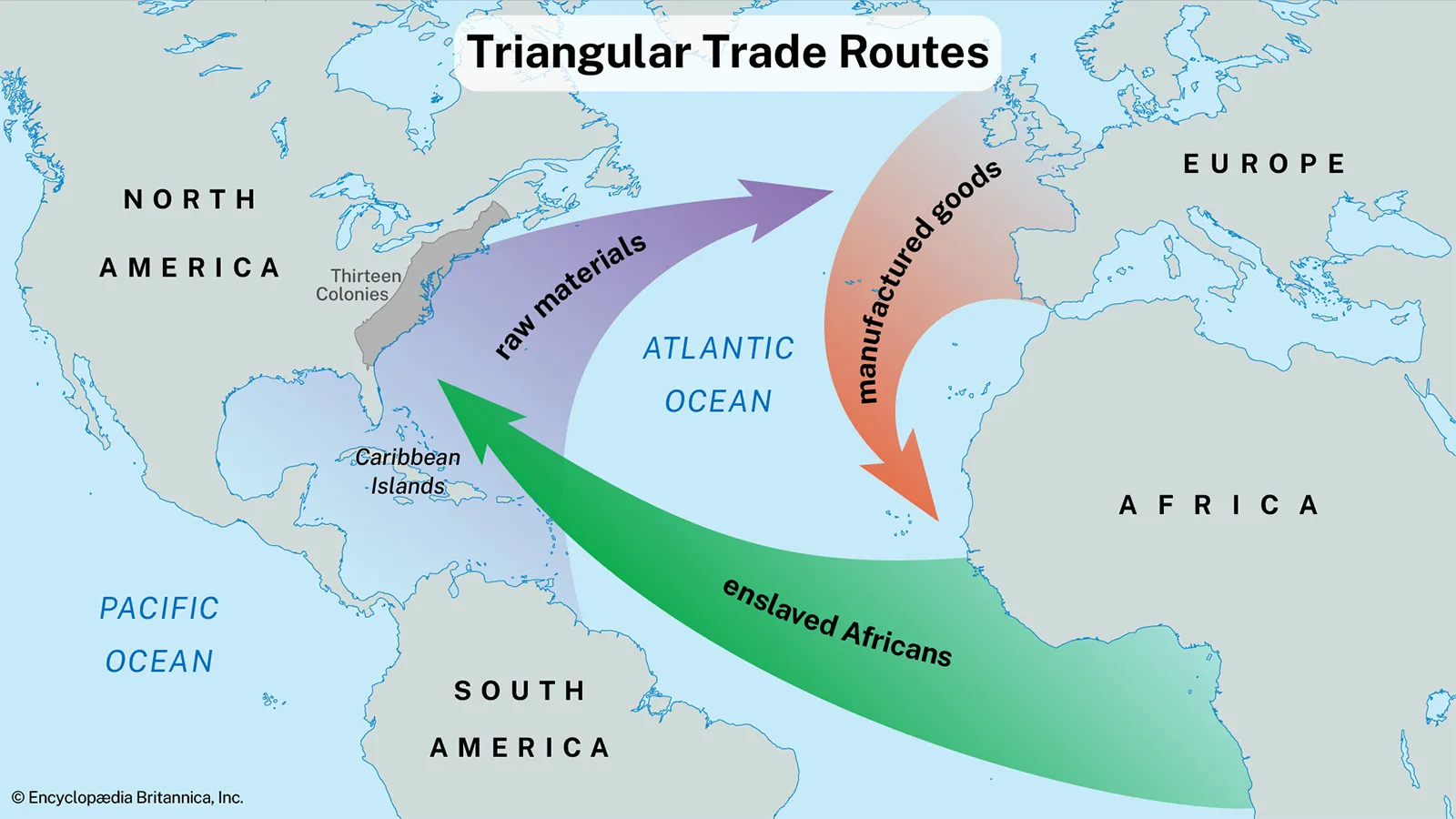
This map illustrates the major legs of the triangular trade. It shows the movement of raw materials, manufactured goods, and enslaved Africans across the Atlantic. The diagram simplifies numerous secondary routes to focus on the most significant flows discussed in the notes. Source.
Labor, Commodities, and Imperial Competition
The expansion of interconnected trade intensified European competition in the Americas. Control over profitable plantations, shipping routes, and trading posts shaped colonial policies and diplomatic strategies.
Imperial Goals and Economic Outcomes
Britain sought to integrate its colonies into a mercantilist system emphasizing controlled trade and the accumulation of wealth.
France, Spain, and the Netherlands established rival commercial networks that challenged British dominance.
Enslaved Africans and Indigenous populations bore the heaviest burdens of this economic expansion, facing displacement, coercion, and violence.
The Atlantic economy functioned through a set of routes and commercial relationships that facilitated production, transport, and exchange.
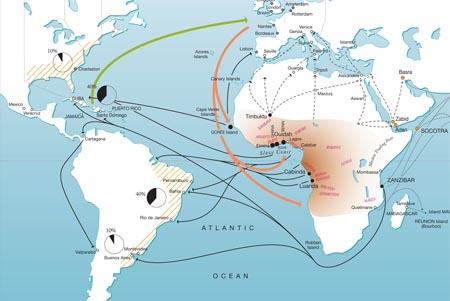
This map depicts the triangle trade alongside overlapping Atlantic routes, emphasizing the complexity of trade connections. It also traces the path of one enslaved person, a detail that exceeds the AP specification but clarifies the human dimension of forced migration. The arrows highlight how trade networks were dense and multidirectional rather than strictly triangular. Source.
FAQ
European merchants typically exported textiles, metal tools, firearms, gunpowder, and alcohol. These goods were produced in increasing quantities as European industries expanded.
In West and Central Africa, such items were valued because they reinforced political power, supported military competition, and fulfilled cultural and economic needs within existing trade systems.
In the Americas, these goods supplied colonial households, supported plantation operations, and sustained port economies that lacked advanced manufacturing capacity.
Port cities such as Boston, Newport, Philadelphia, and Charleston became commercial hubs due to increased shipping traffic, maritime services, and merchant activity.
Growth occurred through:
Expanded shipbuilding industries
Warehousing and processing of goods
The rise of merchant elites controlling transatlantic credit and trade flows
These cities also became points of cultural exchange, linking the colonies more directly to European political and economic developments.
Sugar commanded exceptionally high demand in Europe and yielded large profits relative to production costs.
Plantations ran year-round, creating a constant need for labour and generating continuous shipments of sugar, molasses, and rum.
Because of this scale and intensity, Caribbean colonies absorbed the largest share of enslaved Africans, shaping demographic patterns across the Atlantic world and reinforcing the commercial importance of plantation ports like Barbados and Jamaica.
Atlantic trade relied heavily on credit because voyages took months and payment often depended on the sale of goods far from their origin.
Merchants used:
Bills of exchange
Long-term credit agreements
Partnerships linking investors in different port cities
These mechanisms enabled traders to secure vessels, purchase goods, and pay crews before receiving returns, creating a financial infrastructure that tied colonial ports to London’s powerful banking networks.
Intercolonial trade allowed British North American colonies to exchange foodstuffs, timber, livestock, and finished goods with Caribbean plantations and other mainland settlements.
This supported the Atlantic economy by:
Providing essential supplies to sugar islands unable to grow their own food
Ensuring full ship cargoes on every leg of a voyage
Broadening commercial opportunities for colonial merchants
Such exchanges strengthened economic interdependence and helped sustain plantation societies that formed the backbone of Britain’s Atlantic commercial system.
Practice Questions
Question 1 (1–3 marks)
Identify one way in which the development of the Atlantic economy affected labour systems in the British American colonies during the seventeenth and eighteenth centuries.
Question 1
1 mark: Provides a basic but accurate identification of an effect on labour systems.
(Example: “It increased the use of enslaved African labour.”)
2 marks: Identifies a valid effect and offers a brief explanation.
(Example: “It led to a greater reliance on enslaved Africans because plantation crops like sugar and tobacco required a large labour force.”)
3 marks: Provides a clear and accurate effect with a well-developed explanation linking it directly to Atlantic economic activity.
(Example: “The Atlantic economy increased the demand for enslaved Africans, as the profitability of plantation crops like tobacco and sugar meant that British colonies turned increasingly to chattel slavery as a permanent, inheritable labour system.”)
Question 2 (4–6 marks)
Explain how the emergence of interconnected Atlantic trade networks shaped economic development in both Europe and the British American colonies. In your answer, refer to specific examples of the goods, labour systems, or trade relationships involved.
Question 2
4 marks: Gives a general explanation of the Atlantic economy’s impact on Europe and the colonies, with at least one specific example.
(Example: Mentions manufactured goods from Europe or colonial exports such as tobacco.)
5 marks: Provides a clear, structured explanation with multiple accurate examples, showing how interconnected trade shaped economic development in both regions.
(Example: Describes how European demand stimulated plantation expansion and how colonial raw materials supported European industries.)
6 marks: Demonstrates a thorough and well-supported explanation, making explicit connections between trade networks, labour systems, economic specialisation, and imperial interests. Uses multiple precise examples and shows a strong understanding of interdependence in the Atlantic system.
(Example: Explains how European manufactured goods supported African trading relationships; how enslaved labour enabled Caribbean and mainland plantation production; and how the flow of commodities such as sugar, rice, and tobacco shaped both Europe’s industrial growth and colonial economic structures.)