AP Syllabus focus:
‘Convention delegates compromised over slave-state representation in Congress and over federal regulation of slavery and the slave trade, allowing an end to the international trade after 1808.’
Delegates at the Constitutional Convention confronted disputes over slavery and political representation, forging compromises that balanced sectional interests and enabled agreement on a new framework.
Slavery, Representation, and the Search for Unity
The Constitutional Convention of 1787 revealed deep sectional divisions between Northern and Southern delegates. Southern states depended heavily on enslaved labor and feared that any new national government might restrict slavery or weaken their political influence. Northern delegates, while not uniformly antislavery, questioned the fairness of Southern states gaining additional representation and power from populations denied freedom and citizenship. These tensions made slavery central to debates about how to structure Congress and the scope of federal authority.
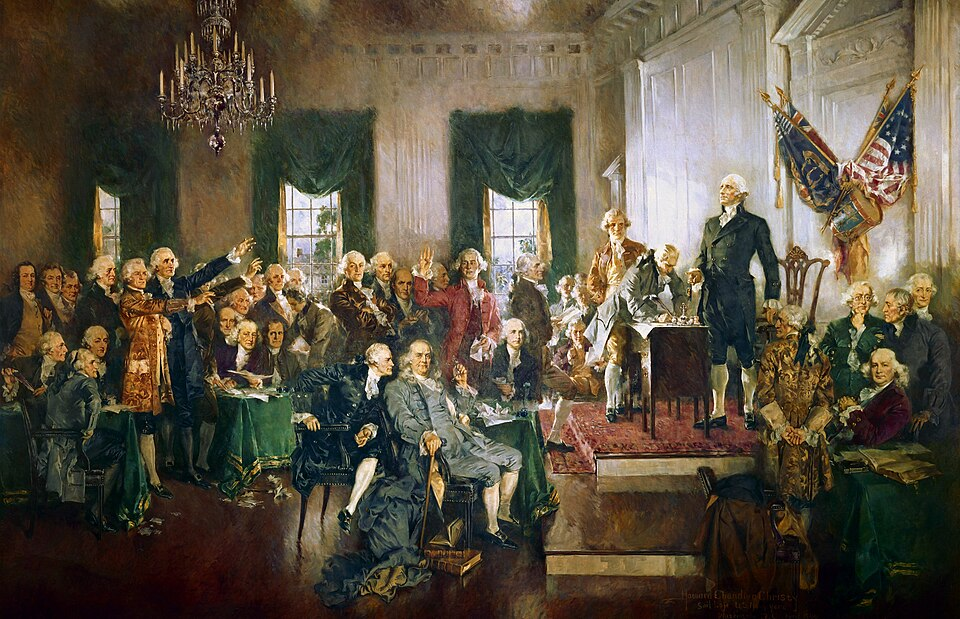
This painting portrays the delegates at the Constitutional Convention in Philadelphia, where central debates over slavery and representation shaped the resulting compromises. George Washington presides over the assembly, with key framers such as Benjamin Franklin and Alexander Hamilton visible among the delegates. The image includes additional historical detail not required by the syllabus but helps illustrate the setting in which the compromises were formed. Source.
To secure ratification and preserve the fragile union, delegates crafted compromises intended to balance these competing priorities. Their decisions shaped the political landscape of the early republic and set precedents that would endure until the Civil War.
Defining Enslaved People in Representation Debates
One of the most contentious questions involved the status of enslaved people in determining representation in the House of Representatives. Southern delegates insisted that the enslaved population—though denied political rights—should be counted fully to increase Southern influence. Northern delegates argued this was illogical and unjust, since enslaved people could not participate in government and were treated as property under Southern law.
The Three-Fifths Compromise
The eventual agreement, known as the Three-Fifths Compromise, counted three-fifths of each state’s enslaved population for purposes of representation and taxation. This compromise gave Southern states substantially more seats in the House and greater weight in the Electoral College than they would have had if only free populations were counted.
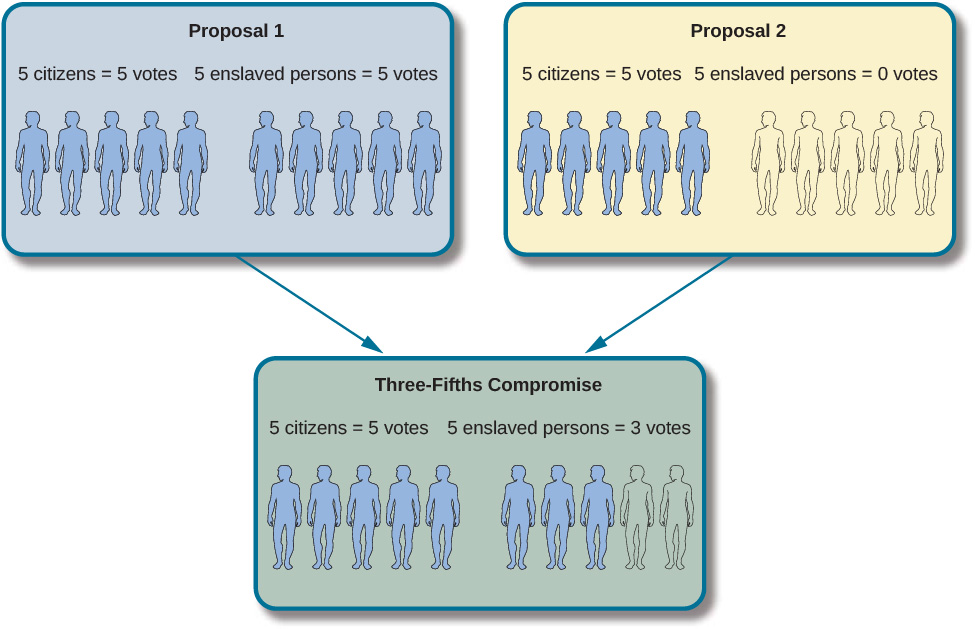
This diagram compares the two original proposals for counting enslaved people and illustrates how the Three-Fifths Compromise emerged as a political middle ground. It shows how each approach changed the population numbers used for representation, demonstrating why the compromise significantly boosted the political power of slaveholding states. The image adds no extra conceptual material beyond the numerical comparison already explained in the notes. Source.
Three-Fifths Compromise: A representation agreement in which three-fifths of a state’s enslaved population counted toward congressional representation and direct taxation.
This formula originated in earlier debates under the Articles of Confederation and reappeared at the Convention as a way to bridge sectional divides. The compromise did not settle the moral issue of slavery but instead embedded it into the political structure of the new republic.
Delegates understood that this representation system dramatically shaped national power. For decades, it contributed to Southern dominance in Congress and the presidency, influencing legislation and judicial appointments.
Federal Power and the Regulation of Slavery
Beyond representation, delegates disagreed about whether the federal government should have authority to regulate or restrict the slave trade and the institution of slavery itself. Many Northern delegates opposed the continuation of the Atlantic slave trade, arguing that it contradicted the emerging nation’s republican ideals. Southern delegates, especially from South Carolina and Georgia, insisted on safeguarding their ability to import enslaved laborers, claiming economic necessity.
The Commerce and Slave Trade Compromise
The result was a second major compromise: Congress received broad authority to regulate interstate and international commerce, but it was forbidden from abolishing the international slave trade before 1808. This agreement ensured Southern economic interests were protected for at least twenty years.
International Slave Trade (in constitutional context): The transatlantic importation of enslaved Africans, which the Constitution allowed to continue until 1808, after which Congress could prohibit it.
After 1808, Congress did indeed pass legislation to end the international trade, although domestic slave trading and the institution of slavery continued.
The compromise over the slave trade was paired with another concession: Congress could levy import duties on enslaved people, generating revenue while avoiding a direct challenge to slavery’s legality.
Representation, Taxation, and the Balance of Power
The intertwining of slavery and representation shaped every major political debate in the early republic. Because representation influenced taxation, military obligations, and political authority, the stakes were exceptionally high. The Three-Fifths Compromise validated the idea that enslaved populations could strengthen the political voice of slaveholders, creating an inherent imbalance in national politics.
Political Implications of the Compromises
These compromises had enduring consequences:
Expanded Southern political power by increasing representation in the House and Electoral College.
Influenced presidential elections, including those of Thomas Jefferson and James Madison, whose victories depended partly on representation from enslaved populations.
Shaped legislative outcomes, especially on issues involving slavery, tariffs, and western expansion.
Delayed confrontation over slavery by avoiding immediate federal regulation, but entrenched sectional tensions that grew in subsequent decades.
The Convention’s decisions demonstrated how pragmatic political considerations often outweighed ideological commitments. Delegates seeking unity prioritized forming a stable central government over resolving slavery’s contradictions.
Attempts to Balance Federalism and Sectionalism
The slavery and representation compromises reflected broader concerns about federalism and the distribution of power. Delegates aimed to create a strong national government while reassuring states—especially Southern states—that their internal institutions would remain primarily under local control. This balancing act preserved the union at a critical moment but institutionalized deep contradictions within the constitutional order.
These compromises ultimately illustrated the limits of Revolutionary ideals when confronted with entrenched economic interests and social hierarchies. The political structure they produced allowed the new Constitution to be ratified, but it did so by embedding slavery into the nation’s foundational framework, shaping American political development for generations.
Practice Questions
Question 1 (1–3 marks)
Explain one reason why the Three-Fifths Compromise was important to Southern delegates at the Constitutional Convention of 1787.
Mark scheme
1 mark: Identifies a basic reason (e.g., increased representation).
2 marks: Explains how the compromise increased Southern political influence in the House of Representatives or Electoral College.
3 marks: Provides a developed explanation linking Southern interests in slavery, representation, and the desire to maintain political power within the new national government.
Question 2 (4–6 marks)
Analyse how the disputes over slavery and representation shaped two major compromises made at the Constitutional Convention.
Mark scheme
1–2 marks: Describes the compromises with limited detail (e.g., Three-Fifths Compromise; agreement to permit the international slave trade until 1808).
3–4 marks: Offers clear explanation of how disagreements between Northern and Southern delegates led to these compromises, noting specific sectional concerns.
5–6 marks: Provides a well-developed analysis linking the disputes to the final constitutional arrangements, showing how these compromises balanced competing political and economic interests and influenced the structure of the new government.
FAQ
The compromise boosted the Electoral College votes of slaveholding states, making it easier for Southern-backed candidates to win national office.
This influence extended beyond Congress, shaping the political landscape by allowing Southern interests to dominate the executive branch during the early republic. Thomas Jefferson’s victory in 1800, for instance, was partly secured by electoral votes gained through counting enslaved populations.
Southern delegates, especially from South Carolina and Georgia, claimed their agricultural economies would collapse without continued importation of enslaved labourers.
They argued that restricting the trade would unfairly disadvantage their states compared with Northern commercial interests.
They also insisted that any strong national government must respect regional economic differences to maintain unity.
Yes. Some delegates objected to granting political power based on enslaved populations, arguing it contradicted republican ideals and rewarded states for denying basic rights.
Others feared it would entrench slavery by giving Southern states disproportionate influence in national policy, making future antislavery legislation harder to pass.
However, these objections were ultimately outweighed by the desire to reach a workable compromise.
The Three-Fifths Compromise applied not only to representation but also to direct taxation, meaning states with large enslaved populations would pay more in potential federal taxes.
Southern delegates accepted this because the political benefits in representation outweighed the financial costs.
Northern delegates saw it as a fair balance between population-based taxation and ensuring states benefitted proportionately from political power.
Delegates recognised that a direct challenge to slavery would fracture the Convention and risk the collapse of efforts to create a unified national government.
They believed the most urgent task was forming a functional federal system, even if this required postponing deeper moral conflicts.
Several delegates assumed—incorrectly—that slavery would gradually decline without direct intervention, making immediate confrontation unnecessary.