CIE Syllabus focus:
'Candidates should understand the effect on profit or loss and asset values when capital and revenue expenditure are treated incorrectly.'
Incorrectly classifying expenditure changes both reported performance and reported asset values. This can mislead owners and other users, so accountants must understand the exact effect of each error.
Why correct classification matters
Accounting must place expenditure in the correct category because the classification determines whether the cost is charged fully against the current year or carried forward as part of a non-current asset.
A wrong choice distorts both performance and financial position. It also affects comparisons between accounting periods.
Capital expenditure
Capital expenditure: Spending on acquiring, improving, or extending a non-current asset so that benefits are expected to last for more than one accounting period.
Capital expenditure is not treated as an immediate expense in full. Instead, it is included in the asset value and then charged to profit or loss over time as the asset is used.
Revenue expenditure
Revenue expenditure: Spending incurred for the day-to-day running, maintenance, or repair of a business asset, with benefit used up within the current accounting period.
Revenue expenditure belongs in profit or loss for the period because it helps earn current revenue rather than creating a lasting asset.
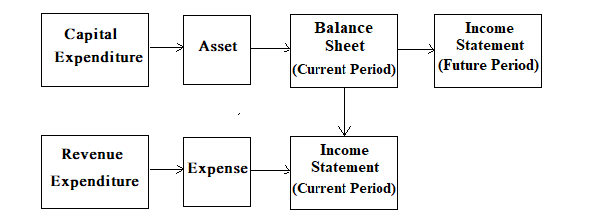
Diagram contrasting capital expenditure (costs recorded as an asset and allocated over time) with revenue expenditure (costs charged against the current period). It helps students connect classification to where the cost appears in the financial statements and why misclassification shifts profit and asset values. Source
Main effects of incorrect classification
The two possible mistakes are simple, but their effects are opposite. Either a capital item is wrongly treated as revenue, or a revenue item is wrongly treated as capital. In each case, both profit or loss and asset values are misstated.
Capital expenditure treated as revenue expenditure
If an item such as the purchase of equipment or an extension to premises is posted as an expense, the whole amount is charged immediately to profit or loss.
This causes:
Profit for the current year to be understated, because too much expense has been recognized at once.
Non-current assets to be understated, because the asset has not been included, or has been included at too low a value.
Total assets to be understated, so the statement of financial position looks weaker than it should.
There is also a timing effect across periods. Because the cost was written off too early, later periods may show higher profit than they should, as there will be no depreciation charge, or the depreciation charge will be based on too low an asset value.
Revenue expenditure treated as capital expenditure
If routine repairs, servicing, or maintenance are added to a non-current asset instead of being charged as an expense, the cost is carried forward incorrectly.
This causes:
Profit for the current year to be overstated, because an expense that should have been charged now has been removed from profit or loss.
Non-current assets to be overstated, because the asset includes costs that do not create additional long-term benefit.
The statement of financial position to appear stronger than it really is, since reported asset values are inflated.
If depreciation is charged on the capitalized amount, the current-year profit may still be overstated, but by less than the full error. The incorrect expense is then spread over future periods, so later profits may be understated as depreciation is charged on a value that should never have been capitalized.
Effect on profit or loss
The key idea is timing of expense recognition. Revenue expenditure should be matched against the period that benefits from it. Capital expenditure should be allocated over several periods because the asset provides future benefit.
When a capital item is expensed immediately:
the current period bears too much cost
current profit is too low
future periods bear too little cost
When a revenue item is capitalized:
the current period bears too little cost
current profit is too high
future periods may bear unnecessary depreciation charges
So, incorrect classification does not change the cash paid, but it changes when the cost affects reported profit.
Effect on asset values
Asset values should represent expenditure that properly forms part of a non-current asset. Only costs that acquire, improve, or extend the useful capacity of the asset should be included.
If capital expenditure is treated as revenue:
the asset may be omitted completely, or recorded at too low a value
the carrying amount of the asset is understated
If revenue expenditure is treated as capital:
the asset includes costs that should not remain in the books beyond the period
the carrying amount is overstated
This matters because users rely on asset figures to judge the size, strength, and stability of the business.
What to state in exam answers
When a question asks for the effect of incorrect classification, a strong answer should do two things clearly:
identify whether the item should have been capital or revenue
state whether profit and asset values are overstated or understated
If the question refers to later years, mention the effect of depreciation timing as well. Always focus on the direction of the error and the reason for it.
Practice Questions
State the effect on profit for the year and on non-current asset values when routine repair expenditure is incorrectly treated as capital expenditure. [2 marks]
Profit for the year overstated. (1)
Non-current asset values overstated. (1)
A business spent 18,000 on an extension to its warehouse. The accountant recorded the amount in repairs expense.
Required: State the effect of this error on: (a) profit for the year (b) non-current asset values
Explain your answers.
[4 marks]
The expenditure should be treated as capital expenditure, not revenue expenditure. (1)
Profit for the year understated. (1)
Reason: the full amount has been charged as an expense in the current year. (1)
Non-current asset values understated. (1)
FAQ
Yes. A single invoice may include a capital item and a revenue item together.
For example:
purchase of a machine
installation cost
first-year maintenance contract
The acquisition and installation may be capital, but the maintenance contract is usually revenue. If the whole invoice is posted to one account, part of it may be misclassified.
In practice, the accountant should split the invoice using the supplier’s breakdown or supporting documents.
The size of the amount is not the deciding factor. A very large cost can still be revenue if it only restores an asset to its original condition.
The key question is whether the expenditure:
maintains existing performance, or
improves, extends, or upgrades the asset beyond its original standard
If it only restores usefulness, it is usually revenue. If it creates extra future benefit, it is more likely to be capital.
No. In many cases it affects profit for the year but not gross profit.
That is because many capital or revenue classification errors involve:
repairs
maintenance
non-current asset costs
administrative or operating expenses
These are usually reported below gross profit.
Gross profit would be affected only if the misclassification entered cost of sales or inventory-related figures, which is less common for this topic.
The business must correct the wrong entry and record the item in the proper category.
This may involve:
removing the expense and creating or adjusting the asset
removing the wrongly capitalized amount from the asset
adjusting accumulated depreciation if relevant
In exam questions, the main focus is usually the effect on reported profit and asset values. In real accounts, the correction may also require prior-period adjustments, depending on reporting rules and materiality.
A business can reduce errors by setting a clear capitalization policy. This gives staff guidance on which types of spending should be treated as capital and which should be treated as revenue.
Useful controls include:
reviewing unusual or large invoices
requiring descriptions on purchase documentation
separating repairs from asset additions in coding systems
having senior staff approve asset account entries
Good internal guidance is especially important where similar-looking costs can have different treatments.