

CIE Syllabus focus:
'Candidates should prepare ledger accounts and journal entries for non-current asset acquisition, revaluation, depreciation and disposal, including part exchange.'
Non-current asset entries must show how an asset’s recorded amount changes over time. Accurate ledger postings keep the asset account, accumulated depreciation, and any profit or loss on disposal correctly stated.
Core ledger accounts used
Non-current assets are usually recorded through several linked accounts rather than one single entry. The main accounts are:
the non-current asset account, which records the asset at cost or revised valuation
the accumulated depreciation account or provision for depreciation account, which stores total depreciation charged to date
the disposal account, used when an asset is sold, scrapped, or traded in
the revaluation reserve, used when a revaluation gain is recognized
The carrying amount is the amount of the asset remaining after deducting depreciation already charged.
Carrying amount: The cost or valuation of a non-current asset less accumulated depreciation to date.
This figure is needed before any revaluation or disposal entry is recorded.
= Amount at which the asset is shown before further adjustment
= Original recorded amount of the asset
= Total depreciation charged to the asset to date
Acquisition of a non-current asset
When a business acquires a non-current asset, the asset account is debited because the business now controls an additional asset. The account credited depends on how the purchase is financed.
If paid immediately in cash or by bank:
Debit non-current asset account
Credit bank or cash
If bought on credit:
Debit non-current asset account
Credit payable or supplier
The amount debited should include the full cost of bringing the asset into use, such as delivery, installation, and other directly attributable costs. These costs form part of the acquisition entry rather than ordinary operating expenses.
A journal entry is often prepared first and then posted to the ledger accounts. The narration should clearly identify the asset acquired and the date of purchase.
Revaluation entries
If a non-current asset is revalued, the ledger entries must adjust the asset from its current carrying amount to the new valuation. In many accounting questions, any accumulated depreciation relating to that asset is first transferred out of the provision for depreciation account and back to the asset account. This leaves the asset account at carrying amount before the revaluation change is recorded.
When the revaluation is an increase:
Debit non-current asset account
Credit revaluation reserve
When the revaluation is a decrease:
Debit revaluation reserve, if there is an existing surplus relating to that asset
any remaining decrease is debited to profit or loss
Credit non-current asset account
The key point is that the ledger must show both the revised asset value and the correct reserve movement. Revaluation does not use the disposal account because the asset is still owned by the business.
Depreciation entries
Depreciation is recorded periodically to allocate the cost or valuation of the asset over its useful life. The usual ledger entry is:
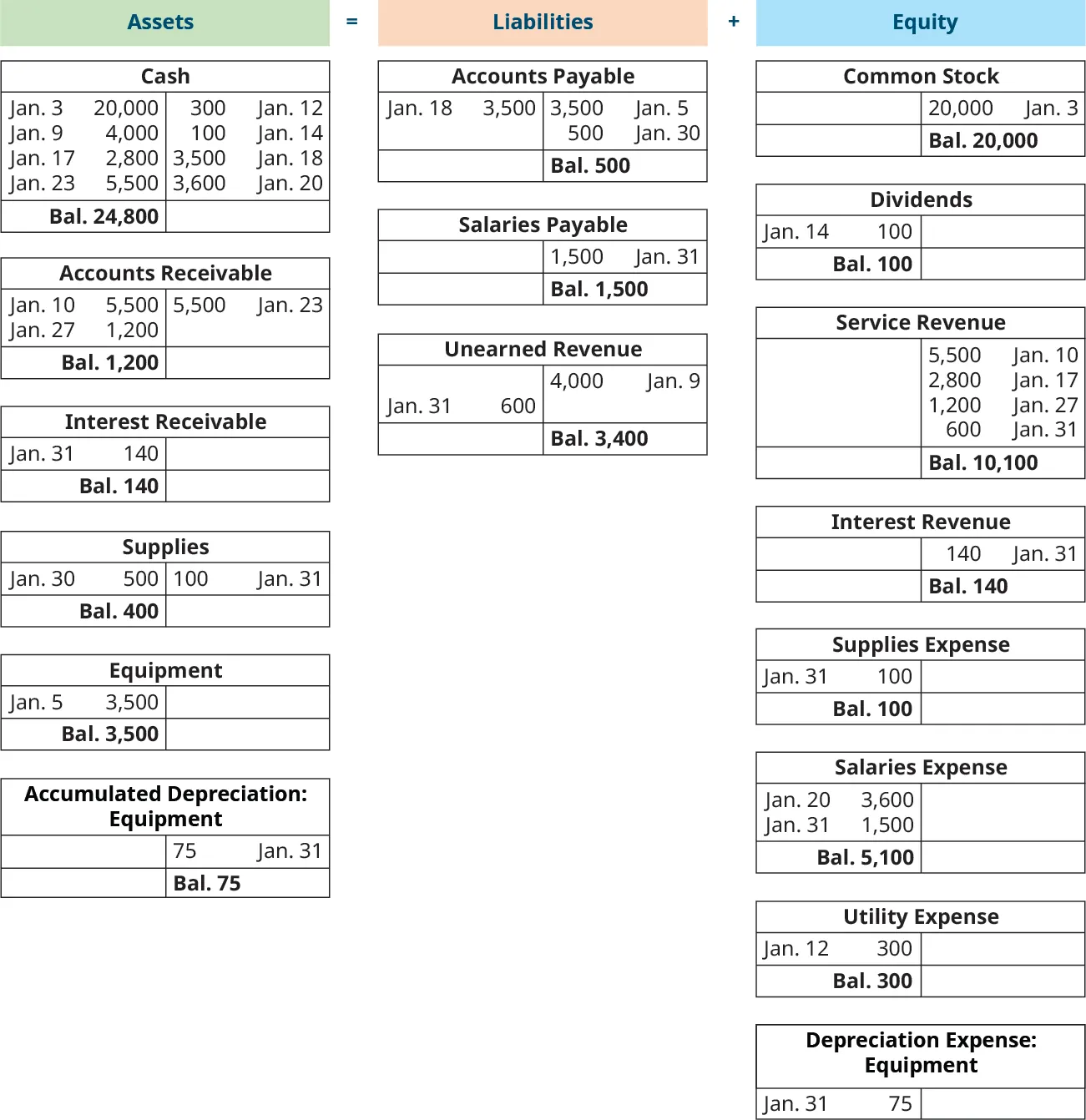
A worked example of journal entries posted into T-accounts, including a clearly labeled accumulated depreciation T-account. It illustrates the standard posting logic: depreciation expense is debited while accumulated depreciation is credited, increasing the contra-asset balance over time. This makes the separation between original cost and total depreciation charged easier to visualise. Source
Debit depreciation expense
Credit accumulated depreciation account
This keeps the original asset cost separate from the total depreciation charged to date. In exam questions, the account may be called provision for depreciation rather than accumulated depreciation, but the double entry is the same in principle.
Where a full journal is required, the journal entry records the depreciation charge for the period, and the ledger posting updates both the expense account and the relevant provision for depreciation account. The balance on the provision for depreciation account is then used when calculating carrying amount or preparing for disposal.
Disposal of a non-current asset
When a non-current asset is disposed of, several entries are needed because the business must remove both the asset’s recorded cost and its accumulated depreciation. A disposal account is commonly used to collect these entries and reveal the profit or loss.
Disposal account: A temporary ledger account used to determine the profit or loss when a non-current asset is disposed of.
The normal sequence is:
transfer the asset’s cost:
Debit disposal account
Credit non-current asset account
transfer the accumulated depreciation:
Debit accumulated depreciation account
Credit disposal account
record the proceeds received:
Debit bank, cash, or receivables
Credit disposal account
After these postings, the balance remaining on the disposal account is transferred:
credit balance on disposal account = profit on disposal
debit balance on disposal account = loss on disposal
To close the disposal account:
for a profit:
Debit disposal account
Credit profit on disposal or profit or loss
for a loss:
Debit profit or loss
Credit disposal account
The disposal account is therefore a working account that gathers all related entries before the final result is transferred.
Part exchange entries
A part exchange happens when an old asset is given in as part payment for a new asset. The accounting treatment combines an acquisition and a disposal.
The old asset is disposed of in the usual way through the disposal account. The amount allowed by the supplier for the old asset is treated as the proceeds of disposal, even though cash is not received directly.
The new asset must be recorded at its full cost, not just the cash difference paid. The entries usually include:
Debit new non-current asset account with the full price of the new asset
Credit bank or payable with the cash balance due
Credit disposal account with the part exchange allowance for the old asset
Any remaining balance on the disposal account is then transferred as a profit or loss on disposal. This ensures that the old asset is fully removed from the books and the new asset is recorded correctly.
Checks for accurate ledger postings
Common mistakes in this area include:
failing to transfer accumulated depreciation when an asset is disposed of
recording only the net cash paid in a part exchange instead of the full cost of the new asset
posting revaluation increases to profit or loss instead of the revaluation reserve
leaving a balance on the disposal account after the profit or loss entry has been made
using the wrong asset category account when several classes of non-current assets are maintained
Each ledger entry should remove or update the old balances completely, so the remaining accounts represent only assets still held by the business.
Practice Questions
State the journal entry to record annual depreciation on machinery when a provision for depreciation account is maintained. (2 marks)
Debit depreciation expense / income statement (1)
Credit provision for depreciation on machinery / accumulated depreciation (1)
A machine cost 48,000 and had accumulated depreciation of 30,000 at the date of disposal. It was sold for 20,000 cash. Prepare the ledger entries to record the disposal, including the transfer of the profit or loss on disposal. (5 marks)
Debit disposal account 48,000 and credit machinery account 48,000 (1)
Debit provision for depreciation / accumulated depreciation 30,000 and credit disposal account 30,000 (1)
Debit bank 20,000 and credit disposal account 20,000 (1)
Correctly identify profit on disposal of 2,000 (1)
Debit disposal account 2,000 and credit profit on disposal / profit or loss 2,000 (1)
FAQ
The ledger usually gives total balances for each asset class, but an asset register gives item-by-item detail.
This helps with:
serial numbers and locations
purchase dates and suppliers
depreciation history for each asset
revaluation and disposal tracking
physical verification and internal control
The register supports the ledger rather than replacing it.
Yes. An asset may be scrapped, donated, stolen, or removed with no sale proceeds.
The disposal entries are still needed to:
remove the asset’s cost
remove its accumulated depreciation
calculate any resulting loss
If there are no proceeds, there is simply no bank or receivables entry. The disposal account will then usually show a loss.
The carrying amount is an accounting figure, not necessarily the current market or trade-in value.
A supplier may offer:
a strong trade-in deal
a promotional allowance
a value linked to the purchase of the new asset
If the allowance exceeds carrying amount, this can create a profit on disposal. That does not automatically mean the records are wrong.
It is technically possible, but it is usually poor practice.
Separate disposal accounts are better because they:
make each profit or loss easier to identify
reduce the chance of mixing entries
improve checking and audit trail quality
help if assets are sold on different dates
In exam questions, a separate disposal account for each asset is normally the clearest approach.
The business should keep a clear history of:
original cost
accumulated depreciation before revaluation
revaluation date and amount
reserve created or reduced
final disposal details
This is important because later review may be needed to explain:
how the carrying amount was reached
whether a previous revaluation surplus existed
why the final profit or loss on disposal arose
Good documentation makes the ledger entries easier to verify.
