

CIE Syllabus focus:
'Candidates should understand how to measure the value of non-current assets using the cost model or the revaluation model.'
Non-current assets can be reported at historic cost or at an updated value. Understanding both models helps explain why businesses may show very different asset figures in their financial statements.
Measuring non-current assets
A business buys non-current assets for long-term use, not for resale. After purchase, the asset must still be shown in the statement of financial position at a value that is acceptable under accounting rules. The key figure used is the carrying amount, which is the amount remaining after the chosen measurement basis has been applied.
Carrying amount: The value at which a non-current asset is shown in the statement of financial position at a particular date.
The carrying amount matters because it affects total assets, depreciation charged in later periods, and the way users assess the business’s financial position.
The cost model
Under the cost model, an asset continues to be based on its original cost after it has been acquired. This is the most straightforward approach because the starting point is the amount actually paid, supported by invoices and other objective evidence.
Cost model: A method of measuring a non-current asset at cost less accumulated depreciation charged to date.
The cost model does not try to update the asset to current market value. Instead, it keeps the asset at historical cost and reduces that amount over time as the asset is used. This makes the model easy to apply and relatively objective. It is particularly useful where market values are difficult to estimate or where changes in value are not significant enough to justify revaluation.
The basic carrying amount under the cost model can be expressed as follows.
= value of the asset shown at the reporting date
= original purchase cost and directly attributable acquisition costs
= total depreciation charged up to that date
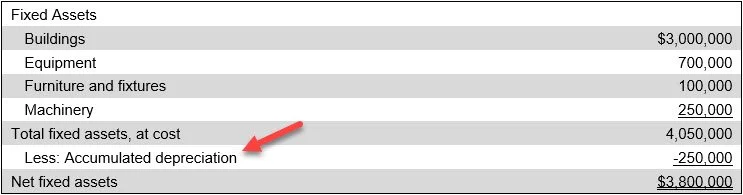
A balance sheet presentation showing fixed assets at cost, then “Less: Accumulated depreciation,” to arrive at net fixed assets (net book value/carrying amount). This is the standard layout that operationalizes the cost model’s idea that the reported amount declines as depreciation accumulates. Source
Because the cost model is based on historical transactions, it is usually seen as reliable and easy to verify. However, if prices change significantly over time, the carrying amount may become very different from the asset’s current value.
The revaluation model
Under the revaluation model, the asset is updated to a more current value instead of remaining at historical cost. This means the figure shown in the statement of financial position is intended to reflect the asset’s value at or close to the reporting date.
Revaluation model: A method of measuring a non-current asset at a revalued amount, with later depreciation based on that updated value.
The revaluation model is used when historical cost no longer gives a sufficiently relevant measure of value. This is often associated with assets such as land and buildings, where values may change considerably over time.
After an asset has been revalued, future depreciation is based on the revalued amount, not the original cost. As a result, later depreciation charges may rise or fall depending on the direction of the revaluation. The business must also review values regularly enough to keep the carrying amount reasonably close to current value. If revaluations are too infrequent, the reported figure can again become outdated.
A business should apply this policy consistently to a whole class of similar assets rather than revaluing only selected assets with favorable movements. Selective revaluation would reduce the fairness and comparability of the reported figures.
A revaluation may increase or decrease the carrying amount. An increase creates a revaluation surplus, usually recorded in equity rather than as normal operating profit. A decrease reduces the asset’s carrying amount and may reduce any existing revaluation surplus for that asset before affecting profit. The main point is that the asset is shown at a current measure, not at an old purchase price.
Comparing the two models
Why businesses use the cost model
The cost model is often preferred when simplicity and objectivity are important. Historical cost is based on actual transactions, so it is easier to support with documentary evidence. It also avoids the need for frequent professional valuations. For many assets, especially those that lose value steadily through use, businesses may regard this method as practical and sufficient.
Why businesses use the revaluation model
The revaluation model may provide more relevant information because it updates asset values to reflect current conditions. This can make the statement of financial position more meaningful where asset values change substantially over time. Users may get a better view of the resources controlled by the business, particularly when older historical costs no longer represent economic reality.
Limits of each model
Neither model is perfect. The cost model may understate assets when prices have risen significantly. This can make the business appear less asset-rich than it really is. The revaluation model can improve relevance, but it introduces judgment. Current values may depend on estimates, market evidence, or expert opinion, so the figures may be less certain than historical cost.
Revaluation can also reduce comparability if businesses do not revalue with similar frequency or if reliable market values are difficult to obtain. For this reason, the revaluation model works best where a realistic current value can be determined with reasonable confidence.
Effects on financial reporting
Choosing between the two models affects more than a single figure in the statement of financial position. It can change:
the reported value of non-current assets
future depreciation charges
total equity, if a revaluation surplus arises
ratios that use asset values or capital employed
This is why the choice of model can alter users’ interpretation even when the same physical asset is being used by the business.
Practice Questions
State one difference between the cost model and the revaluation model when measuring a non-current asset. (2 marks)
1 mark for stating that the cost model keeps the asset at original or historic cost less depreciation.
1 mark for stating that the revaluation model updates the asset to a current or revalued amount.
A business bought land many years ago. Its market value has risen substantially since purchase.
Explain why the revaluation model may provide more useful information than the cost model for this asset. State one limitation of using the revaluation model. (5 marks)
1 mark for explaining that the revaluation model updates the asset to a current or more recent value.
1 mark for explaining that the cost model may now be outdated or understate the land value.
1 mark for explaining that users receive a more realistic statement of financial position.
1 mark for explaining that total assets or equity may be shown more fairly.
1 mark for one valid limitation, such as valuation being subjective, costly, or needing regular review.
FAQ
Usually no.
A revaluation reserve comes from an unrealized gain, not from trading profit or cash generated by operations. Because of that, it is normally treated as part of equity that is not available for ordinary dividend distribution.
This helps prevent a business from paying out amounts that have not actually been realized in cash.
Land and buildings are often easier to value because:
there may be active property markets
professional valuers can compare similar properties
values may rise significantly over time
Machinery and vehicles are often more specialized and lose value through use, making historic cost less misleading and revaluation less worthwhile.
The revaluation model becomes harder to apply reliably.
In that situation, the business may need a professional valuation based on estimates rather than direct market prices. If the estimate is not reliable enough, the cost model may be more appropriate because it is based on objective historical evidence.
No.
A revaluation is an accounting adjustment, not a cash transaction. The business does not receive money simply because the carrying amount rises.
However, a stronger statement of financial position may influence lenders’ views or borrowing capacity, even though cash itself has not increased.
Yes.
If an asset is revalued upward, later depreciation is usually based on the higher amount. That can increase annual depreciation expense and reduce reported profit in future periods.
So, even though the asset value rises, the profit figure after revaluation may become lower than before.
