

CIE Syllabus focus:
'Candidates should calculate depreciation using the reducing balance and straight-line methods and select the most appropriate method.'
These notes explain how to calculate depreciation using the two examinable methods and how to judge which method best matches the way a non-current asset is used.
Straight-line method
Straight-line depreciation is often used when an asset is expected to provide benefits evenly over its useful life.
Straight-line depreciation: A method that charges an equal amount of depreciation to each accounting period over the asset's useful life.
The annual charge is found by taking the depreciable amount, which is cost less residual value, and spreading it evenly over the estimated life of the asset.
= Annual depreciation charge
= Cost of the non-current asset
= Estimated residual value
= Estimated useful life in years
Under this method:
the same amount of depreciation is charged each full year, if estimates do not change
accumulated depreciation increases by equal amounts
the asset's net book value falls steadily until it reaches residual value
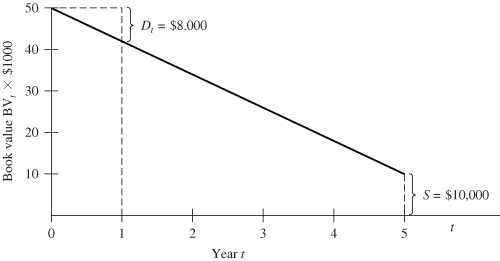
This graph shows straight-line depreciation as a constant, linear fall in book (net book) value over time. The straight line indicates the asset loses the same amount of value each year, reaching the salvage/residual value at the end of its useful life. Source
This method is easy to apply and makes comparisons between accounting periods more straightforward. It is usually suitable where the asset is used at a fairly even rate throughout its life. If the pattern of benefit is stable, a constant annual charge gives a fair representation of asset usage.
Reducing balance method
Reducing balance depreciation applies a fixed rate each year to the asset's net book value at the beginning of the year.
Reducing balance depreciation: A method that charges depreciation at a fixed rate on the net book value of an asset, causing the annual charge to decrease over time.
Because the net book value becomes lower after each year's depreciation, the annual expense also becomes lower from year to year.
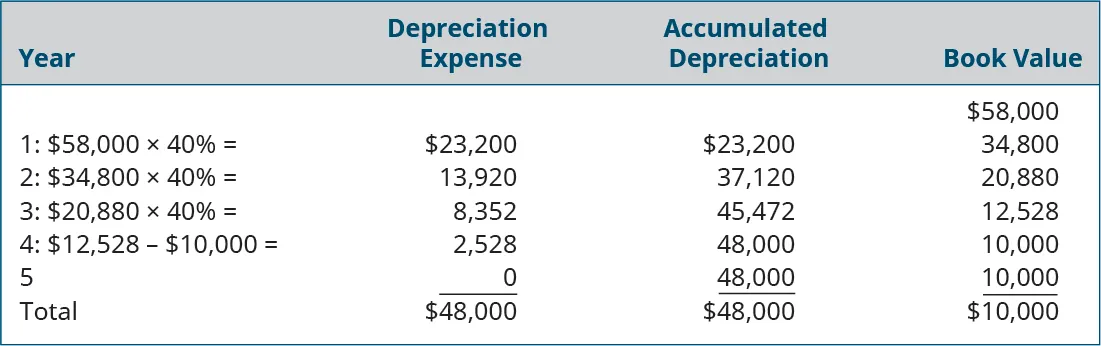
This schedule table shows a declining-balance pattern where depreciation expense is highest in the first year and then decreases as the book value falls. It visually connects the idea that each year’s charge is calculated using a percentage applied to the opening book value, so the base becomes smaller over time. Source
= Depreciation charge for the year
= Annual depreciation rate as a decimal
= Net book value at the beginning of the year
Under this method:
the highest depreciation charge is made in the early years
later years have a smaller charge
the asset's net book value falls more quickly at first and then more slowly
This method is often appropriate for assets that lose value quickly after purchase or generate greater benefit in earlier years. It may also suit assets where repairs and maintenance tend to rise as the asset gets older, because the falling depreciation charge can offset increasing operating costs.
Comparing the two methods
Pattern of depreciation charge
The main difference is the pattern of depreciation over time.
Straight-line gives a constant annual amount.
Reducing balance gives a decreasing annual amount.
This difference affects reported profit. For the same asset, the reducing balance method usually results in a larger expense in early years and a smaller expense in later years. Straight-line produces a more even effect on profit from year to year.
Effect on net book value
The method chosen also affects the value shown for the asset in the statement of financial position.
With straight-line, net book value decreases by equal amounts each year.
With reducing balance, net book value decreases rapidly at first, then more gradually.
In examination questions, it is important to update the net book value correctly after each year's depreciation. A reducing balance calculation must always be based on the opening net book value, not the original cost, unless the question states otherwise.
Selecting the most appropriate method
The most appropriate method is the one that best reflects how the asset's economic benefits are consumed. The decision should be based on the nature of the asset and the way it is expected to be used.
Straight-line is usually more suitable when:
the asset is expected to be used evenly over time
its efficiency stays relatively stable
the benefit received each year is broadly similar
Examples may include some items of office furniture, fittings, or assets used consistently over many years.
Reducing balance is usually more suitable when:
the asset is most efficient when new
it loses value quickly in the early years
the benefit received from the asset is higher at the start of its life
Examples may include vehicles, computers, and some machinery that become outdated or less efficient fairly quickly.
The choice of method should not be made simply to produce a preferred profit figure. In accounting, the method should reflect the expected pattern of use of the asset.
Common calculation points
Straight-line steps
identify the cost
deduct the residual value
divide by the useful life
charge the same annual amount for each full year
Reducing balance steps
start with the opening net book value
apply the fixed depreciation rate
deduct the depreciation charge
carry the closing net book value forward to the next year
Common errors include:
using original cost instead of net book value for reducing balance
ignoring a stated residual value in straight-line calculations
confusing a fixed amount with a fixed rate
failing to base each new year's reducing balance calculation on the updated carrying amount
Clear presentation matters. Candidates should show each year's depreciation charge separately and distinguish carefully between cost, accumulated depreciation, and net book value.
Practice Questions
An asset cost 24,000 and has an estimated residual value of 4,000. Its useful life is 5 years.
Calculate the annual depreciation charge using the straight-line method. (2 marks)
Correct method: = 1 mark
Correct answer: 4,000 = 1 mark
A computer system was purchased for 40,000 on January 1. It is depreciated at 25% per year using the reducing balance method.
(a) Calculate the depreciation charge for Year 1 and Year 2. (4 marks)
(b) State one reason why the reducing balance method may be more appropriate than the straight-line method for this asset. (2 marks)
(6 marks)
(a)
Year 1 depreciation: = 1 mark
Year 1 net book value: 30,000 = 1 mark
Year 2 depreciation: = 1 mark
Year 2 net book value: 22,500 = 1 mark
(b)
States that computers often lose value quickly in early years = 1 mark
Or states that computers give greater benefit when new / become obsolete quickly = 1 mark
One developed reason can earn 2 marks
FAQ
A business usually charges depreciation only for the period the asset was owned during that accounting year.
This means the full-year depreciation is time-apportioned. For example:
12 months owned = full year's charge
6 months owned = half of the annual charge
The exact approach depends on the business policy or the instruction in the question.
Yes, if the new method gives a more reliable measure of how the asset's benefits are being used.
A change should not be made just to improve reported profit. It should be based on better information about the asset's actual pattern of use.
In practice, such a change is treated carefully because consistency is important in accounting.
Because the same percentage is applied to a continuously decreasing net book value.
Each year, the amount becomes smaller, so the asset's value approaches zero gradually rather than reaching it exactly. In practice, businesses may:
stop depreciation at a small residual amount
use an estimated residual value
adjust the final year if needed
The rate is usually based on judgment about how quickly the asset is expected to lose value or usefulness.
A business may consider:
expected wear and tear
risk of obsolescence
past experience with similar assets
manufacturer information
industry practice
There is no single correct rate unless the question provides one.
Depreciation for future periods is revised using the new estimate.
Past depreciation is not usually rewritten. Instead, the remaining net book value is spread over the revised remaining life, or the new residual value is taken into account from that point onward.
This means later depreciation charges may increase or decrease.
