

CIE Syllabus focus:
'Candidates should calculate profit or loss on disposal and record the effect of depreciation charges in the financial statements.'
When a non-current asset is sold, scrapped, or otherwise removed from use, the accounts must show the disposal result and the correct depreciation charge for the period owned.
Understanding asset disposal
An asset disposal happens when a business no longer keeps a non-current asset as part of its operations. Common disposals include a sale for cash or the asset being scrapped with little or no value. The key accounting point is that the asset must be removed from the records at the date of disposal.
Before the profit or loss on disposal can be found, the business must know the asset’s value at that date. This means depreciation should be charged up to the disposal date if it has not already been recorded for the current accounting period.
Key amounts
The most important figure is the carrying amount.
Carrying amount: The value of a non-current asset at a given date, calculated as cost less accumulated depreciation.
The carrying amount is sometimes called the net book value.
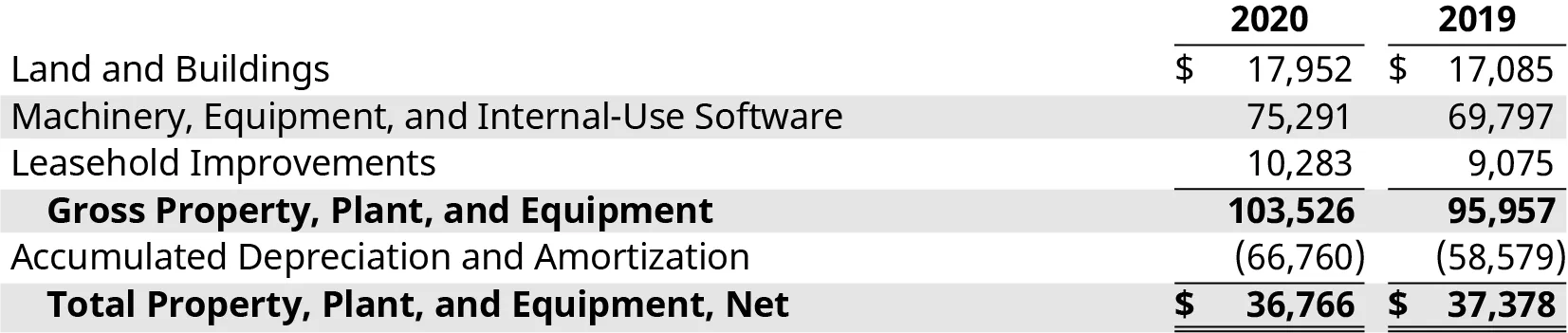
Extract-style illustration of Property, Plant and Equipment reported as gross cost less accumulated depreciation to arrive at the net (carrying) amount. It reinforces that and connects the calculation to how non-current assets are presented in the statement of financial position. Source
It is the amount that remains in the statement of financial position immediately before the asset is disposed of.
Another key figure is the disposal proceeds, which is the value received when the asset is sold or otherwise given up. This may be cash, a bank receipt, or another agreed value. If the asset is scrapped, the proceeds may be zero.
Calculating profit or loss on disposal
A business makes a profit on disposal when the disposal proceeds are greater than the carrying amount. It makes a loss on disposal when the disposal proceeds are less than the carrying amount. If both figures are equal, there is no profit or loss.
= Amount recognized in the statement of profit or loss
= Value received on disposal
= Cost less accumulated depreciation at disposal date
This calculation shows why sale proceeds alone do not determine whether a disposal is favorable. A business may receive a relatively small amount of cash and still make a profit if the asset’s carrying amount has become even lower.
Essential sequence
To calculate the result on disposal correctly, follow this order:
identify the asset’s cost
find the accumulated depreciation up to the disposal date
calculate the carrying amount
identify the disposal proceeds
compare proceeds with carrying amount
recognize the resulting profit or loss
The depreciation charge up to the date of disposal is especially important. If it is omitted, the carrying amount will be too high, which may understate a profit or overstate a loss on disposal.
Effect of depreciation charges in the financial statements
Depreciation is charged for the period during which the business used the asset. If the asset is disposed of during the year, the depreciation charge should usually cover only the time from the start of the accounting period, or from acquisition, to the disposal date.
In the statement of profit or loss, the depreciation charge:

Journal-entry diagram showing depreciation recorded as a debit to Depreciation Expense and a credit to Accumulated Depreciation (a contra-asset). This makes the financial statement effect explicit: profit for the period falls (expense), while the asset’s carrying amount falls through higher accumulated depreciation. Source
appears as an expense
reduces the profit for the year
is recognized even though it does not involve a current cash payment
The charge for depreciation is separate from the profit or loss on disposal. These are related, but they are not the same item:
depreciation allocates the cost of using the asset over time
profit or loss on disposal arises when the asset leaves the business and its carrying amount is compared with the value received
A common mistake is to treat disposal proceeds as ordinary trading revenue. For most businesses, the proceeds from selling a non-current asset are not part of normal revenue from sales of goods or services. Instead, the business records a separate profit or loss on disposal.
Presentation after disposal
The disposal affects the statement of financial position as well as the statement of profit or loss.
After disposal:
the asset’s cost should no longer appear under non-current assets
the related accumulated depreciation should also be removed
the asset’s carrying amount disappears from non-current assets
the amount received will appear as an increase in cash, bank, or sometimes a receivable
The profit or loss on disposal does not appear as a separate non-current asset or liability. Instead, it affects the period’s profit, and this then affects the owner’s capital, partnership equity, or company reserves through retained earnings or equivalent closing balances.
Depreciation also has a statement of financial position effect. Each depreciation charge reduces the carrying amount of non-current assets. Therefore, if the final depreciation charge before disposal is omitted, non-current assets will be overstated immediately before the asset is removed from the books.
Common errors to avoid
Several examination errors occur repeatedly in disposal questions:
using original cost instead of carrying amount when finding the profit or loss
forgetting to record depreciation up to the disposal date
continuing to charge depreciation after the date of disposal
leaving the disposed asset in non-current assets at year-end
treating the sale proceeds as the profit on disposal
showing the full year’s depreciation when the asset was owned for only part of the year
It is also important to keep the logic clear. Depreciation affects the disposal result because it changes the carrying amount. The disposal result then affects profit for the year. If both are recorded properly, the financial statements show:
the correct expense for using the asset during the period
the correct gain or loss from giving up the asset
the correct closing value of non-current assets
Practice Questions
State how to determine whether the disposal of a non-current asset results in a profit or a loss. (2 marks)
1 mark for stating that disposal proceeds are compared with the carrying amount or net book value.
1 mark for stating that proceeds greater than carrying amount give a profit, while proceeds less than carrying amount give a loss.
A machine cost . At 1 January, accumulated depreciation on the machine was . The machine was sold on 30 June for cash. Depreciation of for the period to the date of disposal had not yet been recorded.
Required: (a) Calculate the carrying amount of the machine at the date of disposal. (2 marks) (b) Calculate the profit or loss on disposal. (2 marks) (c) State two effects of recording the depreciation charge and the disposal on the financial statements. (2 marks)
(6 marks)
(a)
1 mark for updated accumulated depreciation of .
1 mark for carrying amount of .
(b)
1 mark for correct comparison of proceeds with carrying amount.
1 mark for loss on disposal of .
(c) Award 1 mark each for any two valid points, up to 2 marks:
depreciation expense of is charged in the statement of profit or loss
profit for the year decreases because of the depreciation charge
loss on disposal of is shown in the statement of profit or loss
the machine is removed from non-current assets in the statement of financial position
cash increases by
FAQ
The disposal is usually recognized when the asset is given up, not when all the cash is collected.
At that date:
the full agreed disposal value is used to calculate profit or loss on disposal
any unpaid amount is recorded as a receivable
later cash receipts reduce that receivable
If part of the amount later becomes irrecoverable, that is a separate issue from the original disposal result.
A fully depreciated asset has a carrying amount of zero.
If the business then sells it for any amount above zero, the whole amount received becomes a profit on disposal because:
$Carrying\ amount = 0$
$Disposal\ proceeds > 0$
This does not mean the asset was not useful. It simply means its cost had already been fully allocated through depreciation before it was sold.
If an asset is destroyed, the business still needs to remove it from non-current assets.
The amount used as disposal proceeds may include the insurance compensation receivable. The business then compares that amount with the carrying amount to find the profit or loss on disposal.
If the insurance claim is uncertain, the accountant must be careful not to overstate what will be received.
Profit on disposal can make a year’s profit look stronger even though it may be a one-time event.
Analysts often review it separately because:
it may not come from normal trading activity
it may not happen regularly
it can hide weaker operating performance
This helps users judge whether profit was earned mainly from day-to-day business operations or from selling assets.
The disposal result depends on the carrying amount, not just the selling price.
Two businesses may have different carrying amounts because of:
different depreciation methods
different estimates of useful life
different residual value estimates
different dates of purchase
different levels of accumulated depreciation at disposal date
So even if both businesses receive the same proceeds, one may report a profit while the other reports a loss.
