CIE Syllabus focus:
'Candidates should understand factors causing non-current assets to depreciate and the purpose of accounting for depreciation using relevant concepts.'
Depreciation is a core accounting idea because many non-current assets lose usefulness over time. Businesses must recognize this loss so profit and asset values are reported more fairly.
What depreciation means
A business buys many non-current assets to help earn revenue over several accounting periods. These assets are not normally used up immediately, but their ability to generate future benefits usually decreases as they are used or as time passes.
Depreciation: The systematic allocation of the depreciable amount of a non-current asset over its useful life.
This means depreciation is an expense for the period, not a sudden write-off of the whole cost when the asset is purchased.

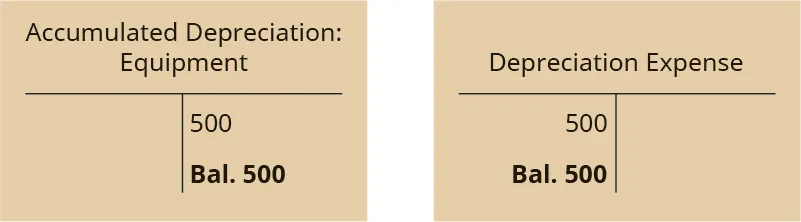
Adjusting entry for depreciation (Dr Depreciation Expense, Cr Accumulated Depreciation) alongside T-accounts showing the resulting debit balance for the expense and credit balance for the contra-asset. This visual reinforces how depreciation reduces profit for the period while accumulated depreciation reduces the asset’s carrying amount on the statement of financial position (without changing the asset’s original cost figure). Source
It is also not simply a measure of market price changes. In accounting, the focus is on how much of the asset’s service potential has been used up during the period.
Main causes of depreciation
Depreciation happens because most non-current assets do not last forever. Their value to the business falls as their economic usefulness is gradually consumed.
Physical deterioration
Many assets depreciate because of wear and tear. Machinery, motor vehicles, fixtures, and equipment become less efficient or less reliable after repeated use. Parts may wear out, performance may decline, and repair costs may rise.
Physical deterioration may be caused by:
continuous use in production
heavy workloads or long operating hours
exposure to weather, rust, damp, or damage
poor maintenance
Even when an asset is maintained carefully, use over time usually reduces its remaining useful life.
Passage of time
Some assets lose value mainly because time passes, even if they are not heavily used. A lease, patent, or license may have a fixed legal life. As the end of that period gets closer, the future benefit available to the business becomes smaller.
This shows that depreciation is not always linked only to physical damage. An asset can decline in usefulness simply because the period during which it can legally or economically benefit the business is getting shorter.
Obsolescence
An asset may also depreciate because it becomes obsolete. This means it is no longer as useful as before because something better or more suitable is available. Obsolescence can happen quickly, especially where technology changes rapidly.
Common causes of obsolescence include:
new and more efficient machinery becoming available
changes in customer preferences
changes in production methods
new legal or safety requirements
An asset may still function, but if it no longer meets the needs of the business efficiently, its economic value has fallen.
Why businesses account for depreciation
The purpose of accounting for depreciation is to ensure that financial statements present a more reliable view of profit and asset values. It helps match the cost of using a non-current asset to the periods that benefit from that use.
Matching and accruals
The matching and accruals concepts are central to depreciation. If a machine helps produce goods over several years, its cost should not be charged entirely to the first year. Instead, part of that cost should be treated as an expense in each accounting period that benefits from the machine’s use.
Without depreciation:
profit in the year of purchase would be understated if the full cost were charged immediately, or
profit in later years would be overstated if no asset cost were charged at all
Depreciation therefore helps each period bear a fair share of the asset’s cost.
Prudence
The concept of prudence supports depreciation because assets and profits should not be overstated. If depreciation is ignored, the carrying amount of a non-current asset may remain too high in the statement of financial position, even though some of its usefulness has already been consumed.
At the same time, profit for the period would also be overstated because no expense would have been recognized for the asset’s use. Charging depreciation reduces this risk and gives users of accounts more cautious and realistic information.
Historic cost and going concern
The historic cost concept is also relevant. Non-current assets are initially recorded at cost, and depreciation then allocates that cost over the asset’s useful life. This keeps accounting records based on a clear and objective starting point.
The going concern concept matters because a business is assumed to continue operating. Since the asset is expected to help earn revenue over future periods, its cost is spread over those periods rather than treated as a short-term item. Depreciation reflects the continuing use of the asset in the business.
Important points for exam answers
When explaining depreciation, it is important to focus on loss of usefulness to the business, not just falling resale price.
You should also remember:
depreciation is charged on assets with a limited useful life
it is an expense in the statement of profit or loss
it reduces the carrying amount of the asset in the statement of financial position
it helps avoid overstating both profit and assets
it does not mean cash is being set aside automatically to replace the asset
A strong answer links the causes of depreciation to the purpose of charging it and refers clearly to relevant accounting concepts.
Practice Questions
State two factors that may cause a non-current asset to depreciate. [2]
1 mark for each valid factor stated, up to 2 marks
Acceptable answers include:
wear and tear
passage of time
obsolescence
weather or environmental damage
legal or economic expiry
Explain why a business charges depreciation on non-current assets. In your answer, refer to two relevant accounting concepts. [6]
1 mark: depreciation allocates part of the asset’s cost over its useful life
1 mark: cost should be charged to accounting periods benefiting from the asset
1 mark: correct explanation of matching or accruals
1 mark: correct explanation of prudence
1 mark: prevents overstatement of profit
1 mark: prevents overstatement of asset values
Also credit valid reference to historic cost or going concern if well explained
Maximum 6 marks
FAQ
Land often has an unlimited useful life, so its service potential is not normally consumed in the same way as most other non-current assets.
Buildings usually do depreciate because they suffer wear and tear, aging, and sometimes obsolescence. Even if the site remains valuable, the structure on it may still lose usefulness over time.
Yes. Limited use does not always prevent depreciation.
An asset may still lose value because of:
passage of time
legal expiry
technological change
deterioration while idle, such as rust or weather damage
If the asset’s remaining useful life is falling, depreciation may still be appropriate.
No. Maintenance and depreciation are different.
Maintenance helps keep an asset in working condition and may slow physical deterioration. Depreciation recognizes that some economic benefit is still being used up over time, even when the asset is looked after carefully.
A well-maintained asset may last longer, but it does not usually last forever.
Because depreciation is based on when the asset begins providing economic benefit, not on how old it looks.
Once the asset is available for use in the business, its useful life has started to be consumed. This is true even if the asset appears almost new or could still be sold for a high price.
Different businesses may use assets in different ways, so the loss of usefulness may not be identical.
Differences can arise from:
intensity of use
working conditions
maintenance standards
expected useful life
risk of becoming obsolete in that business
So similar assets do not always create the same depreciation pattern.