

Edexcel Syllabus focus:
'Understand why many animals need a heart and circulation: mass transport overcomes the limitations of diffusion in meeting organism requirements.'
As animals become larger and more active, simple diffusion cannot move substances fast enough. A mass transport system allows materials to travel rapidly between exchange surfaces and the cells that need them.
Why diffusion alone becomes insufficient
Small organisms can rely mainly on diffusion because every cell is close to the external environment. Oxygen can enter, carbon dioxide can leave, and nutrients and wastes move over very short distances.
Diffusion: The net movement of particles from a region of higher concentration to a region of lower concentration, down a concentration gradient.
Diffusion is effective only when the distance is short. The longer the pathway, the slower the overall movement of substances. This means diffusion works well in:
unicellular organisms
very small animals
animals with thin bodies and cells close to the surface
In these organisms, the external environment can supply materials directly to most cells.
The effect of increasing body size
As animals increase in size, their volume grows faster than their surface area. This reduces the surface area to volume ratio.
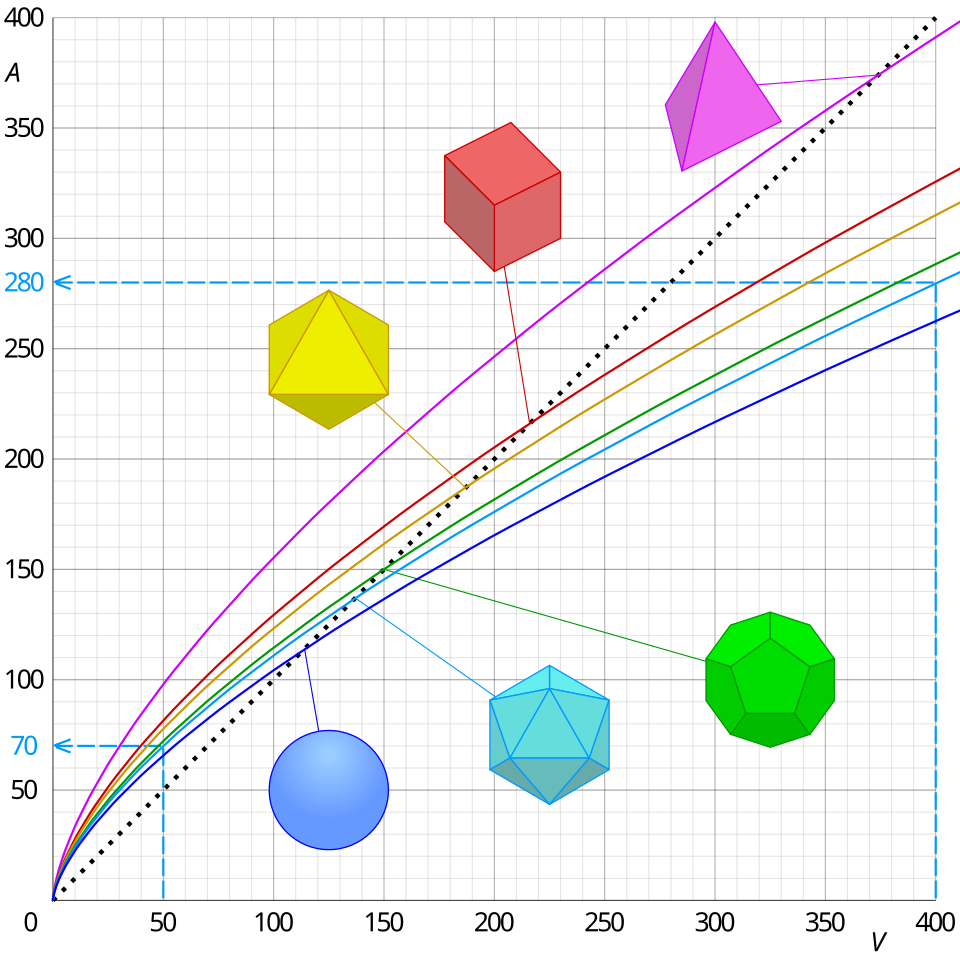
Graphical comparison of surface area and volume as size increases, illustrating that volume rises faster than surface area. The figure also shows that surface-area-to-volume ratio decreases with increasing size, which helps explain why diffusion alone becomes limiting in larger organisms. Source
Surface area to volume ratio: The amount of surface area available compared with the volume of an organism.
A low surface area to volume ratio creates two major problems:
there is less surface area per unit volume for exchange with the environment
many cells are located far from the body surface
This means a large animal cannot absorb enough oxygen or remove enough waste by diffusion across its outer surface alone. Internal cells may be separated from the environment by many layers of other cells, making diffusion much too slow.
Body size also increases the total number of cells. More cells means:
a greater total demand for oxygen
a greater need for nutrients such as glucose and amino acids
a greater production of waste products such as carbon dioxide
So, as size increases, the need for transport rises, while the usefulness of diffusion alone falls.
Why metabolic demand matters
Many animals are highly active. Muscle contraction, movement, growth, and maintaining body processes all require large amounts of energy from respiration. Respiration needs a rapid supply of oxygen and respiratory substrates.
Tissues with a high metabolic rate use materials quickly. If these substances arrive only by diffusion, supply may not meet demand. This is especially true in larger animals, where internal tissues are far from the body surface.
A mass transport system solves this problem by delivering substances much faster than diffusion over long distances. It also removes waste products before they build up to harmful levels.
What mass transport means in animals
Mass transport is the bulk movement of substances in a fluid. In animals, this fluid is usually blood or a similar tissue fluid. Instead of each cell depending on direct exchange with the environment, materials are moved through the body in a transport medium.
A mass transport system typically allows:
oxygen to move from a gas exchange surface to body tissues
digested food molecules to move from the gut to cells
waste products to move from tissues to excretory organs
chemical signals such as hormones to be distributed through the body
This system is much faster than relying on diffusion across the whole body.
Why a circulation is needed
A circulation is important because transported substances must reach all parts of the organism efficiently. If the transport fluid did not move around the body, substances would still depend on slow random diffusion inside the fluid.
Circulation provides:
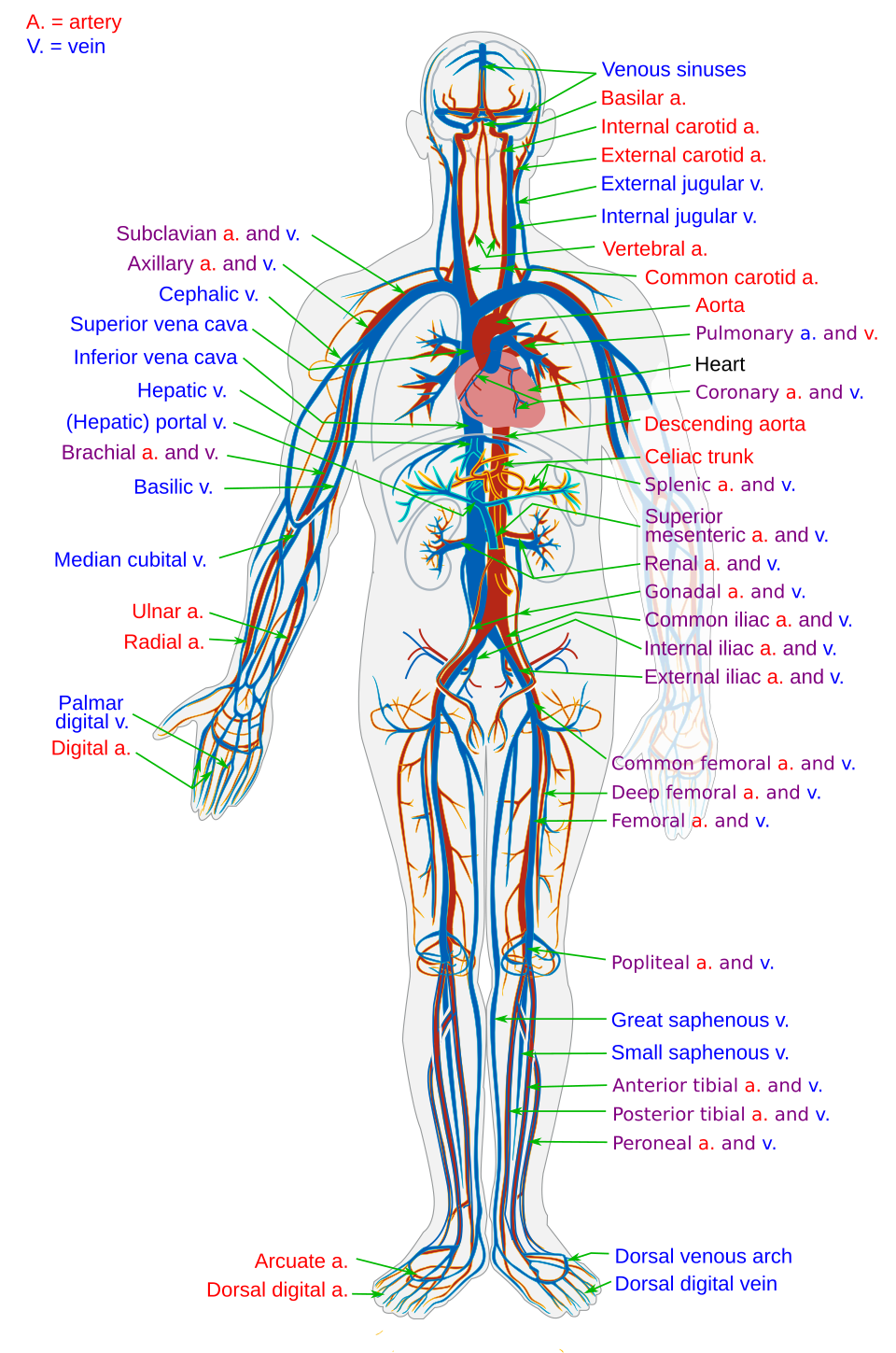
Labeled overview of major arteries and veins in the human body, emphasizing the extensive vessel network needed to distribute the transport medium to all tissues. This helps explain how circulation maintains supply to internal cells that are far from the body surface and supports efficient waste removal. Source
continuous movement of the transport medium
delivery of materials to all tissues
removal of wastes from all tissues
maintenance of concentration gradients at exchange surfaces
These concentration gradients are essential. For example, if oxygen-rich blood is constantly moved away from an exchange surface and replaced with oxygen-poor blood, oxygen continues to diffuse into the transport medium rapidly. Similarly, when blood flowing through tissues unloads oxygen and absorbs carbon dioxide, diffusion between blood and cells can continue efficiently.
So, diffusion still occurs, but only across short distances:
between the environment and an exchange surface
between the transport medium and body cells
The circulation links these short diffusion steps by carrying substances quickly over the long distances inside the body.
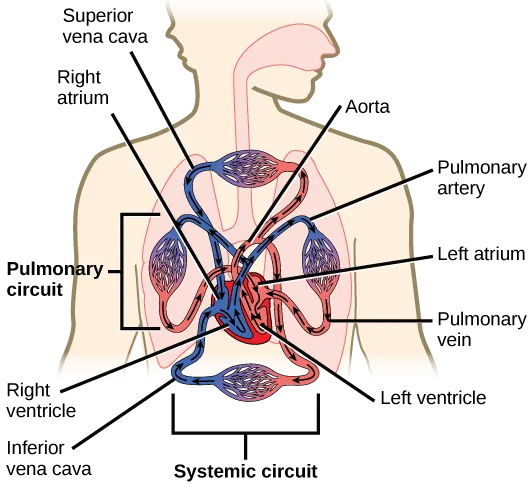
Diagram of double circulation in a mammal, showing how blood moves through the pulmonary circuit (heart ↔ lungs) and the systemic circuit (heart ↔ body tissues). It highlights how bulk flow rapidly transports oxygen and nutrients over long distances, while diffusion is confined to short distances at exchange surfaces and capillary beds. Source
Why many animals need a heart
A heart acts as a muscular pump. It keeps the transport fluid moving and generates pressure so that the fluid can travel around the organism at an adequate speed.
Without a pump:
flow would be too slow in large animals
distant tissues would not receive enough oxygen or nutrients
waste removal would be inefficient
concentration gradients would be harder to maintain
The need for a heart becomes greater as animals become larger, thicker, and more active. In these animals, diffusion alone cannot meet the requirements of all cells. A heart and circulation together overcome the limitations of diffusion by ensuring rapid, directed transport throughout the body.
Not all animals need the same degree of transport specialization, but in many animals, especially large multicellular ones, a heart and circulatory system are essential for survival.
Practice Questions
State two reasons why large animals cannot rely on diffusion alone for transport. (2 marks)
Large animals have a low surface area to volume ratio. (1)
Many cells are far from the body surface / diffusion distance is long. (1)
Large animals have higher metabolic demands / need faster delivery of materials and removal of wastes. (1)
Accept any two.
Explain why many animals need a mass transport system that includes a heart and circulation. (5 marks)
Award 1 mark for each of the following points, up to 5 marks:
As animals get larger, their surface area to volume ratio decreases.
Diffusion is only efficient over short distances.
Internal cells are too far from the body surface for diffusion alone to supply materials quickly enough.
Animals need rapid delivery of oxygen and nutrients to cells.
Animals need rapid removal of waste products such as carbon dioxide.
A mass transport system moves substances in bulk through a fluid.
Circulation carries substances between exchange surfaces and tissues.
The heart acts as a pump to maintain flow / pressure in the transport medium.
Circulation helps maintain concentration gradients for diffusion at exchange surfaces and tissues.
FAQ
They are usually very small, very thin, or both. Their cells are close enough to the outside environment for diffusion to be effective.
Examples often share features such as:
flattened bodies
low activity levels
a moist surface
short diffusion distances
Because transport distances are tiny, they do not need a pump to move substances around the body.
In insects, oxygen usually travels directly to tissues through the tracheal system, so the circulatory system is not the main oxygen transport route.
However, insect circulation still moves other substances, including:
digested nutrients
hormones
metabolic wastes
immune cells
This shows that the need for mass transport is not only about oxygen.
In an open circulatory system, the transport fluid is not always enclosed in blood vessels. It leaves vessels and bathes organs directly.
This can work when:
metabolic demands are lower
high pressure is not essential
body size and activity level allow slower transport
It is generally less efficient than a closed system, but it can still meet the needs of many animals.
Endotherms maintain a fairly constant internal body temperature, which requires continuous energy use.
That means they usually need:
a high rate of respiration
rapid oxygen delivery
rapid fuel delivery
fast removal of carbon dioxide
Because their metabolic demand is high even at rest, they depend strongly on efficient circulation.
Increasing surface area helps exchange with the environment, but it does not solve the whole problem.
A very large animal would still have:
many cells deep inside the body
long internal transport distances
high overall demand for materials
So even with specialized exchange surfaces, a large animal still needs a transport system to move substances between those surfaces and internal tissues.

