

Edexcel Syllabus focus:
'Understand the importance of water as a solvent in transport, including how its dipole nature affects its properties.'
Water is the main transport medium in living organisms because many substances must move efficiently between cells, tissues, and organs. Its molecular structure explains why it performs this role so effectively.
Water as a transport medium
For transport to occur in animals, substances usually need to be carried in a fluid. Water is ideal because many biologically important molecules can dissolve in it and then be moved as part of a solution. In the body, water forms most of the blood plasma, tissue fluid, and cytoplasm, so it provides the medium through which substances travel.
Solvent: A liquid that dissolves other substances, called solutes, to form a solution.
Substances carried in water include:
glucose and other small soluble nutrients
amino acids
mineral ions such as sodium and chloride
urea
some gases, especially carbon dioxide, much of which is transported after conversion into dissolved ions
When a solute dissolves, its particles become surrounded by water molecules and can then move freely with the fluid. This allows distribution around the body, helping cells receive materials they need and removing waste products. Undissolved particles are much harder to move evenly and reliably in a transport system.
At cell surfaces and exchange surfaces, substances usually move between membranes and body fluids only when dissolved. Water therefore links absorption, transport, and waste removal in one continuous system.
Why transport depends on solutions
Transport in a liquid is much more efficient when substances are dissolved rather than present as large undissolved particles. A dissolved substance is spread throughout the fluid, so it can be carried to many different places at once. This is especially important in organisms with high metabolic demands, because cells need a continuous supply of substances and a continuous removal of wastes.
Dissolved solutes can also be present at controlled concentrations, allowing the body to regulate what is delivered to tissues. Water is therefore not just a carrier, but the medium that makes chemical transport possible.
Water's ability to act as a solvent depends on its molecular structure. The oxygen atom attracts shared electrons more strongly than the hydrogen atoms, so the charges within the molecule are unevenly distributed.
Dipole: A molecule with an uneven distribution of charge, producing a partially positive end and a partially negative end.
The dipole nature of water
Each water molecule has a bent shape. Because oxygen is more electronegative than hydrogen, the oxygen end becomes slightly negative (), and the hydrogen ends become slightly positive (). This makes water a polar molecule.
The polarity of water lets it interact with charged and other polar substances. These interactions are what make water such an effective solvent in transport fluids.
Dissolving ionic substances
Ionic compounds separate into positive ions and negative ions in water. The slightly negative oxygen end of a water molecule is attracted to positive ions, while the slightly positive hydrogen ends are attracted to negative ions. Water molecules cluster around the ions, separating them and keeping them in solution.
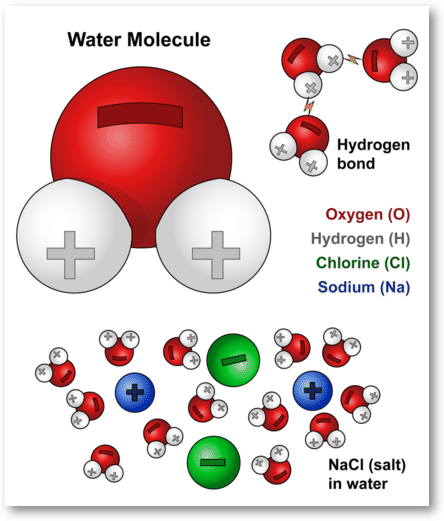
Water molecules orient around ions because of their partial charges: the oxygen end (more negative) faces cations such as Na⁺, while the hydrogen ends (more positive) face anions such as Cl⁻. This produces hydration shells that stabilize separated ions and prevents them from quickly recombining into a crystal, keeping salts dissolved for transport in body fluids. Source
This is why many salts can be transported in body fluids as dissolved ions. Once dissolved, the ions can move wherever the fluid moves, and they are less likely to come back together and form a solid.
Dissolving polar molecules
Some molecules are not ionic but still dissolve because they are polar. Their charged regions interact with the charged regions of water molecules. For example, glucose and amino acids contain groups that can form attractions with water, allowing them to dissolve and be transported.
Non-polar substances do not dissolve easily in water because they cannot form these favorable interactions. This limits their transport in aqueous fluids and is one reason why water is especially suitable for carrying polar and ionic solutes.
Properties of water caused by its polarity
Water's dipole nature affects more than just solubility. It also causes hydrogen bonding between neighboring water molecules.
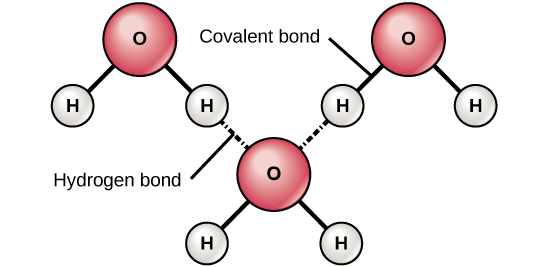
This diagram shows hydrogen bonds forming between neighboring water molecules: the hydrogen of one molecule is attracted to the oxygen of another. Although each hydrogen bond is weak, the large number of these interactions in liquid water creates strong collective effects, including cohesion and resistance to rapid temperature change. Source
These bonds are weak individually, but there are many of them, so together they strongly influence water's behavior.
Water remains liquid over a wide temperature range
Hydrogen bonding means water has a relatively high boiling point for such a small molecule. As a result, water stays liquid at normal body temperatures. This is essential for transport, because a transport medium must be able to flow continuously through tissues and organs.
If water were not liquid under biological conditions, it could not function as the main solvent for transport or as the fluid medium in which dissolved substances are carried.
Temperature stability in transport fluids
Water also has a high specific heat capacity, again because energy is needed to break hydrogen bonds. This means the temperature of water changes relatively slowly. In transport fluids such as blood plasma, this helps resist sudden temperature changes, providing a more stable environment for cells and for the enzymes involved in metabolism.
Large rapid temperature changes would alter enzyme activity and could change the properties of transport fluids. Water reduces this instability while substances are being distributed around the body.
Cohesion and continuous flow
Hydrogen bonding produces cohesion, meaning water molecules are attracted to one another. This helps water behave as a continuous fluid rather than breaking apart easily. For transport, this supports smooth flow and helps keep dissolved substances moving in the same medium.
Because many different solutes can dissolve in water at the same time, one transport fluid can carry nutrients, ions, signaling molecules, and waste products together. Organisms also contain water in large amounts, so this solvent is available throughout tissues wherever transport is needed.
Practice Questions
State two ways in which the dipole nature of water makes it suitable as a transport medium in animals. (2 marks)
Water is polar / has partial positive and partial negative ends. (1)
Allows ionic substances to dissolve because water molecules attract and surround ions. (1)
Allows polar molecules to dissolve. (1)
Leads to hydrogen bonding, helping water remain liquid at body temperature. (1)
Accept any two.
Explain why water is important as a solvent in transport, including how its dipole nature affects this role. (5 marks)
Oxygen attracts electrons more strongly than hydrogen / uneven charge distribution in water. (1)
Water has a partial negative end and partial positive ends / is polar. (1)
Water molecules are attracted to ions and separate them in solution. (1)
Polar molecules can also dissolve because they interact with charged regions of water. (1)
Dissolved solutes can then be transported in body fluids such as plasma or tissue fluid. (1)
Hydrogen bonding between water molecules helps water remain liquid at normal biological temperatures. (1)
Max 5 marks.
FAQ
Oxygen is a small non-polar molecule, so it interacts only weakly with polar water molecules. That means only a limited amount dissolves directly in water.
Carbon dioxide is also small, but some of it reacts in water to form other dissolved substances, including hydrogencarbonate ions. This increases the total amount that can be carried in aqueous fluids.
A hydration shell is the layer of water molecules that surrounds a dissolved ion or polar molecule. The orientation of the water molecules depends on the charge distribution of the solute.
This matters because the shell helps keep particles separated and mobile. Without it, oppositely charged ions would be more likely to recombine and leave solution, reducing how effectively they could be transported.
Most lipids have long non-polar hydrocarbon chains, so they do not form strong attractions with water. Water molecules bond more favorably to each other, so lipids are excluded rather than dissolved.
In animals, lipids are still transported by being packaged with other substances, such as proteins and phospholipids, forming particles that can move through watery fluids.
pH can change whether a molecule carries a charge by adding or removing hydrogen ions. A charged form usually interacts more strongly with water and is often more soluble.
This is important for molecules such as amino acids, which can exist in different ionic forms depending on pH. Their solubility, and therefore how easily they are transported in water, can change with the conditions.
Water-soluble vitamins, such as vitamin C and many B vitamins, dissolve directly in aqueous body fluids and can usually travel freely in plasma.
Fat-soluble vitamins, such as vitamins A, D, E, and K, do not dissolve well in water. They usually need to travel with lipids or carrier proteins, so their transport is less direct and depends on packaging into transport particles.
