

Edexcel Syllabus focus:
'Understand blood clotting, including thromboplastin release, conversion of prothrombin to thrombin, fibrinogen to fibrin, and its role in CVD.'
Blood clotting is a protective response that prevents blood loss after vessel injury, but the same mechanism can become dangerous when clots form inappropriately inside vessels and block blood flow.
Why blood clotting is important
Damage to a blood vessel creates two immediate problems:
blood loss
entry of pathogens
The body responds by reducing bleeding and sealing the damaged area. This process is highly controlled, because a clot must form quickly at the site of injury but should not spread through healthy blood vessels.
Platelets are small cell fragments involved in clotting. When a vessel wall is damaged, platelets come into contact with exposed tissue and become activated. They stick to the damaged area and to each other, helping begin formation of a temporary plug. They also help trigger the chemical events that lead to a stronger, more stable clot.
Hemostasis: The stopping of blood loss from a damaged blood vessel by processes including platelet action and blood clotting.
The clotting cascade
Blood clotting involves a sequence of reactions in which inactive substances are converted into active ones. This allows a very small area of damage to produce a strong local response.
1. Thromboplastin is released
When tissues are damaged, thromboplastin is released. Activated platelets at the injury site also contribute to the clotting process. Thromboplastin starts the main chemical pathway of clot formation.
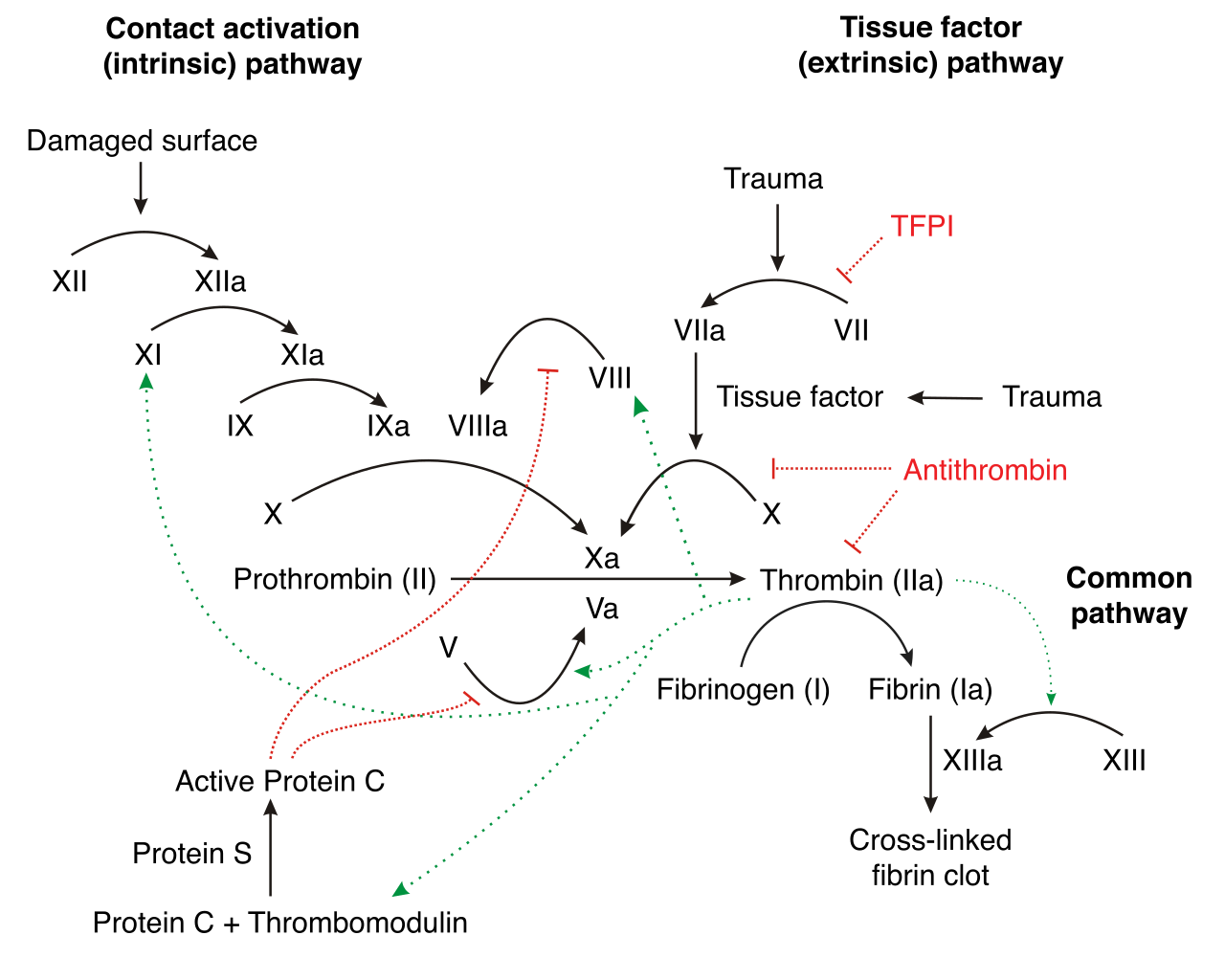
Schematic overview of the coagulation cascade, showing how tissue factor (thromboplastin) initiates a chain of factor activations that culminates in thrombin formation and fibrin production. This is useful for linking the Edexcel “thromboplastin → thrombin → fibrin” sequence to the broader intrinsic/extrinsic pathway context. Source
This is an important step because it links physical damage to the vessel wall with chemical activation of clotting.
2. Prothrombin is converted to thrombin
Prothrombin is a soluble plasma protein that circulates in inactive form. In the presence of thromboplastin, it is converted into thrombin, which is the active enzyme in the next stage.
Thrombin is crucial because it acts directly on another plasma protein, fibrinogen.
3. Fibrinogen is converted to fibrin
Fibrinogen is a soluble plasma protein. Thrombin converts fibrinogen into fibrin, which is insoluble.
The change from soluble fibrinogen to insoluble fibrin is essential. Soluble proteins move freely in plasma, but insoluble fibrin forms long fibers. These fibers create a mesh across the damaged region.
4. A stable clot forms
The fibrin mesh traps:
red blood cells
platelets
other blood components
This produces a blood clot that seals the wound and reduces further bleeding. Over time, the clot may dry at the surface to form a scab if the damage is external.
Why fibrin is so effective
Fibrin is well suited to clot formation because its fibers:
are strong
can form a network
trap cells effectively
remain at the site because they are insoluble
This gives the clot both structure and stability. Without fibrin, a platelet plug alone would be much less secure and could be dislodged more easily by blood flow.
A clot is therefore not just a mass of cells. It is a protein framework reinforced by trapped blood cells.
Thrombosis: The formation of a blood clot inside a blood vessel.
Blood clotting and cardiovascular disease
Blood clotting is beneficial when it occurs after injury, but it becomes harmful when it happens inside an intact blood vessel. In cardiovascular disease, this harmful clot formation is called thrombosis.
A clot that forms within a blood vessel is a thrombus. A thrombus can reduce blood flow by narrowing the vessel, or it can completely block the lumen. This is especially dangerous in arteries supplying vital organs.
Thrombus: A blood clot formed within a blood vessel or within the heart.
In CVD, thrombosis is particularly serious because blood vessels may already be narrowed. This means that even a relatively small clot can cause a major reduction in blood flow.
Coronary thrombosis
If a thrombus forms in a coronary artery, blood flow to part of the heart muscle is reduced or stopped. As a result:
less oxygen reaches cardiac muscle
aerobic respiration decreases
heart muscle cells may become damaged or die
This can lead to a myocardial infarction (heart attack).
Cerebral thrombosis
If a thrombus blocks an artery supplying the brain, brain cells are deprived of oxygen and glucose. This can cause a stroke.
Why thrombosis is dangerous
The main danger is ischemia, meaning an inadequate blood supply to tissues. Cells that are highly active, such as heart muscle and nerve cells, are especially sensitive to interruption of blood flow.
The effects depend on:
where the clot forms
how large it is
how long the blood supply is reduced
A short interruption may damage tissue function. A longer or complete blockage can cause irreversible cell death.
Key sequence to remember
For Edexcel, the central clotting pathway should be learned in order:
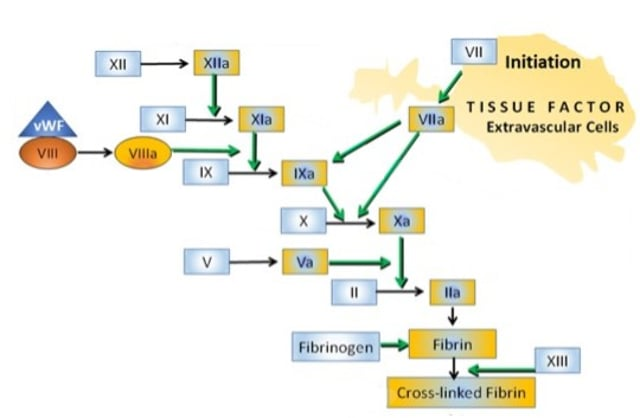
Simplified coagulation cascade diagram highlighting the central catalytic steps that generate thrombin and then convert fibrinogen to fibrin. This supports memorisation of the Edexcel core sequence while still showing that multiple upstream routes converge on the same final fibrin-clot endpoint. Source
damage to vessel or surrounding tissue
thromboplastin released
prothrombin converted to thrombin
fibrinogen converted to fibrin
fibrin forms a mesh
blood cells and platelets are trapped
a clot forms
This sequence explains both the normal protective role of clotting and its harmful role in cardiovascular disease when clots develop in blood vessels and obstruct circulation.
Practice Questions
State the sequence of events that converts prothrombin into a blood clot. (2 marks)
thromboplastin is released / damage causes thromboplastin release (1)
prothrombin is converted to thrombin and fibrinogen is converted to fibrin / fibrin forms the clot (1)
Explain how blood clotting occurs after blood vessel damage and describe how this process can contribute to cardiovascular disease. (6 marks)
damage to tissue or vessel causes release of thromboplastin (1)
thromboplastin causes conversion of prothrombin to thrombin (1)
thrombin converts fibrinogen to fibrin (1)
fibrin forms insoluble fibers / a mesh (1)
mesh traps blood cells and platelets to form a clot (1)
if a clot forms inside a blood vessel it can reduce or block blood flow, causing thrombosis / heart attack / stroke / tissue ischemia (1)
FAQ
Healthy blood vessels have a smooth endothelial lining that discourages platelets from sticking.
They also produce substances that reduce platelet activation and help keep blood in a fluid state. Clotting is therefore normally triggered only when the vessel wall is damaged and underlying tissues are exposed.
A thrombus is a clot that forms and stays in the place where it developed.
An embolus is material carried in the bloodstream from one place to another. A piece of a clot can break off, travel, and block a narrower vessel elsewhere. This can suddenly cut off blood supply to important tissues.
Arteries carry blood under higher pressure to vital organs such as the heart and brain.
If an artery is blocked, oxygen delivery to those tissues can fall very quickly, so damage may occur within minutes. Venous clots are also dangerous, but arterial blockage is more likely to cause immediate tissue death because it stops oxygenated blood reaching cells.
The body can gradually break down a clot once it is no longer needed.
This is done by the fibrinolytic system, which digests fibrin and removes the mesh holding the clot together. Controlled clot removal is important because a clot that remains for too long could continue to obstruct blood flow.
When blood flow is slow, clotting factors are less quickly dispersed and platelets have more opportunity to contact the vessel wall.
Slow flow also means natural anti-clotting influences are less effective at washing activated substances away from one location. This is one reason immobility can increase the risk of abnormal clot formation.

