

Edexcel Syllabus focus:
'Understand why perceived risks often differ from actual risks, including underestimating or overestimating diet and lifestyle risks for heart disease.'
People do not always judge heart disease risk logically. Emotions, habits, social influence, and the way evidence is presented can all affect decisions, so perceived danger may not match real danger.
Why perceived risk and actual risk can differ
In biology and public health, actual risk is based on the best available scientific evidence, usually from large studies over time. However, everyday decisions are often guided by feelings, past experiences, and what seems normal.
People often rely on risk perception when making health choices.
Risk perception: A person's judgment or feeling about how likely and how serious a health risk is.
Actual risk is not the same as certainty.
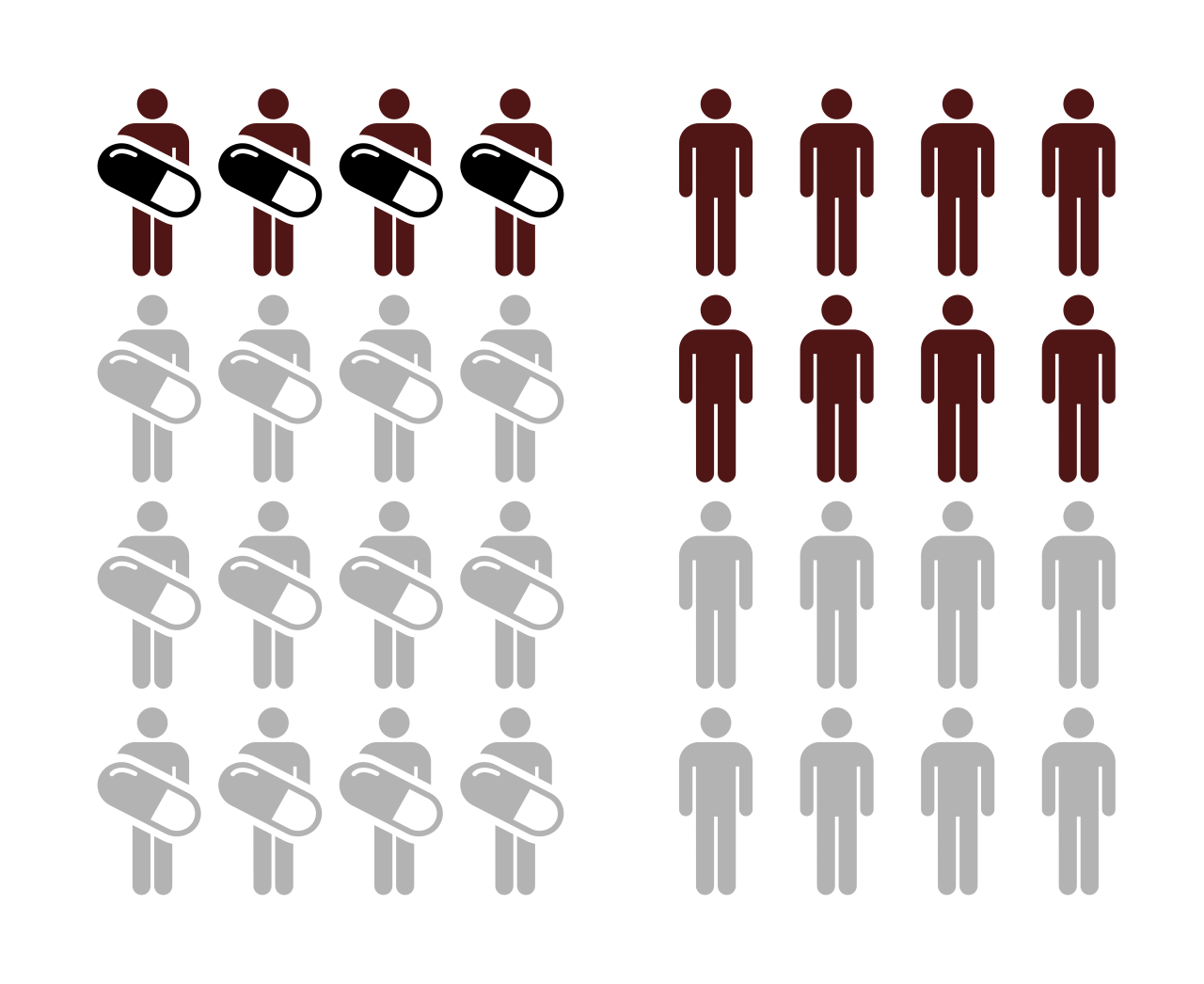
This diagram compares outcomes in an exposed (treated) group versus an unexposed group, illustrating how risk reduction is represented at the population level. It helps students distinguish between a change in probability and a guarantee for any individual. This supports clearer thinking about how evidence-based risk differs from anecdotal certainty. Source
A behavior can increase the chance of heart disease without meaning that every person with that behavior will develop it. This difference can make risk harder to understand. If a person knows someone who ate poorly and still seemed healthy, they may treat that single example as more important than population evidence.
Key influences on risk perception
Personal experience can feel more convincing than scientific data.
Emotions such as fear, denial, or reassurance affect judgment.
Social norms influence what people see as acceptable or “safe.”
Media messages may emphasize dramatic claims rather than balanced evidence.
Misunderstood statistics can make a risk seem much larger or smaller than it really is.
Why people underestimate heart disease risk
Underestimation is common when the effects of a behavior are not immediate. Heart disease usually develops slowly, so people may not connect current diet or lifestyle choices with future disease.
Delayed consequences
Many harmful lifestyle patterns do not cause instant pain or illness. Because there is no immediate warning sign, a person may assume there is little danger. This is very different from risks with quick consequences, which are easier to notice and avoid.
Familiarity and normal behavior
If a behavior is common in a family, school, workplace, or community, it can seem less risky. A person may think, “Everyone lives like this, so it cannot be that bad.” Familiar risks often feel safer than unfamiliar ones, even when the actual risk is high.
Optimism bias
People often believe bad outcomes are more likely to happen to others than to themselves. This is called optimism bias. In heart disease, it may lead someone to think they can continue an unhealthy lifestyle because they will “change later” or because they believe they are naturally less vulnerable.
Diet and lifestyle examples of underestimation
A person may underestimate risk from:
a consistently poor diet because individual meals do not seem harmful
smoking because the effects build up over time
inactivity because it does not feel like an illness
several small unhealthy habits because each one seems minor on its own
This is important because small risks can combine. When different lifestyle factors act together, the overall risk may be much greater than the person realizes.
Why people overestimate heart disease risk
People do not only underestimate risk. They may also overestimate certain diet or lifestyle risks, especially when information is frightening, simplified, or repeated often.
Dramatic stories and headlines
A vivid news story or personal account can strongly affect judgment. If one food, behavior, or study receives intense media attention, people may see it as extremely dangerous even when the evidence is limited or the effect size is small.
Oversimplified messages about diet
Heart disease risk is influenced by long-term patterns, not usually by one food in isolation. However, public messages can turn complex biology into simple labels such as “good” and “bad.” This may lead people to exaggerate the danger of one ingredient or one eating event while ignoring their overall lifestyle.
Fear without context
Risk can sound more serious if it is presented without comparison or explanation.
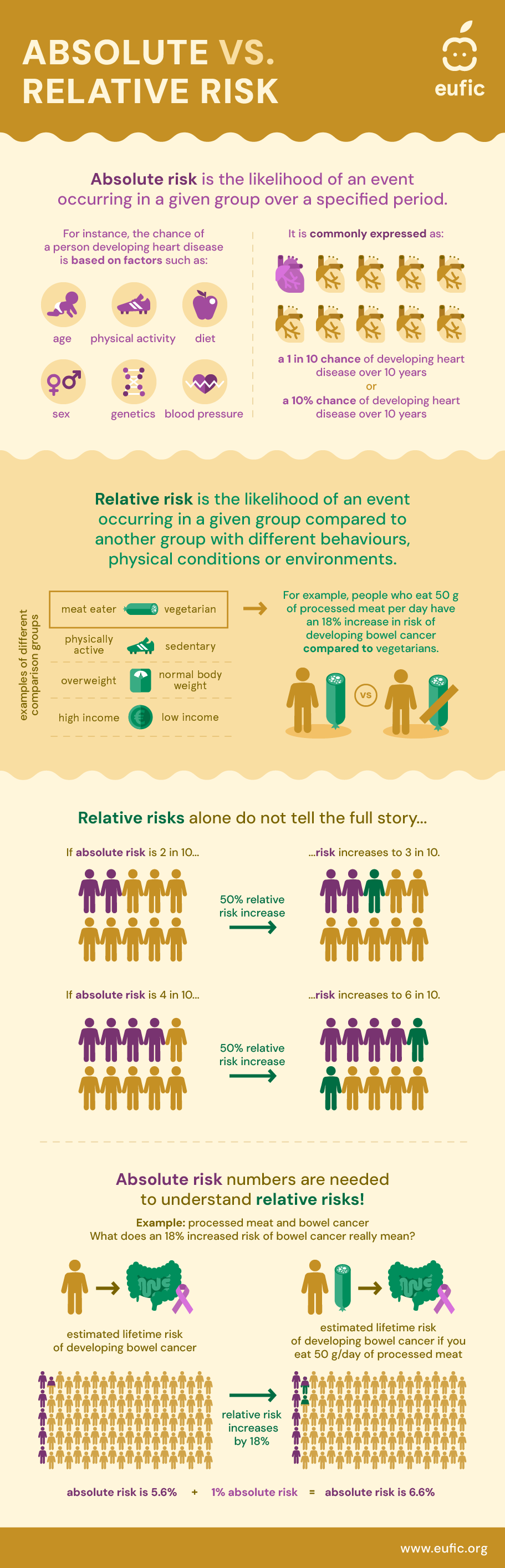
This infographic contrasts relative risk with absolute (baseline) risk using a concrete health example. It highlights how the same data can feel much more alarming when reported only as a percentage change, and much clearer when shown with baseline frequencies. This is central to understanding how communication style can shift perceived heart-disease-related risk away from the actual evidence. Source
For example, a statement that something “increases risk” may alarm people even if the starting risk was low. Without context, people may imagine a much bigger danger than the evidence supports.
How evidence can be misunderstood
Scientific evidence is powerful, but it is not always easy for the public to interpret correctly. Misunderstanding evidence can distort risk perception in both directions.
Correlation and causation
If two things are linked, this does not automatically mean that one causes the other.
People may overestimate risk if they assume every reported association proves cause and effect. On the other hand, if different studies produce slightly different results, some people may wrongly decide that no risk exists at all.
Conflicting evidence
Nutrition and lifestyle research can appear confusing because studies may differ in method, sample size, or reliability. When the public sees disagreement, they may lose trust and choose the message that best matches what they already want to believe.
The problem of selective attention
People often notice and remember information that supports their existing views. If someone enjoys an unhealthy habit, they may focus on evidence that minimizes its risk and ignore stronger evidence showing harm.
Why heart disease risk is especially easy to misjudge
Heart disease is strongly affected by long-term behaviors. That makes it vulnerable to misperception for several reasons:
the disease develops gradually
many risk-related behaviors are socially accepted
changes in behavior require effort and self-control
benefits of prevention are often invisible because they involve disease not happening
As a result, people may downplay important risks or become overly worried about less important ones.
Improving the accuracy of risk perception
Better communication can narrow the gap between perceived and actual risk. Useful approaches include:
using clear, balanced language
explaining risk in a realistic context
relying on large-scale evidence rather than anecdotes
showing that no symptoms does not mean no risk
emphasizing long-term patterns in diet and lifestyle
correcting exaggerated or misleading claims in the media
Public understanding improves when risk is presented honestly and clearly. The goal is not to create fear, but to help people make decisions that match the best scientific evidence about heart disease.
Practice Questions
State one reason why a person may underestimate the risk of heart disease from their lifestyle. (2 marks)
1 mark for a valid reason, such as:
no immediate symptoms
the behavior is common or familiar
optimism bias
reliance on personal experience rather than evidence
1 mark for linked explanation of how this lowers perceived risk
Explain why perceived risk may differ from actual risk for heart disease. Your answer should refer to diet or lifestyle and to the way evidence is presented. (6 marks)
Award 1 mark for each valid point up to 6 marks.
Actual risk is based on scientific evidence from large studies
Perceived risk is influenced by feelings, beliefs, and past experience
Heart disease develops slowly, so delayed effects can lead to underestimation
Familiar lifestyle habits may seem safe because they are normal in a social group
People may believe risk applies to others more than to themselves
Media stories or headlines can exaggerate certain risks
A person may overfocus on one food or one habit instead of overall lifestyle pattern
Misunderstanding evidence, such as confusing association with cause, can distort judgment
Conflicting messages may cause people to ignore real risk
Clearer communication can improve how accurately people judge risk
FAQ
Labels such as “low-fat,” “natural,” or “organic” can create a health halo. This means people assume the product is automatically low-risk, even when it may still contain a lot of salt, sugar, or calories.
This can shift attention away from the full diet pattern, which is usually more important for heart disease risk than a single label on one product.
People vary in:
confidence with numbers
trust in scientists or health authorities
previous beliefs
emotional response to illness
A statistic is not interpreted in a vacuum. One person may see it as a serious warning, while another may see it as unimportant, depending on how they frame the information in their mind.
Yes. Family history can distort judgment in two opposite ways.
Overestimation: A person may believe heart disease is unavoidable because it “runs in the family.”
Underestimation: A person with no known family history may assume lifestyle does not matter much.
In reality, family history can affect risk, but it does not make lifestyle irrelevant.
Images are often easier to remember than statistics. They can make an invisible long-term risk feel more real and immediate.
However, strong images can also increase emotional reactions, which may sometimes lead to overestimation if they are not balanced with accurate explanation.
They can help by making behavior more visible. For example, tracking activity, sleep, or heart rate can turn an abstract health message into something personal and measurable.
But they also have limits:
users may misunderstand the data
devices do not measure full heart disease risk
people may focus on one number and ignore broader lifestyle patterns
They are most useful when combined with accurate health guidance.

