

Edexcel Syllabus focus:
'Know the differences between saturated and unsaturated lipids, including differences in fatty acid structure.'
Saturated and unsaturated lipids differ mainly in the structure of their fatty acids. These structural differences affect molecular shape, packing, and physical properties such as melting point and fluidity.
Lipids and fatty acids
Most dietary fats and oils are triglycerides, made from one glycerol molecule bonded to three fatty acids.
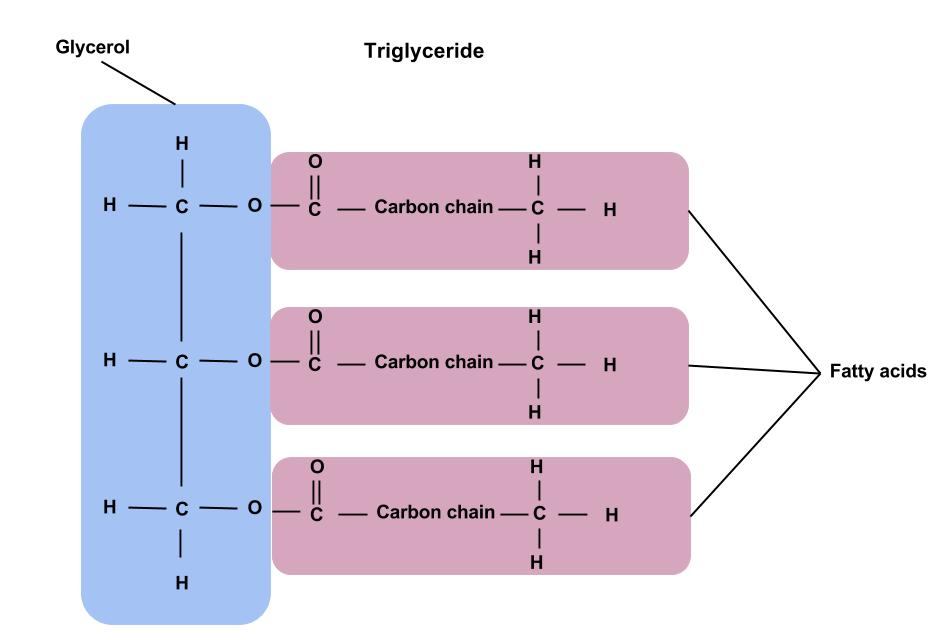
A labeled structural diagram of a triglyceride showing the glycerol backbone and three fatty acids joined by ester bonds. This helps you separate the ‘glycerol part’ from the fatty acid chains, which is essential because saturation depends on the fatty acids, not glycerol. Source
Whether a lipid is described as saturated or unsaturated depends on the structure of those fatty acids, not on the glycerol part of the molecule.
Fatty acid: An organic molecule with a hydrocarbon chain and a carboxyl group that forms part of a lipid.
Fatty acids can differ in chain length, but the key difference here is the type of bonding between the carbon atoms in the hydrocarbon chain. The presence or absence of carbon-carbon double bonds determines whether the fatty acid is saturated or unsaturated.
Saturated fatty acids
A saturated fatty acid contains only single bonds between the carbons in its hydrocarbon chain. Because every available bonding position is filled with hydrogen, the chain is said to be saturated with hydrogen.
Saturated fatty acid: A fatty acid with no carbon-carbon double bonds in its hydrocarbon chain.
This structure produces a fairly straight chain. Straight chains can lie close together, so molecules with saturated fatty acids pack tightly. Tight packing increases the strength of intermolecular forces between neighboring molecules.
As a result, lipids rich in saturated fatty acids usually have higher melting points. They are more likely to be solid at room temperature. The solid state is therefore a result of structure, not the definition of saturation itself.
Unsaturated fatty acids
Unsaturated fatty acids contain at least one carbon-carbon double bond in the hydrocarbon chain. Because of the double bond, the chain does not hold the maximum possible number of hydrogen atoms.
Unsaturated fatty acid: A fatty acid with one or more carbon-carbon double bonds in its hydrocarbon chain.
A fatty acid with one double bond is monounsaturated, while one with two or more double bonds is polyunsaturated. In many biological molecules, these double bonds create a bend, or kink, in the chain.
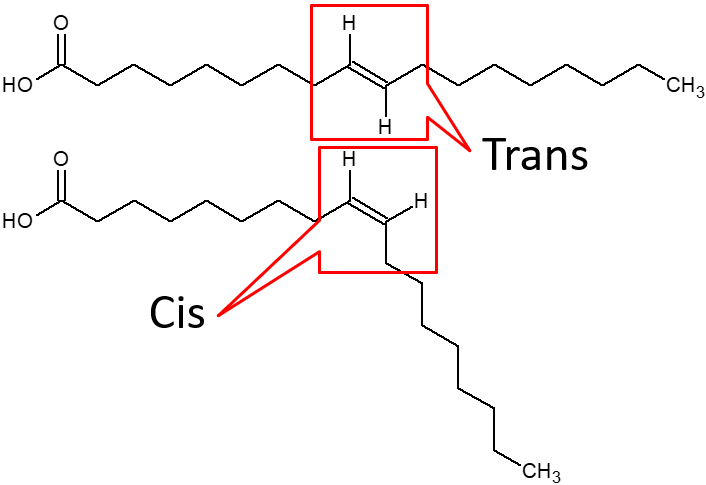
A comparative diagram of cis and trans double-bond configurations in an unsaturated fatty acid. It emphasizes that the cis configuration (common in natural fatty acids) introduces a pronounced kink, altering molecular shape and therefore how closely molecules can pack. Source
The bend means neighboring molecules cannot pack together as closely as saturated fatty acids. Less efficient packing weakens intermolecular forces, so lipids rich in unsaturated fatty acids usually have lower melting points.
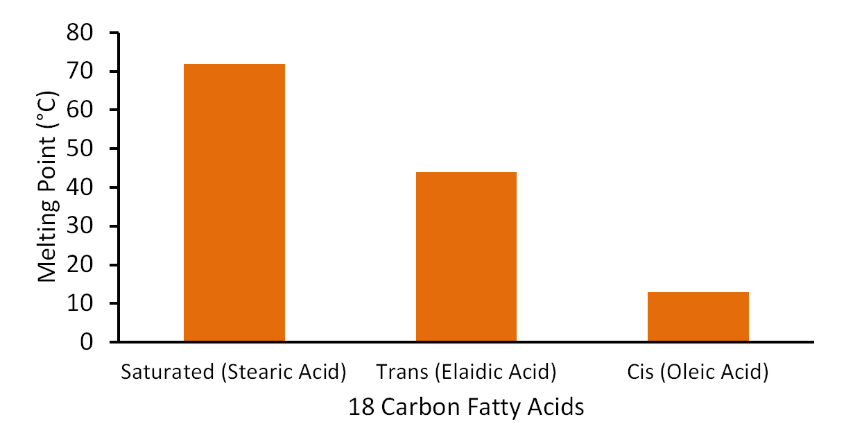
A bar graph comparing melting points for saturated, trans-monounsaturated, and cis-monounsaturated 18-carbon fatty acids. It makes clear that cis unsaturation is associated with much lower melting points, consistent with reduced packing efficiency caused by chain kinks. Source
They are more likely to be liquid at room temperature, which is why many plant oils remain liquid.
Why the double bond changes shape
The carbon-carbon double bond is important because it fixes part of the chain into a different arrangement. In contrast, chains with only single bonds are more regular in shape and can align more easily with nearby molecules.
Even one double bond can make a noticeable difference to the behavior of a lipid. If there are several double bonds, the chain usually becomes even harder to pack closely. This is why polyunsaturated lipids tend to have especially low melting points compared with similar saturated lipids.
The essential idea is that a small chemical change in a fatty acid produces a larger physical change in the whole lipid.
Identifying saturated and unsaturated lipids from structure
When you are shown a molecular diagram, look first for double bonds between carbon atoms in the fatty acid chains.
If there are no carbon-carbon double bonds, the fatty acid is saturated.
If there is one or more carbon-carbon double bonds, the fatty acid is unsaturated.
More double bonds mean a greater degree of unsaturation.
A lipid can contain three saturated fatty acids, three unsaturated fatty acids, or a mixture of both.
When reading displayed formulae, remember that each carbon forms four bonds. A carbon involved in a double bond therefore forms fewer bonds to hydrogen than a carbon in a saturated chain.
This matters because the words saturated and unsaturated are often used to describe the whole lipid, even though the structural feature is found in the fatty acid chains. A triglyceride with one or more unsaturated fatty acids is commonly described as an unsaturated lipid.
Structural differences you should compare
For exam answers, the clearest comparison is:
Saturated fatty acids: no carbon-carbon double bonds, maximum hydrogen, straighter chains, closer packing, higher melting point.
Unsaturated fatty acids: one or more carbon-carbon double bonds, fewer hydrogen atoms, bent chains, less close packing, lower melting point.
These points should be linked as cause and effect. The bond type affects the shape, the shape affects the packing, and the packing affects the physical properties of the lipid.
Common mistakes
A common mistake is to say that saturated lipids are simply “fats” and unsaturated lipids are simply “oils.” While saturated lipids are often solid and unsaturated lipids are often liquid, the correct distinction is the presence or absence of carbon-carbon double bonds in the fatty acids.
Another error is to say that unsaturated fatty acids have no hydrogen. They do contain hydrogen, but they have fewer hydrogen atoms than a saturated fatty acid of the same length.
It is also important not to confuse “more double bonds” with “longer chain.” Chain length and saturation are different features. In this subtopic, saturation specifically refers to whether the fatty acid chain contains double bonds.
What Edexcel expects you to know
You should be able to describe the structural difference between saturated and unsaturated fatty acids and then connect that difference to physical properties.
You should also be able to use correct biological vocabulary, including fatty acid, saturated, unsaturated, monounsaturated, polyunsaturated, double bond, and hydrocarbon chain, when comparing different lipids.
Practice Questions
State two structural differences between a saturated fatty acid and an unsaturated fatty acid. (2 marks)
Saturated fatty acid has no carbon-carbon double bonds, whereas an unsaturated fatty acid has one or more carbon-carbon double bonds. (1)
Saturated fatty acid has a straighter chain / maximum hydrogen, whereas an unsaturated fatty acid has a bent chain / fewer hydrogen atoms. (1)
Explain why a triglyceride containing mainly unsaturated fatty acids is more likely to be liquid at room temperature than a triglyceride containing mainly saturated fatty acids. (5 marks)
Unsaturated fatty acids have one or more carbon-carbon double bonds. (1)
Saturated fatty acids have no carbon-carbon double bonds / have straighter chains. (1)
Double bonds cause bends or kinks in unsaturated fatty acid chains. (1)
Bent chains cannot pack as closely together as straight chains. (1)
Less close packing means weaker intermolecular forces / lower melting point, so the lipid is more likely to be liquid at room temperature. (1)
FAQ
Yes. Many naturally occurring triglycerides are mixed triglycerides, meaning the three fatty acids are not all the same.
For example, one triglyceride molecule may contain one saturated fatty acid and two unsaturated fatty acids. This means real lipids often show a blend of properties rather than fitting into a perfectly simple category.
These names describe the position of the first double bond when counted from the methyl end of the fatty acid chain.
Omega-3: first double bond is at the third carbon
Omega-6: first double bond is at the sixth carbon
This naming system does not tell you how many double bonds are present overall. It only tells you where the first one appears from that end of the molecule.
In cis fatty acids, the hydrogen atoms around the double bond are on the same side. This usually creates a noticeable bend in the chain.
In trans fatty acids, the hydrogens are on opposite sides. The chain stays straighter, so trans fatty acids can pack more like saturated fatty acids. This is why trans fats often have physical properties closer to solid fats.
Hydrogenation adds hydrogen atoms to some of the carbon-carbon double bonds in unsaturated fatty acids.
This:
reduces the number of double bonds
makes the fatty acid chains straighter
increases packing
raises the melting point
As a result, a liquid oil can become more solid. Partial hydrogenation may also produce trans fatty acids.
Carbon-carbon double bonds are more chemically reactive than single bonds, so unsaturated lipids are more vulnerable to oxidation.
Oxidation can:
damage the lipid molecules
change smell and taste
lead to rancidity in stored oils
This is one reason oils rich in unsaturated fatty acids are often stored carefully and may contain antioxidants to slow oxidation.
