

Edexcel Syllabus focus:
'Know how triglycerides are synthesised by condensation reactions between glycerol and three fatty acids, forming ester bonds.'
This page explains how a major biological lipid is assembled from smaller molecules. The key ideas are glycerol, fatty acids, condensation reactions, and the formation of ester bonds.
The molecules involved
To understand triglyceride synthesis, you must first know the structures of the reactants. A triglyceride is made when one glycerol molecule combines with three fatty acid molecules.
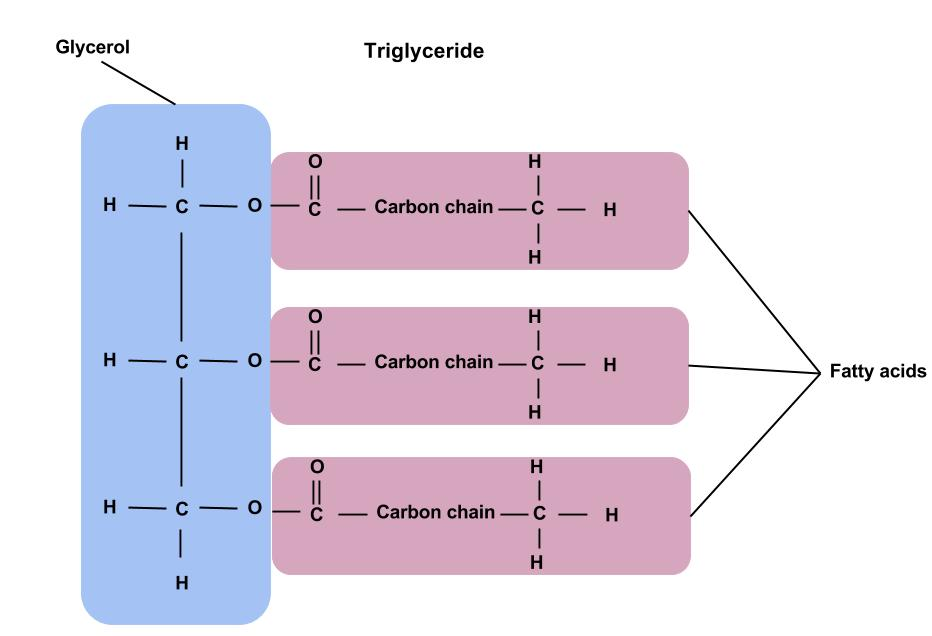
Structural diagram of a triglyceride showing the glycerol backbone and three fatty acid chains attached. This representation makes the ‘tri-’ in triglyceride visually obvious and helps you locate the three positions where ester bonds form. Source
Triglyceride: A lipid formed when one glycerol molecule bonds with three fatty acid molecules.
The word tri is important because it shows that three fatty acids are attached. This fixed ratio helps you remember both the structure of the final molecule and the number of bonds formed during synthesis.
Glycerol is a three-carbon alcohol. Each carbon has a hydroxyl group attached, so glycerol has three hydroxyl groups in total. These hydroxyl groups make glycerol the central molecule to which fatty acids can attach.
Each fatty acid has a long hydrocarbon chain and a carboxyl group. The carboxyl group is the reactive part involved in bond formation with glycerol. Since one glycerol has three hydroxyl groups, it can bond with three separate fatty acids.
Joining the molecules
The joining of glycerol to fatty acids happens by a condensation reaction.
Condensation reaction: A reaction in which two molecules join together and a small molecule, usually water, is removed.
In triglyceride synthesis, a hydrogen from a glycerol hydroxyl group and a hydroxyl from the fatty acid carboxyl group are removed.
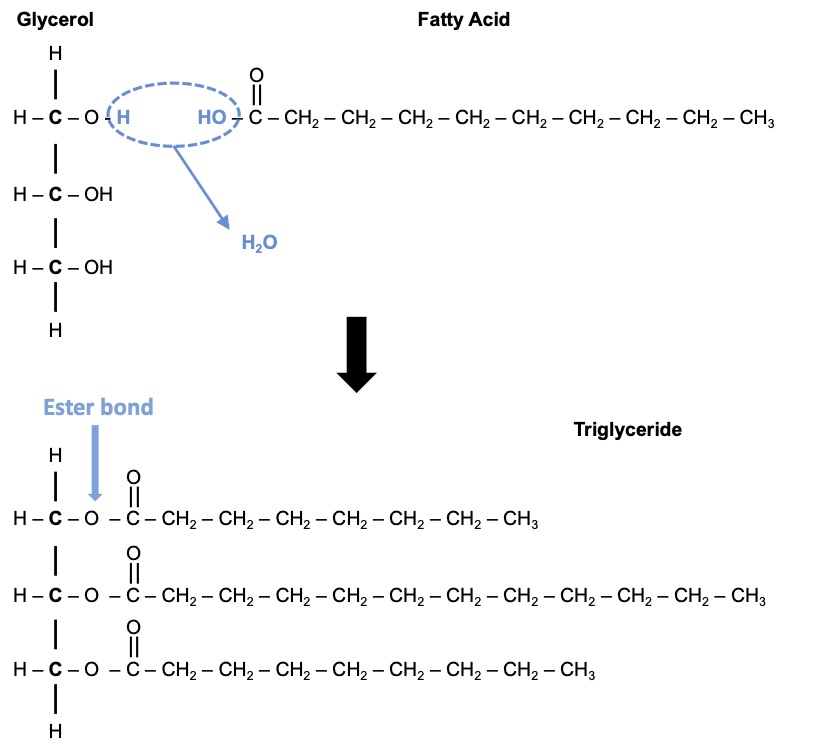
Reaction diagram of triglyceride (triacylglycerol) formation by dehydration synthesis (condensation). It shows the removal of and to form water and the creation of ester linkages between glycerol and each fatty acid, highlighting that the same reaction occurs three times to make a single triglyceride. Source
Together, these form a molecule of water. What remains of the two molecules becomes joined by a new covalent bond.
This happens once for each fatty acid that attaches to glycerol. Because three fatty acids are attached, three separate condensation reactions occur in the full synthesis of one triglyceride.
The synthesis depends on the functional groups present in the two reactants. Glycerol can form three bonds because it has three hydroxyl groups. A fatty acid can attach because it has one carboxyl group, so each fatty acid usually contributes one point of attachment.
The long hydrocarbon tail of a fatty acid does not form the bond directly. Instead, bonding happens at the end of the fatty acid molecule where the carboxyl group is located. This is why exam answers should mention the reactive groups, not just say that glycerol and fatty acids are “joined.”
Step-by-step formation
The process can be understood as a sequence of three similar reactions:
The first fatty acid joins to glycerol by condensation.
One molecule of water is removed.
One bond is formed between the glycerol and that fatty acid.
The same process happens again with a second fatty acid.
It happens a third time with the third fatty acid.
After the first reaction, only one fatty acid is attached. After the second reaction, two fatty acids are attached. Only after the third reaction is the fully formed triglyceride produced, with all three possible bonding positions on glycerol used.
The bond that is formed
The bond formed between glycerol and each fatty acid is an ester bond.
Ester bond: The covalent bond formed when glycerol joins to a fatty acid during triglyceride synthesis.
An ester bond forms between the oxygen from glycerol and the carbon-containing part of the fatty acid’s carboxyl group. In A-Level Biology, you do not need a detailed organic chemistry mechanism, but you do need to know where the bond forms and that it is produced by condensation.
Since one triglyceride contains three fatty acids, it contains three ester bonds in total.

Chemical structure diagram of an example triglyceride with the glycerol portion and three fatty-acid residues distinguished. It helps you identify the three ester functional groups within a full structural formula, linking the ‘three fatty acids’ idea to three ester linkages in a real molecule. Source
This is a common exam point. If asked about the products of triglyceride synthesis, you should link the number of fatty acids, the number of condensation reactions, the number of ester bonds, and the number of water molecules produced.
What is produced overall
When one triglyceride is made:
1 glycerol molecule reacts
3 fatty acid molecules react
3 condensation reactions take place
3 ester bonds are formed
3 water molecules are released
These numbers all match because each fatty acid joins by one condensation reaction, and each condensation reaction forms one ester bond and releases one water molecule.
You may see the process described as one glycerol plus three fatty acids producing one triglyceride plus three water molecules. The key idea is not just memorizing the words, but understanding that the pattern repeats three times because glycerol has three hydroxyl groups.
Common errors to avoid
Students often lose marks by confusing the molecules involved or by missing out the role of water. Make sure you can state that:
glycerol is the molecule with three hydroxyl groups
fatty acids provide the carboxyl groups
the reaction is condensation
an ester bond forms each time a fatty acid attaches
one triglyceride always has three fatty acids attached to one glycerol
Another common mistake is to say that glycerol and fatty acids are simply “mixed together.” That is not enough. They become chemically joined by covalent ester bonds, with water removed as part of the reaction.
A strong answer links the reactants, the type of reaction, the bond formed, and the water released, rather than naming the molecules alone.
Practice Questions
State the number of ester bonds formed and the number of water molecules released when one triglyceride is synthesized. (2)
1 mark: three ester bonds
1 mark: three water molecules
Describe how a triglyceride is synthesized from glycerol and fatty acids. (5)
1 mark: triglyceride is formed from one glycerol and three fatty acids
1 mark: the reaction is a condensation reaction
1 mark: hydroxyl groups on glycerol react with carboxyl groups on fatty acids
1 mark: ester bonds are formed between glycerol and the fatty acids
1 mark: water is removed/released, with three water molecules produced in total
FAQ
Yes. The three fatty acids attached to glycerol do not have to be identical.
A cell can attach different fatty acids to the same glycerol molecule if those fatty acids are available. This produces many possible triglyceride molecules with slightly different properties, such as melting point and shape.
This is why triglycerides are a diverse group of molecules rather than one single fixed structure.
Glycerol is called an alcohol because it contains hydroxyl groups.
More specifically, glycerol has:
three carbon atoms
three hydroxyl groups
Because it has three hydroxyl groups, glycerol is sometimes called a triol. Those hydroxyl groups are also the reason glycerol can form three ester bonds during triglyceride synthesis.
A polymer is made from many repeating monomers joined into a long chain.
Triglycerides do not fit that definition because:
they are made from a small fixed number of molecules
the building blocks are not repeated in a long chain
one triglyceride always contains one glycerol and three fatty acids
So, triglycerides are large biological molecules, but they are not polymers.
Inside cells, triglyceride formation happens through a series of enzyme-controlled steps rather than as one single instant event.
In simple terms:
one fatty acid is attached
then another is attached
then a third is attached
Each step forms an ester bond. The syllabus mainly expects you to know the overall result, but in living systems the process is organized and enzyme-mediated.
When glycerol and fatty acids join, some of the more polar parts involved in the reaction are used to make ester bonds.
After synthesis:
fewer free hydroxyl groups remain on glycerol
the molecule is dominated by long hydrocarbon chains
the overall molecule is less able to interact with water
This helps explain why triglycerides are poorly soluble in water compared with smaller, more polar molecules.
