

Edexcel Syllabus focus:
'Understand that the genetic code is a triplet code, is non-overlapping and is degenerate.'
The genetic code explains how the order of bases in nucleic acids corresponds to the order of amino acids in proteins. Understanding its basic features helps explain how genes can store accurate biological information.
What the genetic code is
The genetic code describes the relationship between base sequences and amino acids in a polypeptide. It allows information stored in nucleic acids to be interpreted in a consistent way.
Genetic code: The set of rules by which groups of bases specify particular amino acids.
A sequence is read in small units called codons.
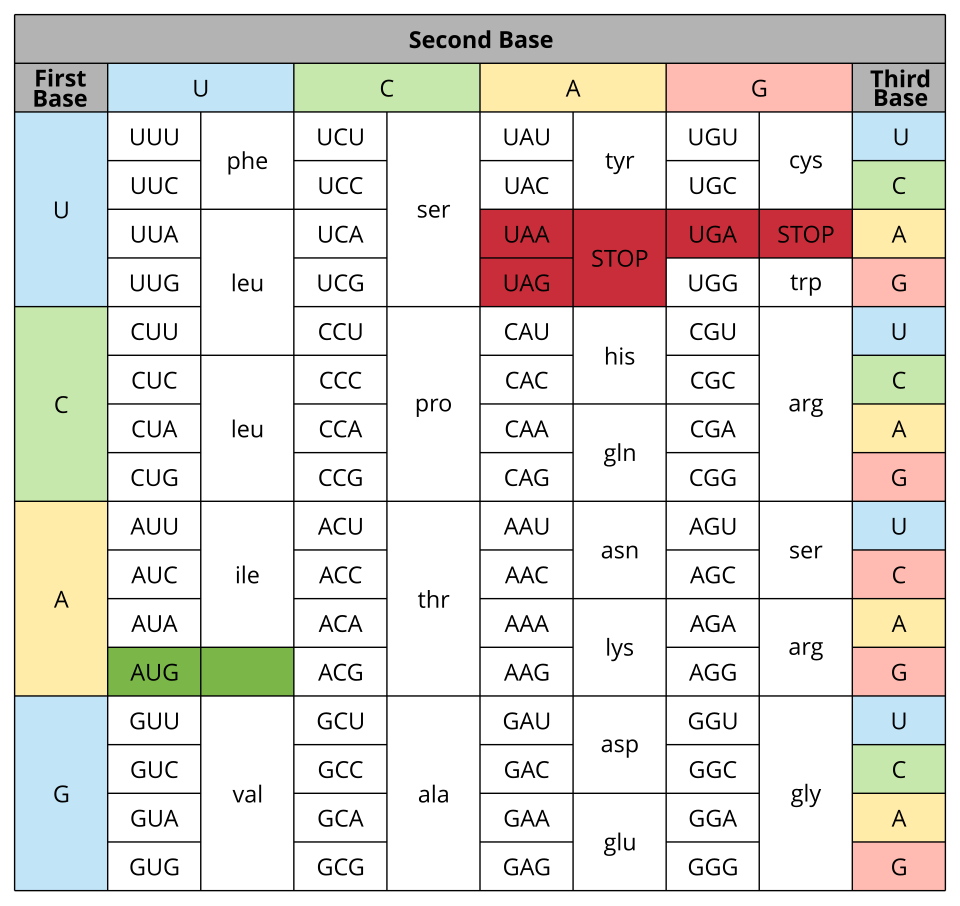
Standard genetic code table showing how each mRNA codon (a three-base triplet) specifies an amino acid or a stop signal. The repeated appearance of the same amino acid across different codons provides a clear visual demonstration of degeneracy (redundancy) in the code. Source
Each codon is made from bases arranged in a precise order, and that order determines the amino acid specified. The code is therefore not random: each codon has a defined meaning. For Edexcel, the key properties to know are that the code is triplet, non-overlapping, and degenerate.
The code is triplet
Why three bases are needed
The code is described as a triplet code because each amino acid is specified by a sequence of three bases. A single base would not provide enough different combinations, and two bases would still not provide enough to code for all amino acids. Using three bases produces many more possible codons, enough for all the amino acids used in proteins.
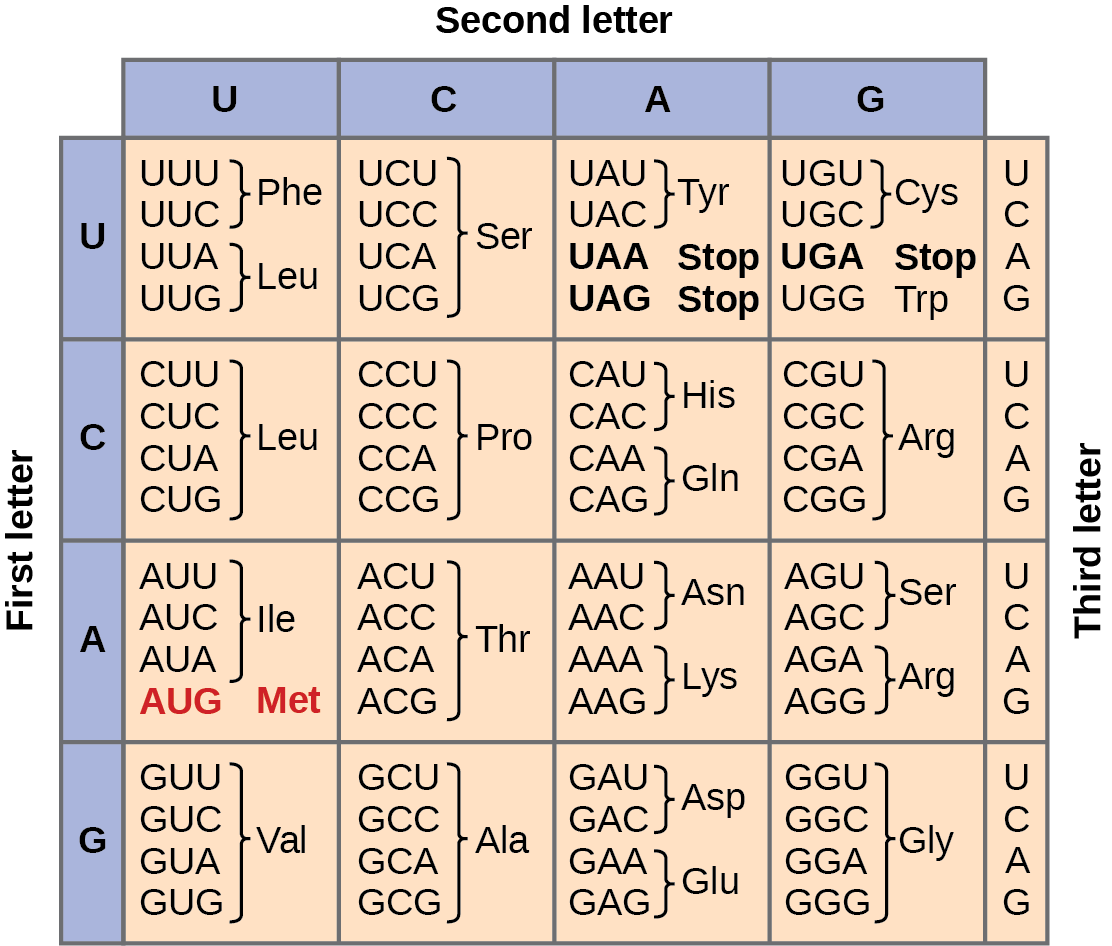
Genetic code chart mapping each of the 64 possible mRNA triplets to an amino acid or a termination (stop) signal. By showing all triplets in one organized table, it makes clear why a three-base code has enough capacity to encode 20 amino acids while still allowing substantial degeneracy. Source
Triplet code: A genetic code in which each amino acid is specified by a codon made of three bases.
This is important because proteins are built from a wide range of amino acids, but nucleic acids contain only a small number of different bases. Grouping bases into triplets allows a limited alphabet to store a much larger amount of information. The sequence of triplets in a gene therefore determines the sequence of amino acids in the resulting polypeptide.
Why the order matters
The order of the three bases in a codon is essential. Changing even one base can change the meaning of the codon. Similarly, rearranging the same three bases into a different order can specify a different amino acid. This shows that the code depends on exact base sequence, not just on which bases are present.
The code is non-overlapping
A non-overlapping code means that each base is read only once, as part of one codon. After one triplet has been read, the next codon begins at the next base, not one or two bases back. This produces a series of separate triplets rather than a sliding pattern.

Example of a single nucleotide sequence being divided into triplets in different possible reading frames. The figure highlights that translation depends on a fixed, non-overlapping grouping of bases into codons, so shifting the frame changes every downstream triplet and therefore the predicted amino-acid sequence. Source
Non-overlapping code: A genetic code in which each base is part of only one codon and is not reused in the next codon.
This feature is important because it keeps the message organized. Each set of three bases contributes to one position in the amino acid sequence. If the code overlapped, one base could affect more than one amino acid at the same time, making the relationship between gene sequence and protein sequence much less direct.
A non-overlapping code also means that the base sequence is read in a fixed grouping. Once the bases are grouped into one set of triplets, the rest of the sequence is interpreted in consecutive threes. The resulting amino acid sequence therefore depends on maintaining the correct grouping of bases throughout the coded region.
The code is degenerate
The genetic code is degenerate, meaning that more than one codon can specify the same amino acid. This does not mean the code is unclear or ambiguous. Each codon still specifies only one amino acid, but several different codons may share that same meaning.
Degenerate code: A genetic code in which two or more different codons can code for the same amino acid.
Degeneracy arises because there are more possible triplet codons than there are amino acids in proteins. As a result, some amino acids are represented by several codons, while others are represented by fewer. This means there is not always a one-to-one relationship between codons and amino acids.
Why degeneracy matters
Degeneracy can reduce the effect of some changes in the base sequence. If one base in a codon changes, the new codon may still specify the same amino acid. In that case, the amino acid sequence of the polypeptide would remain unchanged. This is one reason why not every base change necessarily alters a protein.
However, degeneracy does not make all mutations harmless. Some base changes still produce a codon for a different amino acid, and these changes can alter the structure and function of the protein. The key point is that degeneracy provides some flexibility in the code, not complete protection.
Linking the three properties
These three properties work together to make genetic information usable and reliable:
Triplet: three bases are read together to specify one amino acid.
Non-overlapping: each base belongs to only one codon.
Degenerate: different codons can specify the same amino acid.
Together, these features help explain how genes can store instructions for making proteins using only a small set of bases. The triplet nature provides enough combinations, the non-overlapping arrangement keeps the message orderly, and degeneracy allows some tolerance to base changes. When revising, make sure you can identify each property clearly and explain its biological significance rather than just memorizing the terms.
Practice Questions
State what is meant by the genetic code being triplet and non-overlapping. (2 marks)
1 mark: Triplet means one amino acid is specified by three bases / a codon of three bases.
1 mark: Non-overlapping means each base is read once only / each base is part of one codon only.
Explain what is meant by the genetic code being degenerate, and describe how the properties triplet and non-overlapping allow a base sequence to specify an amino acid sequence. (5 marks)
1 mark: Degenerate means more than one codon can code for the same amino acid.
1 mark: A given codon codes for only one amino acid.
1 mark: Triplet means codons consist of three bases.
1 mark: Three-base codons provide enough different combinations to code for all amino acids.
1 mark: Non-overlapping means bases are read in separate consecutive codons / each base belongs to one codon only.
FAQ
In the standard genetic code, leucine, serine, and arginine each have six codons. Methionine and tryptophan each have one.
This uneven pattern shows that degeneracy is not spread equally across all amino acids. Some amino acids have many alternative codons, while others have very little redundancy.
Many codon groups share the same first two bases and differ only at the third. Because of that pattern, a change at the third base often leaves the amino acid unchanged.
This makes the code more fault-tolerant. It helps explain why some single-base substitutions do not alter the amino acid sequence of a polypeptide.
The genetic code is nearly universal. In most organisms, a given codon specifies the same amino acid.
There are a few exceptions, especially in mitochondria and some microorganisms, where certain codons are assigned differently. The overall similarity is strong evidence that living organisms share a common evolutionary origin.
A codon table is a chart that shows which amino acid corresponds to each codon.
Most codon tables are read in this order:
first base
second base
third base
Some books use a grid, while others use a circular chart. The format may change, but the codon meanings stay the same.
Scientists used artificial RNA sequences in cell-free systems and observed which polypeptides were produced. Repeating sequences helped them match specific codons to specific amino acids.
Later experiments completed the full codon assignments. This showed that codons are interpreted in a consistent and predictable way, rather than being assigned at random.

