

Edexcel Syllabus focus:
'Understand the role of start and stop codons in controlling where translation begins and ends during protein synthesis.'
Start and stop codons act as essential punctuation in protein synthesis, ensuring ribosomes begin translation at the correct place and stop at the correct point on an mRNA molecule.
Codons as control signals
During translation, the ribosome reads the base sequence on mRNA in groups of three. These three-base units are important because each one provides an instruction during protein synthesis.
Codon: A sequence of three bases on mRNA that is read by the ribosome during translation.
Most codons specify an amino acid, but start codons and stop codons have a special control role. They do not simply add information about amino acid order. Instead, they help determine exactly where translation starts and where it finishes.
This means that start and stop codons are essential for producing the correct polypeptide. If either is in the wrong place, the ribosome may produce a protein with the wrong amino acid sequence or the wrong length.
Start codons
The start codon begins translation
A start codon marks the point on the mRNA where the ribosome should begin translating the base sequence into an amino acid sequence. In the standard genetic code, the start codon is usually AUG.
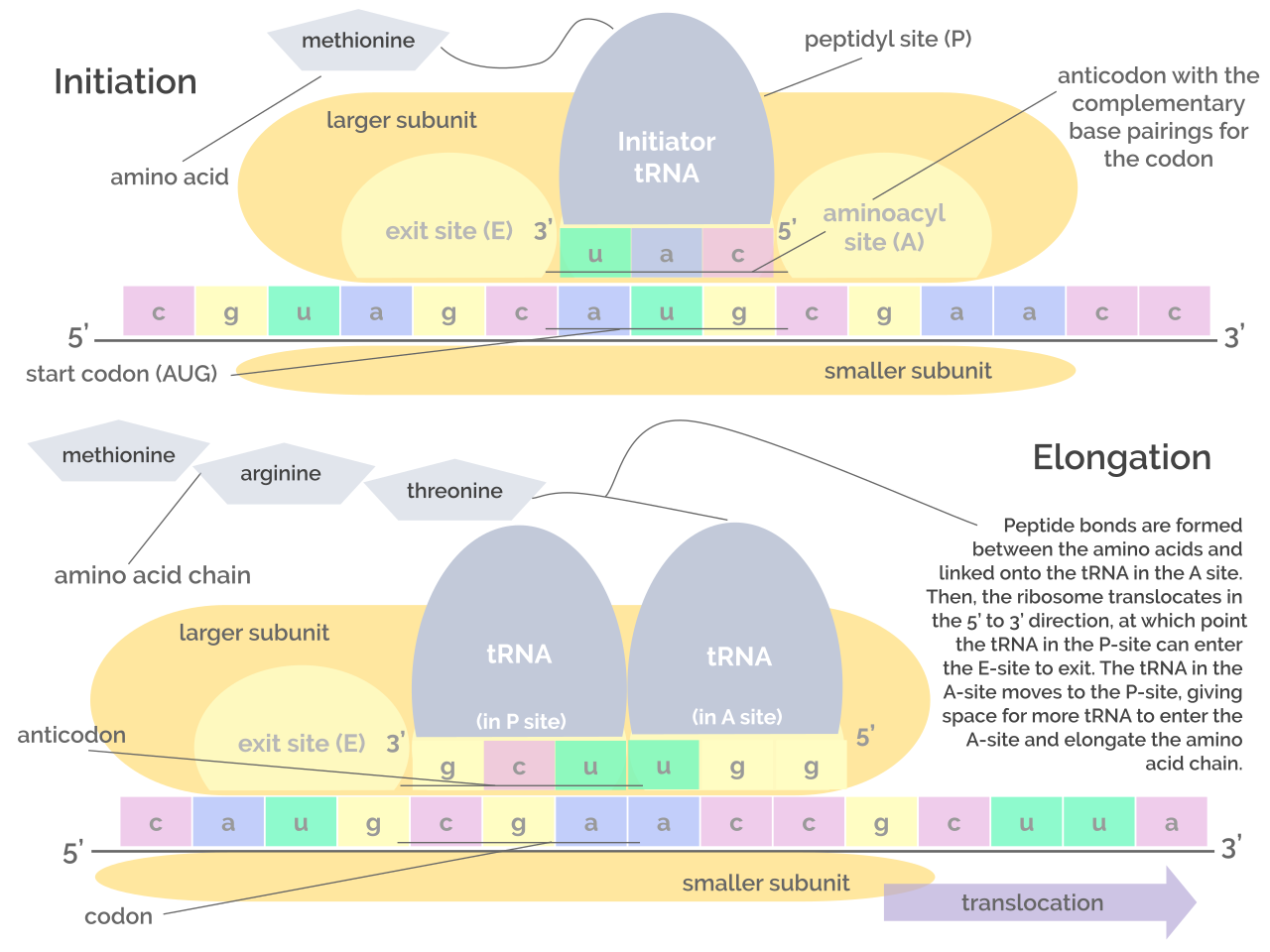
Diagram of translation initiation and early elongation, showing the initiator tRNA (methionine) pairing with the AUG start codon inside the ribosome. The labeled A, P, and E sites help connect codon recognition on mRNA to orderly polypeptide growth as the ribosome moves along the transcript. Source
AUG has two linked roles:
it signals the beginning of translation
it codes for the amino acid methionine
This means the first amino acid added to a newly forming polypeptide is usually methionine.
The start codon sets the reading frame
The exact position of the start codon is extremely important because the ribosome reads the mRNA in continuous triplets from that point onward.
Reading frame: The way a nucleotide sequence is divided into consecutive, non-overlapping triplets during translation.
Once the ribosome begins at the correct start codon, every following base is grouped correctly into codons. This ensures the correct amino acids are added in the correct order.
If translation started one base earlier or one base later, the triplets would be grouped differently. As a result:
different codons would be read
different amino acids would be added
the polypeptide produced would usually be incorrect
So, the start codon does more than indicate “begin here.” It also fixes the entire reading frame for the rest of the translated sequence.
Why the start position matters
Because the start codon determines the first codon read, it strongly influences the identity of the final protein. A ribosome must begin at the correct place to make the intended product of that gene.
If the correct start codon is not used:
translation may fail to begin
translation may begin at a different AUG farther along the mRNA
the resulting polypeptide may be shorter than normal
the amino acid sequence may be altered
Therefore, the start codon is a key control point in protein synthesis.
Stop codons
The stop codon ends translation
A stop codon marks the point where translation must end.
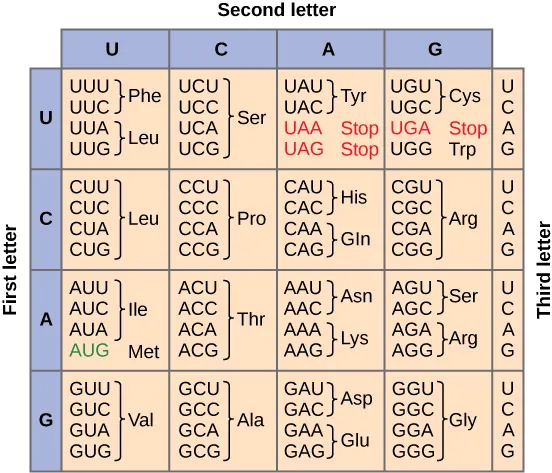
Genetic code (codon) table showing how each mRNA triplet specifies an amino acid, with AUG labeled as the start codon (methionine) and UAA/UAG/UGA labeled as stop signals. It reinforces that stop codons terminate translation rather than adding an amino acid, while AUG both initiates translation and encodes methionine. Source
The three stop codons in mRNA are:
UAA
UAG
UGA
Unlike most codons, stop codons do not code for an amino acid. When the ribosome reaches one of them, no further amino acid is added to the polypeptide chain.
Instead, the stop codon acts as a signal that the polypeptide is complete. The chain is released, and translation terminates.
What stop codons control
The position of the stop codon determines the length of the polypeptide. Every codon from the start codon up to, but not including, the stop codon contributes to the amino acid sequence.
This means the stop codon:
defines where the amino acid sequence finishes
prevents extra amino acids from being added
ensures the protein has the correct length
The stop codon itself is not translated into an amino acid. It functions only as a termination signal.
How start and stop codons work together
Start and stop codons work together to define the section of mRNA that will be translated into a polypeptide.
The start codon tells the ribosome where to begin, and the stop codon tells it where to end. Together, they establish the precise boundaries of the translated region.
This is important because the function of a protein depends on its specific amino acid sequence and its correct length. If translation begins or ends in the wrong place, the protein may not fold properly or may not carry out its normal function.
Changes affecting these codons can have major effects:
a changed start codon may prevent translation from starting normally
a new stop codon appearing too early can cause translation to end too soon
loss of a normal stop codon can allow translation to continue too far
In each case, the control of where translation begins and ends is disrupted.
Key distinctions to remember
A start codon usually is AUG
A start codon begins translation
A start codon codes for methionine
A stop codon may be UAA, UAG, or UGA
A stop codon ends translation
A stop codon does not code for an amino acid
The start codon establishes the reading frame
The stop codon determines where the polypeptide chain finishes
Correct protein synthesis depends on both signals being in the correct positions on the mRNA.
Practice Questions
State the role of a start codon and a stop codon in translation. (2 marks)
Start codon identifies where translation begins / where the ribosome starts reading the mRNA. (1)
Stop codon identifies where translation ends / where the ribosome stops and releases the polypeptide. (1)
Explain how start and stop codons control the production of the correct polypeptide during translation. (6 marks)
A start codon marks the point where translation begins. (1)
The usual start codon is AUG. (1)
The start codon sets the correct reading frame for the ribosome. (1)
Reading from the wrong starting point would change the codons read and therefore change the amino acid sequence. (1)
A stop codon marks the end of translation. (1)
Stop codons do not code for an amino acid / ensure the polypeptide has the correct length by stopping addition of further amino acids. (1)
FAQ
Yes, equivalent base sequences are present in DNA, but the ribosome reads mRNA, not DNA.
For example:
the common start codon in mRNA is AUG
the corresponding sequence on the coding DNA strand is ATG
Stop codons also have DNA equivalents. However, when discussing translation, codons are usually given as mRNA sequences because that is the molecule directly read by the ribosome.
AUG is widely used because the translation machinery has evolved to recognize it efficiently as the main initiation signal.
It is useful because it does two jobs at once:
it tells the ribosome where to begin
it specifies methionine as the first amino acid
This creates a reliable starting point for protein synthesis. In some organisms and special cases, alternative start codons can be used, but AUG is the standard one students are expected to know.
Having three stop codons makes termination more reliable.
This provides:
more than one sequence that can signal the end of translation
a lower chance that a random base change will remove all stopping ability
flexibility in how genes are organized
All three stop codons perform the same basic function: they tell the translation machinery to terminate protein synthesis rather than add another amino acid.
Stop codons are recognized by release factors, not by tRNA molecules.
Release factors:
enter the ribosome when a stop codon is exposed
trigger release of the completed polypeptide
help separate the translation complex
This is why stop codons do not add an amino acid. Instead, they switch the ribosome from elongation to termination.
This is often called a premature stop codon.
It can cause:
translation to end too early
a shortened polypeptide to be produced
loss of important regions of the protein
A shorter protein may fold incorrectly, be unstable, or fail to function at all. The effect depends on how early the new stop codon appears and how important the missing section is to the final protein.

