

Edexcel Syllabus focus:
'Understand transcription, including the role of RNA polymerase and the DNA template, or antisense, strand.'
Transcription is the first stage of gene expression, where the base sequence of DNA is copied into RNA. Understanding which DNA strand is used is essential for predicting the RNA produced.
What transcription is
A gene is expressed by first making an RNA copy of its base sequence. During transcription, the information in DNA is transferred into a single-stranded RNA molecule, usually messenger RNA (mRNA), in the nucleus of eukaryotic cells.
Transcription: The synthesis of an RNA molecule using a DNA template strand.
Only the gene being used is copied, not the whole chromosome. This means different cells can transcribe different genes at different times, helping control cell activity. The RNA made is much shorter than the entire DNA molecule because only the relevant section of DNA is transcribed.
The DNA template strand
DNA has two strands, but only one is read for a particular gene during transcription.
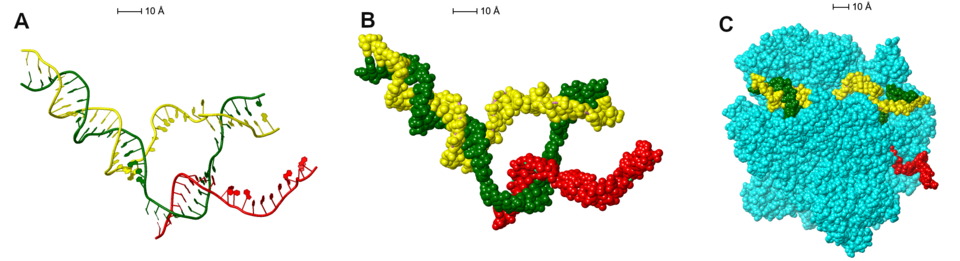
This diagram shows a transcription bubble: a short region of DNA unwound so RNA polymerase can read the template (antisense) strand and synthesize an RNA strand. The figure explicitly labels the template/antisense versus sense/coding strands and shows the RNA product emerging, reinforcing why the RNA sequence is complementary to the template strand (and nearly matches the coding strand). Source
This strand is the template strand, also called the antisense strand.
Template strand: The DNA strand read by RNA polymerase during transcription to produce a complementary RNA sequence.
RNA polymerase moves along the template strand and builds an RNA molecule with a complementary base sequence. Because the RNA is complementary to the template, it is not identical to it.
The other DNA strand is often called the coding or sense strand. Its sequence matches the RNA sequence except that RNA contains uracil (U) instead of thymine (T). This is why identifying the correct strand in exam questions is so important.
Base-pairing rules during transcription
DNA A pairs with RNA U
DNA T pairs with RNA A
DNA C pairs with RNA G
DNA G pairs with RNA C
These pairing rules ensure that the genetic information in the gene is copied accurately into RNA.
The role of RNA polymerase
The key enzyme in transcription is RNA polymerase.
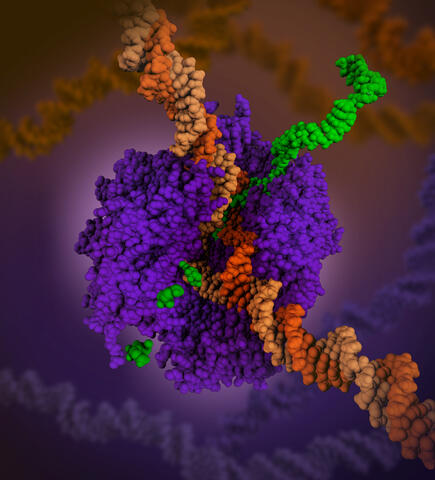
This structural visualization depicts RNA polymerase bound to DNA while synthesizing an RNA strand, highlighting the physical basis of transcription. The image helps connect the idea of a “template strand” to the enzyme’s active site, where incoming RNA nucleotides are assembled into a growing RNA chain as the DNA is locally unwound. Source
It recognizes the start of a gene, opens a short section of the DNA double helix, and controls the assembly of the new RNA strand.
RNA polymerase: An enzyme that catalyzes the formation of an RNA strand from RNA nucleotides using a DNA template.
The enzyme reads the exposed bases on the template strand. Free RNA nucleotides pair with these bases by complementary base pairing, and RNA polymerase joins the nucleotides together to form the sugar-phosphate backbone of the RNA molecule.
Only a short length of DNA is unwound at one time. Behind the enzyme, the DNA strands re-form hydrogen bonds and the double helix reforms, so the DNA molecule is not permanently opened.
The action of RNA polymerase also determines which DNA strand is used. Because the enzyme binds to the gene in a particular orientation, only one strand serves as the template for that transcription event. This explains why the two DNA strands do not both produce the same RNA sequence.
Sequence of transcription
Transcription can be described as a series of linked events:
RNA polymerase attaches to the DNA at the start of the gene.
Hydrogen bonds between DNA bases break in that region.
One DNA strand is exposed and acts as the template strand.
Free RNA nucleotides pair with the exposed DNA bases.
RNA polymerase joins the RNA nucleotides together in the correct order.
The RNA strand lengthens as the enzyme continues along the gene.
At the end of the gene, the RNA detaches and the DNA rewinds.
The final RNA transcript is single stranded, and its base order depends directly on the order of bases in the DNA template strand.
What determines the RNA sequence
The order of bases on the template strand determines the order of bases in the RNA transcript. Each DNA base on the template allows only one RNA base to pair with it, so the DNA sequence directly controls the RNA sequence produced.
If the template strand contains a different base at any position, the RNA formed at that position will also be different. This means the base sequence in DNA is passed on into RNA through complementary base pairing.
The accuracy of transcription depends on correct base pairing and correct action of RNA polymerase. The enzyme does not choose bases at random. It adds nucleotides according to the sequence of bases exposed on the template strand.
Why the template strand matters
Understanding the template strand is especially important in sequence questions. If you are given an antisense DNA sequence, you must write the RNA sequence that is complementary to it. If you are given the coding strand, the RNA sequence is the same apart from uracil replacing thymine.
A common mistake is to copy the template strand directly into RNA. This is incorrect because the RNA is built using complementary base pairing. Another frequent error is forgetting that RNA uses uracil, not thymine.
For one gene, only one of the two DNA strands acts as the template. However, a different gene on the same DNA molecule may use the opposite strand as its template.
Quick checks
Identify whether the sequence shown is template or coding.
Apply complementary base pairing carefully.
Replace T with U when writing RNA.
Remember that RNA is single stranded.
These checks help prevent avoidable transcription errors.
Practice Questions
State two roles of RNA polymerase in transcription. (2 marks)
Binds to DNA at the start of the gene / recognizes the start of the gene (1)
Separates or unwinds the DNA strands in a short region (1)
Joins RNA nucleotides together to form the RNA strand (1)
Max 2 marks.
A section of DNA has the following template strand sequence:
TACGGTAA
Explain how transcription produces an RNA molecule from this DNA and give the RNA base sequence formed. (5 marks)
RNA polymerase binds to the gene / start of the DNA sequence (1)
DNA unwinds or hydrogen bonds break to expose the template strand (1)
Free RNA nucleotides pair by complementary base pairing with the template strand (1)
RNA polymerase joins the RNA nucleotides together to make a single RNA strand (1)
Correct RNA sequence: AUGCCAUU (1)
FAQ
It is called the antisense strand because its base sequence is complementary to the RNA sequence that is produced.
The sense or coding strand has the same base order as the RNA transcript, except that DNA has thymine and RNA has uracil. The antisense strand is therefore the opposite, complementary version.
Yes. One gene may use one DNA strand as its template, while another gene on the same DNA molecule may use the opposite strand.
What matters is the direction and position in which RNA polymerase binds. For any single transcription event, only one strand acts as the template.
RNA polymerase recognizes specific DNA base sequences linked to genes.
In eukaryotes, it usually works with other proteins that help it bind at the correct starting point. It also stops when it reaches DNA signals that mark the end of transcription, so only the required section is copied.
Uracil is a nitrogenous base used in RNA in place of thymine.
RNA is usually shorter-lived and single stranded, so uracil is suitable for its role. DNA is a more stable long-term store of information, and thymine helps support that stability. For transcription questions, the key point is that RNA contains U, never T.
Yes. If a cell needs a lot of RNA from one gene, multiple RNA polymerase molecules can move along the same gene one after another.
This allows many RNA transcripts to be produced in a short time, increasing the rate of gene expression without changing the DNA sequence itself.

