

Edexcel Syllabus focus:
'Understand translation, including messenger RNA, transfer RNA, ribosomes, codons on mRNA and anticodons on tRNA.'
Translation converts the base sequence carried by mRNA into the amino acid sequence of a polypeptide.
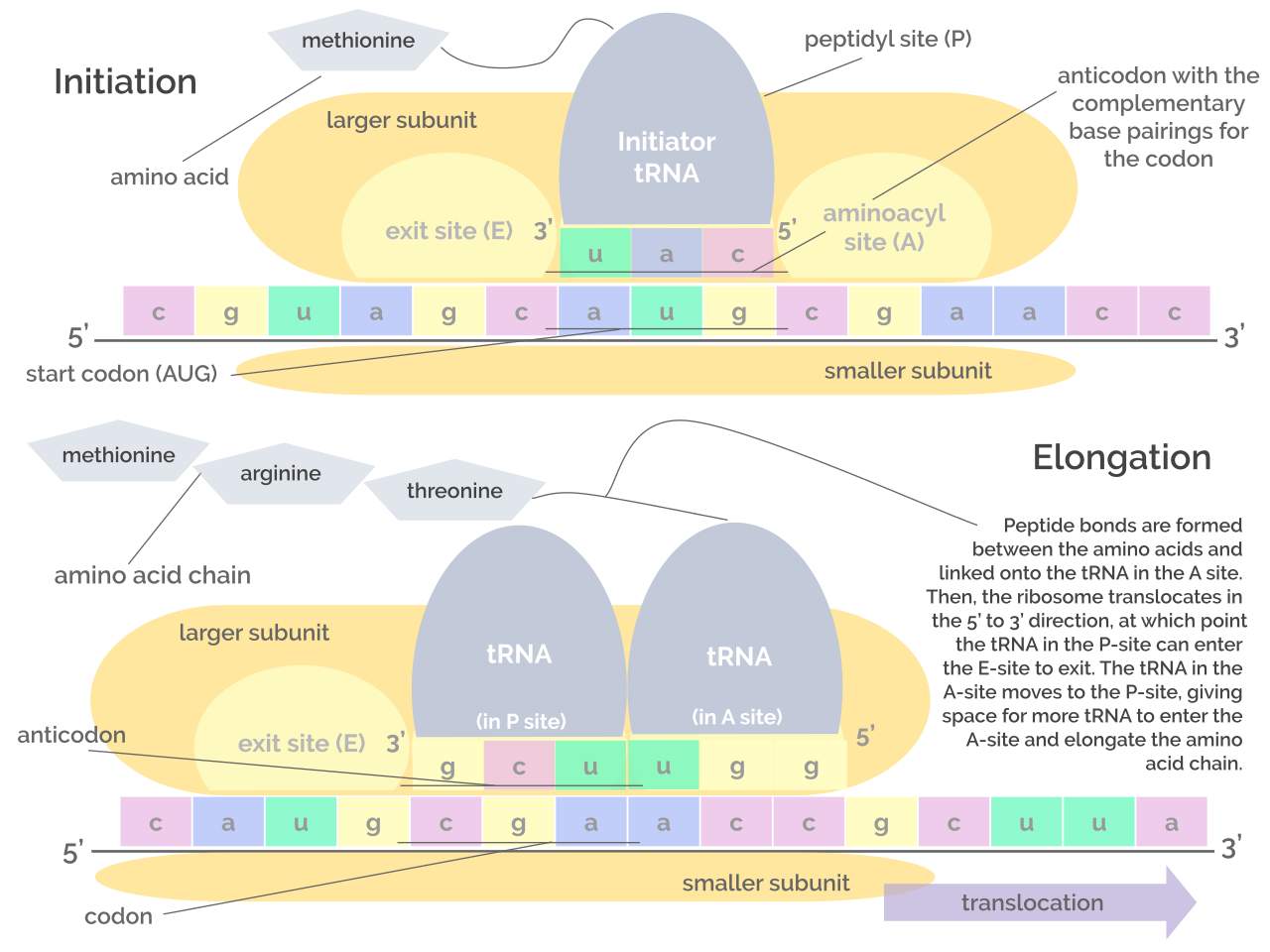
This diagram summarises translation by showing how a ribosome reads mRNA codons while tRNAs with complementary anticodons deliver specific amino acids. It highlights the A, P, and E ribosomal sites and shows how translocation moves tRNAs through these sites as the polypeptide chain elongates. Source
Ribosomes and tRNA molecules make this possible by matching bases accurately and joining amino acids together.
Translation as part of protein synthesis
Translation is the stage of protein synthesis in which information carried in mRNA is used to assemble a polypeptide. It takes place at ribosomes in the cytoplasm. The sequence of bases on mRNA is converted into a sequence of amino acids, so translation links nucleic acid information to protein structure.
Translation: The process in which the base sequence of mRNA is decoded at a ribosome to assemble amino acids into a polypeptide.
This is essential because the function of a protein depends on the order of amino acids in its chain. If the amino acid sequence changes, the protein produced may also change.
Messenger RNA and codons
Messenger RNA (mRNA) carries a copy of the genetic information needed to make a polypeptide from the nucleus to a ribosome. It is single stranded, so its bases are exposed and can be read by the ribosome. This makes mRNA well suited to acting as a temporary set of instructions.
Along the mRNA molecule, bases are read in groups of three. Each group of three bases is called a codon.
Codon: A sequence of three bases on mRNA that specifies an amino acid during translation.
The ribosome reads codons in sequence, one after another. Each codon determines which amino acid should be added next, so the order of codons on mRNA controls the order of amino acids in the polypeptide. If the order of codons changes, the amino acid sequence can change as well.
Transfer RNA and anticodons
Transfer RNA (tRNA) brings amino acids to the ribosome during translation. Each tRNA molecule has a specific three-dimensional shape, a site where one amino acid can attach, and a three-base sequence called an anticodon.
Anticodon: A sequence of three bases on tRNA that is complementary to a codon on mRNA.
During translation, the anticodon on a tRNA pairs with a complementary codon on the mRNA. This ensures that the amino acid carried by that tRNA is placed in the correct position in the growing chain. Different tRNA molecules carry different amino acids, so the cell needs many types of tRNA. The folded shape of tRNA helps it fit accurately into the ribosome.
tRNA as an adaptor molecule
Amino acids do not recognize codons directly. tRNA solves this problem by acting as an adaptor molecule between nucleic acids and amino acids. One end of the tRNA carries a specific amino acid, while the anticodon end recognizes the matching codon on mRNA. Because of this, the sequence of bases on mRNA can control the sequence of amino acids without amino acids binding directly to codons themselves.
Ribosomes as the site of translation
Ribosomes are the sites where translation happens. They hold mRNA and tRNA in the correct positions so that codons and anticodons can pair accurately by complementary base pairing. Ribosomes are made of ribosomal RNA (rRNA) and protein, and their structure is essential for efficient protein synthesis.
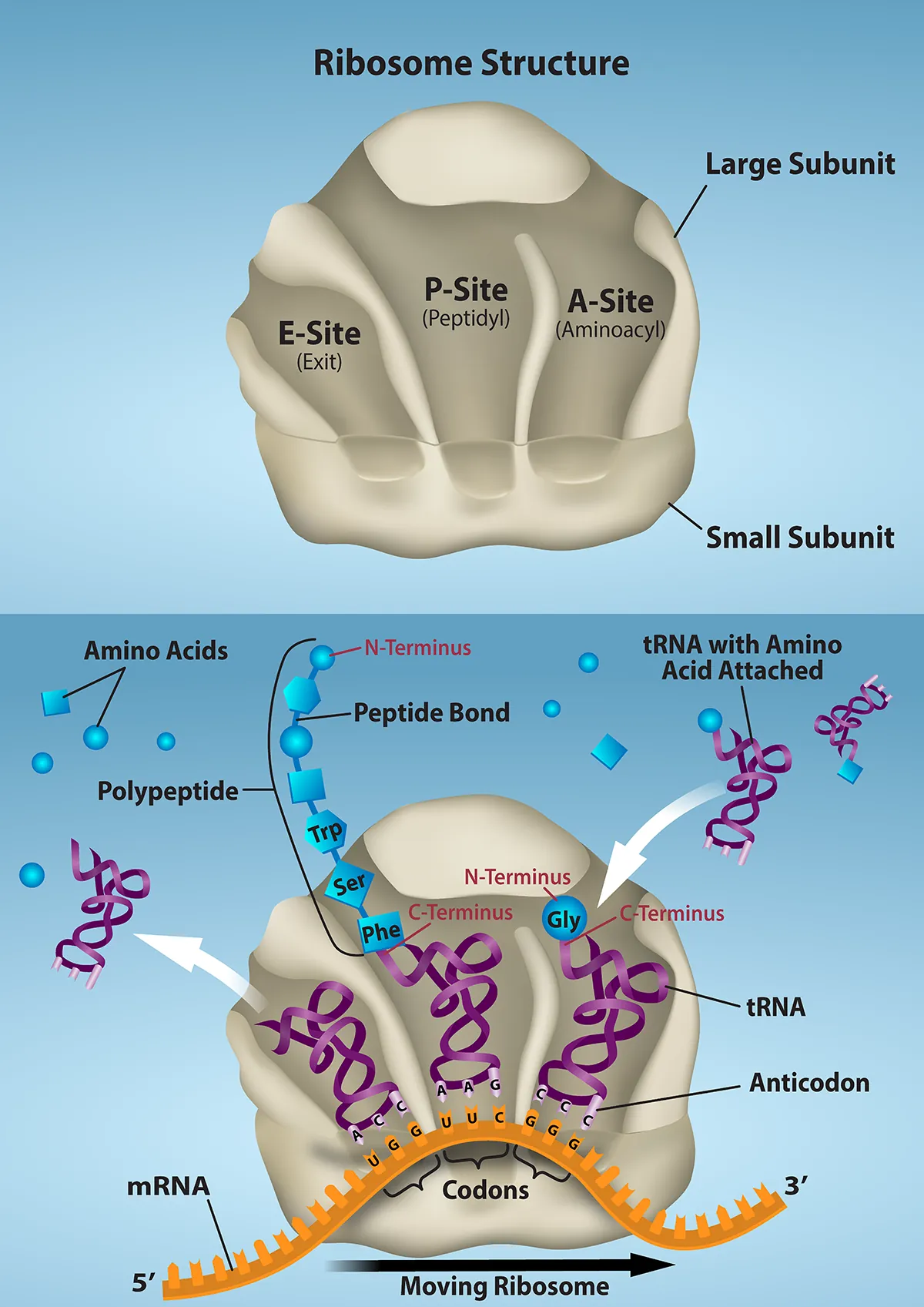
This figure shows the functional layout of a ribosome, including the A (aminoacyl), P (peptidyl), and E (exit) sites where tRNAs bind during translation. It illustrates how codon–anticodon pairing positions amino acids so peptide bonds can form and the polypeptide can be built in the correct order. Source
A ribosome moves along the mRNA one codon at a time. It also catalyzes the formation of peptide bonds between adjacent amino acids. This means the ribosome does not simply support the process; it actively helps build the polypeptide chain.
Sequence of events in translation
Main steps
An mRNA molecule attaches to a ribosome.
A tRNA with a complementary anticodon binds to the first exposed codon on the mRNA.
A second tRNA binds to the next codon, bringing another specific amino acid.
The ribosome catalyzes a peptide bond between the two amino acids.
The first tRNA leaves once its amino acid has been added to the chain.
The ribosome moves along the mRNA, exposing the next codon.
Another tRNA binds, and the cycle repeats, causing the polypeptide to lengthen.
As translation continues, the amino acid chain extends from the ribosome. The order of codons on the mRNA determines the order in which amino acids are joined. In this way, the base sequence on mRNA determines the amino acid sequence of the polypeptide produced.
Why codon-anticodon pairing matters
Accurate pairing between codons and anticodons is essential because even one incorrect amino acid can alter a protein's structure and function. Translation depends on complementary base pairing, but it also depends on the ribosome holding the molecules in the correct arrangement at the correct time.
The roles of mRNA, tRNA, and ribosomes are closely linked:
mRNA provides the sequence of codons
tRNA brings specific amino acids and matches anticodons to codons
ribosomes coordinate the process and join amino acids together
Together, these components allow cells to produce the correct polypeptides needed for normal cell activity.
Practice Questions
State the role of mRNA and the role of tRNA in translation. (2 marks)
1 mark for stating that mRNA carries the genetic code / codons to the ribosome
1 mark for stating that tRNA carries a specific amino acid and has an anticodon complementary to the codon on mRNA
Explain how ribosomes, codons on mRNA, and anticodons on tRNA interact during translation to produce a polypeptide. (5 marks)
1 mark for stating that the ribosome is the site of translation / mRNA attaches to the ribosome
1 mark for stating that mRNA is read in codons / groups of three bases
1 mark for stating that tRNA carries specific amino acids
1 mark for stating that the anticodon on tRNA pairs with a complementary codon on mRNA
1 mark for stating that the ribosome catalyzes peptide bond formation between amino acids
1 mark for stating that the ribosome moves along the mRNA and the process repeats
Maximum 5 marks
FAQ
This allows the cell to make many copies of the same polypeptide quickly.
When several ribosomes attach to one mRNA, the structure is called a polysome. Each ribosome reads the same mRNA independently, so multiple polypeptide chains can be produced at once. This is an efficient way to increase protein production without needing a new mRNA molecule every time.
A specific enzyme attaches the correct amino acid to each tRNA.
These enzymes are called aminoacyl-tRNA synthetases. Each enzyme recognizes:
a particular amino acid
the correct tRNA or group of related tRNAs
This is important because the ribosome checks codon-anticodon pairing, but it does not check whether the tRNA is carrying the correct amino acid. Accurate loading of tRNA is therefore essential for accurate translation.
mRNA is a temporary message rather than a permanent cell component.
Its short lifespan helps the cell control protein production more precisely. If conditions change, the cell can stop making a protein by degrading the relevant mRNA. In contrast, tRNA and rRNA are reused many times in translation, so they are generally more stable.
Ribosomes on the rough endoplasmic reticulum (RER) usually make proteins that will be:
secreted from the cell
inserted into cell membranes
sent to organelles within the endomembrane system
This arrangement is efficient because the newly made polypeptide can enter the RER as it is being synthesized, where it can be folded and processed for transport.
Some amino acids can be specified by more than one codon.
Because of this, cells may have different tRNA molecules with different anticodons that all carry the same amino acid. This helps the translation system read different codons correctly while still adding the same amino acid to the polypeptide. It increases flexibility without changing the final protein sequence.

