

Edexcel Syllabus focus:
'Understand how Meselson and Stahl's classic experiment supported the accepted theory of DNA replication and refuted competing theories.'
Meselson and Stahl designed a powerful experiment that used isotopes and centrifugation to test how DNA copies itself, providing strong evidence for semiconservative replication and ruling out alternative explanations.
Why this experiment was needed
By the time Meselson and Stahl carried out their work, scientists accepted that DNA stored genetic information, but they still needed strong evidence for the exact mechanism of copying it. The central idea under test was semiconservative replication.
Semiconservative replication: DNA replication in which each new DNA molecule contains one original strand and one newly synthesized strand.
The competing theories were conservative replication, in which the original double helix stayed intact while an entirely new copy was made, and dispersive replication, in which old and new DNA were mixed together within both strands.
This schematic compares how parental DNA strands are distributed into daughter molecules under conservative, semiconservative, and dispersive replication models. By explicitly tracking “old” versus “new” strands, it clarifies why different mechanisms predict different density-banding patterns after isotope switches. Source
Each model gave different predictions, so the correct one could be identified experimentally.
Semiconservative replication became the accepted theory because Meselson and Stahl produced results that matched its predictions and contradicted the alternatives.
Experimental design
Meselson and Stahl used E. coli bacteria because they reproduce quickly, allowing several generations of DNA replication to be studied in a short time. They first grew the bacteria in a medium containing the heavy isotope of nitrogen, . Because nitrogen is present in DNA bases, the bacteria produced heavy DNA.
To separate DNA molecules by density, they used density-gradient centrifugation.
Density-gradient centrifugation: A technique that separates molecules according to density by spinning them at high speed in a solution that forms a density gradient.
The bacteria were then transferred into a medium containing the lighter isotope, . Any DNA made after this transfer would contain the lighter nitrogen. Samples were taken after one generation of replication and after later generations so the densities of the DNA molecules could be compared over time.
When the extracted DNA was centrifuged in cesium chloride, it formed bands at different positions.
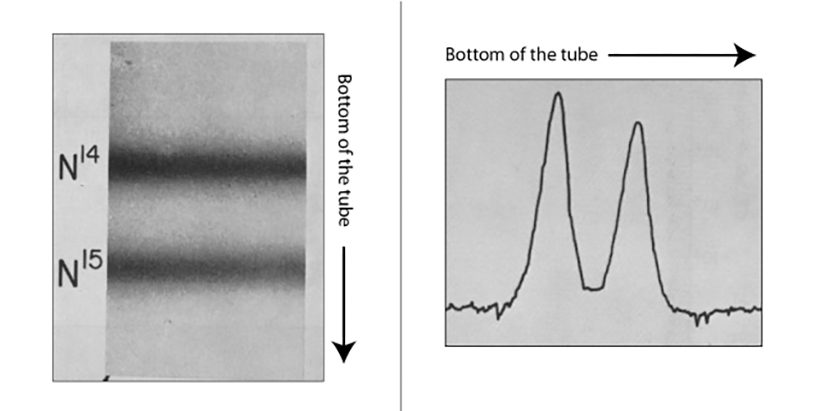
This figure illustrates how DNA of different buoyant densities forms discrete bands in a cesium chloride gradient after ultracentrifugation. The accompanying trace converts the band positions into a quantitative intensity profile, making it easier to compare predicted versus observed outcomes in replication-model tests. Source
Heavy DNA formed a lower band, light DNA formed a higher band, and hybrid DNA containing one heavy strand and one light strand formed a band in between.
Predictions of the different models
The experiment was so important because each replication model made a clear prediction.
Semiconservative replication
After one generation in , all DNA should be hybrid, so there should be one intermediate band.
After two generations, there should be two bands: one hybrid and one light.
Conservative replication
After one generation, there should be two separate bands, one heavy and one light, because the original heavy DNA stays unchanged.
After two generations, the heavy band should still remain, with more light DNA present.
Dispersive replication
After one generation, all DNA should give one intermediate band.
After two generations, there should still be one band only, but it would move slightly closer to the light position because each molecule would contain a greater proportion of light nitrogen.
Results after one and two generations
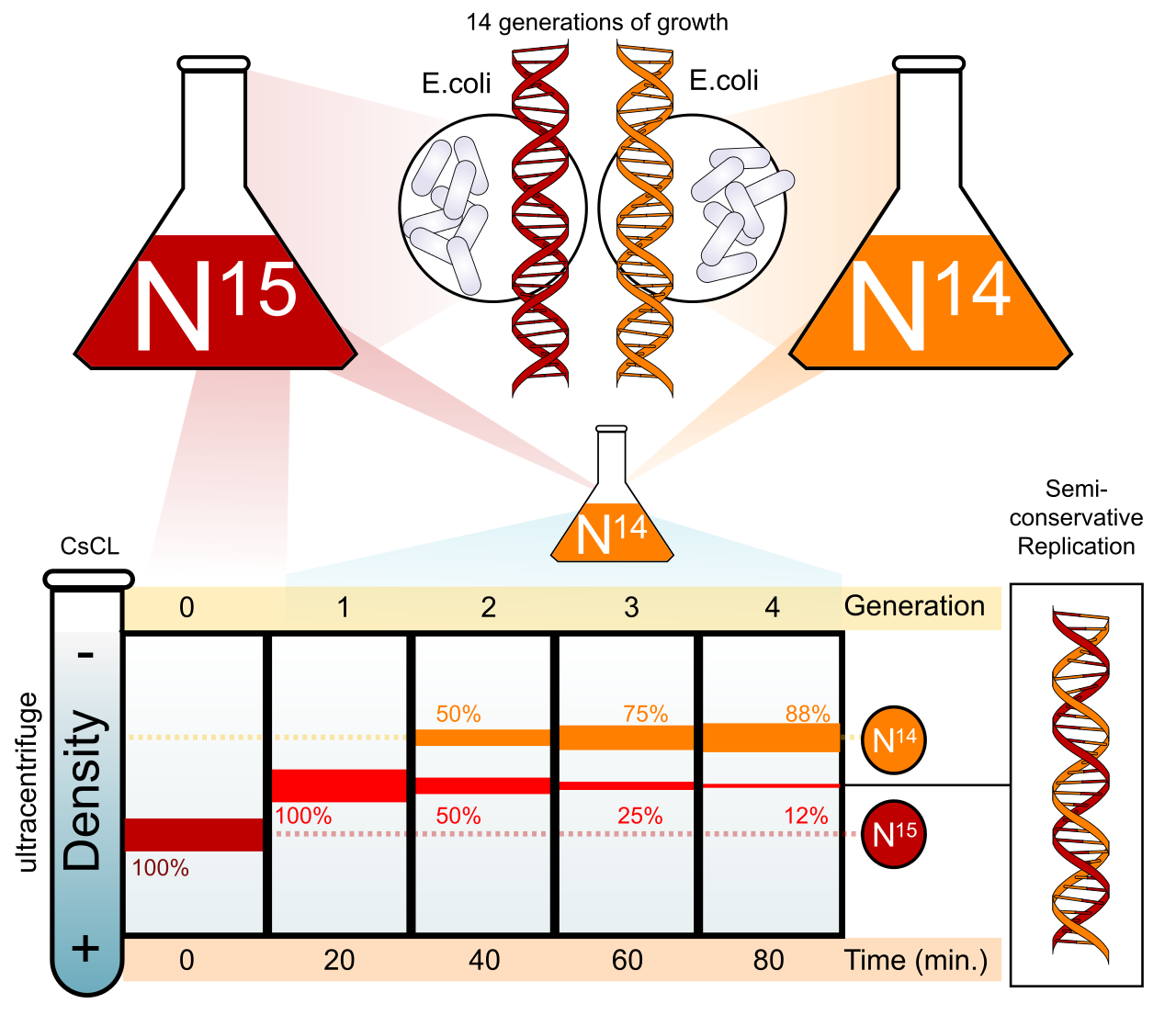
After one generation, Meselson and Stahl observed a single intermediate band. This result immediately refuted the conservative model, because conservative replication predicted two distinct bands, not one hybrid band.
However, this first result did not distinguish between semiconservative and dispersive replication. Both of those models predicted DNA of intermediate density after one generation in .
After two generations, the DNA formed two bands: one intermediate band and one light band.
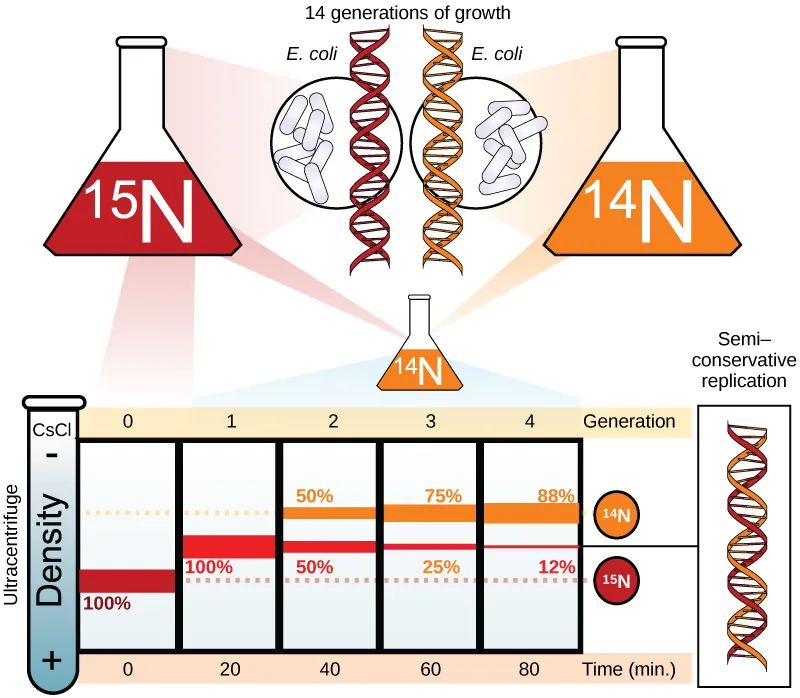
This diagram summarizes the Meselson–Stahl results from density-gradient centrifugation after shifting cells from to . It shows the emergence of an intermediate-density (hybrid) band after one generation and the appearance of a separate light band after two generations, the signature pattern expected for semiconservative replication. Source
This was the crucial result. It matched the prediction of semiconservative replication exactly. It also refuted the dispersive model, because dispersive replication predicted only a single band of intermediate density, not a separate light band.
In later generations, the light band became more intense, while the hybrid band remained present in a smaller proportion. This pattern was also consistent with semiconservative replication.
Why the experiment was convincing
Meselson and Stahl's experiment is often described as a classic experiment because it tested competing ideas directly rather than simply collecting descriptive evidence.
The use of and allowed old and new DNA to be distinguished by density.
The use of successive generations made the predictions more powerful.
The banding pattern gave visible, measurable evidence that could be compared with each model.
This meant the experiment did two things at once. It supported the accepted theory of semiconservative replication, and it refuted competing theories by showing that their predicted banding patterns did not occur.
Scientific significance
The experiment is a strong example of how scientific explanations are tested. A model is not accepted just because it sounds reasonable. It must make predictions that can be checked against evidence. Meselson and Stahl showed that semiconservative replication best explained the results, while conservative and dispersive replication failed to do so. Their work turned DNA replication from a proposed idea into a process supported by clear experimental evidence.
Practice Questions
After one generation in a medium containing , Meselson and Stahl found a single intermediate DNA band. Explain why this result refuted the conservative model of DNA replication. (2 marks)
Conservative replication predicted two separate bands, one heavy and one light. (1)
Only one intermediate band was seen, showing the DNA was hybrid rather than separated into old heavy DNA and new light DNA. (1)
Describe how Meselson and Stahl used nitrogen isotopes and centrifugation to investigate DNA replication, and explain how their results supported semiconservative replication. (5 marks)
E. coli were grown first in so their DNA became heavy. (1)
Bacteria were then transferred to so newly made DNA contained light nitrogen. (1)
DNA was extracted after generations and separated by density using density-gradient centrifugation. (1)
After one generation, one intermediate band was seen, ruling out conservative replication. (1)
After two generations, one intermediate band and one light band were seen, supporting semiconservative replication and ruling out dispersive replication. (1)
FAQ
Nitrogen is part of the nitrogen-containing bases in DNA, so changing the isotope changes the density of DNA directly.
This made $^{15}N$ and $^{14}N$ especially useful because:
they behave chemically very similarly
they do not radically alter DNA structure
they allow old and new DNA to be separated by density
That gave a cleaner test than many other labels would have provided.
E. coli was useful because it grows rapidly and can be cultured easily in a controlled medium.
This meant researchers could:
produce many cells quickly
switch the nitrogen source at a known time
collect DNA after specific generations
obtain enough DNA for clear banding results
Using a bacterium made the experiment faster and technically simpler than using a large multicellular organism.
Cesium chloride forms a density gradient during ultracentrifugation. That means the solution becomes gradually denser from top to bottom.
DNA molecules move until they reach the point where their own density matches the surrounding solution. This is called their buoyant density.
As a result:
light DNA settles higher
heavy DNA settles lower
hybrid DNA forms a band in between
This is why distinct DNA bands could be seen.
DNA absorbs ultraviolet light, so the bands could be located by examining the centrifuge tube with UV detection methods.
The DNA was not identified by color alone. Instead, researchers detected where the DNA had concentrated in the tube.
What mattered was the position of each band:
lower position = denser DNA
higher position = less dense DNA
middle position = intermediate density
That position revealed whether the DNA was heavy, light, or hybrid.
Not as clearly. A radioactive label can show that new material has been incorporated, but it does not automatically separate intact DNA molecules by density.
Meselson and Stahl needed to distinguish between whole DNA molecules predicted by different replication models. Density labeling did this especially well because it allowed:
heavy DNA
light DNA
hybrid DNA
to appear as separate bands.
So radioactive labeling could provide useful information, but it would not have given the same direct visual test of the competing models.

