

Edexcel Syllabus focus:
'Understand the process of DNA replication, including the role of DNA polymerase in forming new complementary DNA strands.'
DNA replication copies genetic information before cell division.
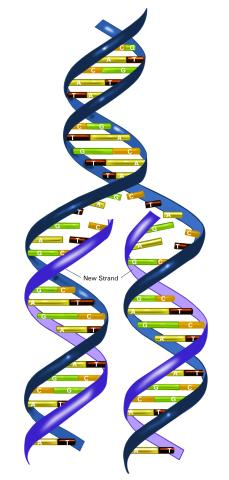
Overview of DNA replication showing the original double helix separating and each original strand acting as a template for a newly synthesized complementary strand. The labeled ‘New Strand’ makes the semiconservative outcome visually explicit: two DNA molecules form, each containing one old and one new strand. Source
A clear understanding of strand separation, complementary base pairing, and the action of DNA polymerase is essential for explaining how new DNA molecules are produced.
Purpose of DNA replication
Before a cell divides, it must make an exact copy of its DNA so that each daughter cell receives a full set of genetic information. Replication allows the base sequence of genes to be passed on.
When biologists refer to DNA replication, they mean the copying of a DNA molecule to produce new DNA molecules from an original template.
DNA replication: The copying of a DNA molecule to produce new DNA molecules using an original DNA molecule as a template.
The structure of DNA makes this possible. DNA is double stranded, and the bases on one strand pair specifically with the bases on the other strand. Because of this complementary base pairing, each existing strand can be used to direct the formation of a new partner strand.
Stages of DNA replication
Separation of the original strands
At the start of replication, the hydrogen bonds between paired bases break. The double helix unwinds, and the two strands separate. This exposes the bases on each strand.
Each original strand now acts as a template strand. A template is a pattern used to make something new. Here, the order of bases on the template controls the order of bases added to the new strand.
The two template strands are copied during the same overall replication event, so both original strands are used to guide synthesis. This ensures the whole DNA molecule is reproduced, not just half of it.
Complementary base pairing
Free DNA nucleotides in the nucleus move into place next to the exposed bases on each template strand. The pairing rules are fixed:
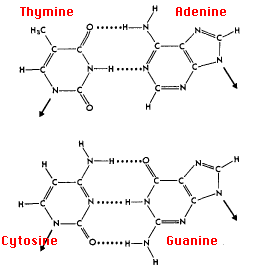
Watson–Crick base pairing shown as chemical structures: adenine pairs with thymine via two hydrogen bonds, while cytosine pairs with guanine via three. This diagram helps explain why base pairing is chemically specific and therefore supports accurate copying of the base sequence. Source
adenine pairs with thymine
cytosine pairs with guanine
This means nucleotides do not line up randomly. If a base on the template strand is adenine, thymine is added opposite it. If the template has guanine, cytosine is added opposite it. The template therefore determines the sequence of the new strand.
This stage is essential because the information in DNA lies in its base sequence. Replication works by preserving that sequence through base-pairing rules.
Because base pairing is chemically specific, adenine does not normally pair with cytosine in DNA, and guanine does not pair with thymine. This helps reduce errors during copying.
Formation of the new sugar-phosphate backbone
The enzyme DNA polymerase is responsible for building the new strand once the correct nucleotides are in position.
DNA polymerase: An enzyme that joins DNA nucleotides together to form a new complementary DNA strand during replication.
DNA polymerase moves along each template strand and joins the adjacent nucleotides together. It forms the phosphodiester bonds of the sugar-phosphate backbone, creating a continuous polynucleotide strand. The new strand is therefore not just a row of matched bases; it becomes a stable DNA strand with the correct chemical structure.
Each nucleotide added contributes a deoxyribose sugar, a phosphate group, and a nitrogen-containing base. DNA polymerase links one nucleotide to the next in the order set by the template. Its role is central because without it, complementary nucleotides might match temporarily, but they would not become part of a permanent new DNA molecule.
End products of replication
As the process continues on both original strands, a new complementary strand is formed alongside each template. Replication produces two DNA molecules that carry the same genetic information as the starting molecule.
In each new DNA molecule:
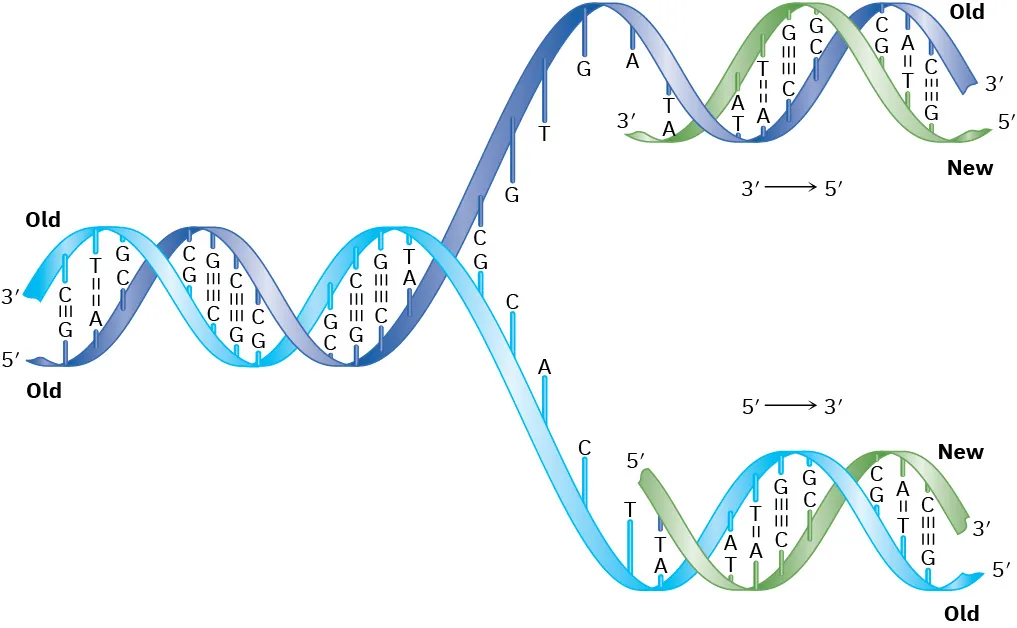
Semiconservative replication: the parental (old) strands separate and each serves as a template for synthesis of a new complementary strand. The figure also highlights strand polarity (5′ and 3′ ends), linking base pairing to directional strand formation. Source
one strand is from the original DNA molecule
one strand has been newly made by DNA polymerase
Hydrogen bonds form again between complementary bases, restoring the double-stranded structure.
Why DNA replication is accurate
The accuracy of replication depends mainly on two features working together:
the strict rules of complementary base pairing
the action of DNA polymerase in joining nucleotides into the correct sequence
The cell does not guess the order of bases in the new strand. Instead, the sequence already present on the template strand determines it. This is why DNA can be copied precisely, even though DNA molecules are very long.
If the template strand has a particular sequence, only one complementary sequence can be formed. This preserves the information stored in genes and makes DNA suitable for inheritance from one cell generation to the next.
The specific role of DNA polymerase
It is important to be precise about what DNA polymerase does. It does not provide the genetic information. That information is already present in the template strand. DNA polymerase also does not decide which bases pair together, because the pairing rules are determined by the chemical structure of the bases themselves.
Instead, DNA polymerase:
reads along the template indirectly by following base-pairing
adds nucleotides in the correct complementary order
joins those nucleotides into a new strand
helps produce two complete DNA molecules before division
This makes DNA polymerase the key enzyme in converting base pairing into an actual copied DNA strand.
Why replication matters in cells
Every time a cell divides, its DNA must already have been copied. If replication did not occur, daughter cells would not receive a complete set of genetic instructions. If DNA polymerase failed to form the new complementary strands properly, the DNA would not be fully reproduced.
DNA replication therefore links molecular structure to biological continuity. The double-stranded nature of DNA, the pairing between bases, and the activity of DNA polymerase together allow genetic information to be copied reliably in living cells.
Practice Questions
Name the enzyme that forms new complementary DNA strands during DNA replication and state the type of bond it forms between nucleotides. (2 marks)
DNA polymerase (1)
phosphodiester bond / forms the sugar-phosphate backbone (1)
Describe the process of DNA replication, including the role of DNA polymerase. (6 marks)
hydrogen bonds between bases break / double helix unwinds (1)
two original DNA strands separate (1)
each original strand acts as a template (1)
free DNA nucleotides pair with exposed bases by complementary base pairing (1)
A pairs with T and C pairs with G (1)
DNA polymerase joins nucleotides / forms phosphodiester bonds / forms the sugar-phosphate backbone / forms new complementary strands (1)
FAQ
It is called semi-conservative because each new DNA molecule keeps one original strand and contains one newly made strand.
The word “conservative” refers to the fact that half of the original molecule is conserved in each daughter molecule.
Some DNA polymerase enzymes can proofread as they work.
If the wrong nucleotide is added, the enzyme may detect the mismatch, remove it, and replace it with the correct nucleotide. This reduces the number of replication errors, although it does not make replication perfect.
Eukaryotic chromosomes are very long, so copying from only one starting point would take too much time.
Instead, replication begins at many origins of replication along the chromosome. This allows different sections of DNA to be copied at the same time, making the overall process much faster.
In eukaryotic cells, most DNA replication happens in the nucleus because that is where the chromosomes are found.
However, mitochondria also contain small amounts of DNA, and that DNA is replicated inside the mitochondria. In plant cells, chloroplast DNA is also replicated inside chloroplasts.
If DNA polymerase stops, the new DNA strand cannot be completed properly.
This can lead to:
incomplete DNA replication
cell cycle delay or arrest
activation of repair systems
If the problem is severe and cannot be fixed, the cell may be prevented from dividing.
