

Edexcel Syllabus focus:
'Understand how cystic fibrosis can result from one of several possible mutations in a gene.'
Cystic fibrosis shows that one genetic disorder does not always come from one single mutation. Different changes in the same gene can disrupt the protein it codes for and cause the same disease.
Cystic fibrosis and the CFTR gene
Cystic fibrosis is caused by mutations in the CFTR gene. This gene codes for a membrane protein called cystic fibrosis transmembrane conductance regulator, which mainly functions as a chloride ion channel.
Normal CFTR activity depends on the correct amino acid sequence and the correct three-dimensional shape of the protein.
When the base sequence of the gene changes, the protein produced may be altered or may not be produced correctly.
Gene mutation: A permanent change in the base sequence of a gene.
Because proteins are built from coded DNA sequences, different changes in the same gene can damage the same protein in different ways. In cystic fibrosis, affected people do not all need to have exactly the same mutation. What matters is that each disease-causing mutation reduces the function of the CFTR protein.
Cystic fibrosis: An inherited disorder caused by mutations in the CFTR gene that lead to defective or absent CFTR protein.
The key biological idea is that different mutations in one gene can produce the same disorder if they all disrupt the same essential protein.
How different mutations in one gene can cause the same disorder
Several types of mutation can occur in the CFTR gene.
A substitution changes one base for another.
A deletion removes one or more bases.
An insertion adds one or more bases.
These changes can alter one or more codons. Since codons determine the amino acid sequence in a polypeptide, a mutation may:
change one amino acid
remove an amino acid
add an amino acid
shift the reading frame if bases are added or removed in numbers not divisible by three
create a premature stop codon
Any of these outcomes can change the primary structure of the CFTR protein. Since primary structure affects folding, a mutation can produce a protein with an abnormal shape. A misfolded protein may be broken down inside the cell, may fail to reach the cell membrane, or may reach the membrane but not function properly. Therefore, several different DNA changes can all lead to reduced CFTR function and so cause cystic fibrosis.
Examples of CF-causing mutations
One well-known mutation is F508del. In this mutation, three DNA bases are deleted, so one amino acid, phenylalanine, is missing from position 508 in the CFTR protein. The reading frame is not shifted, but the missing amino acid still affects folding. As a result, the protein is often recognized as faulty and broken down before it can be inserted into the cell membrane.
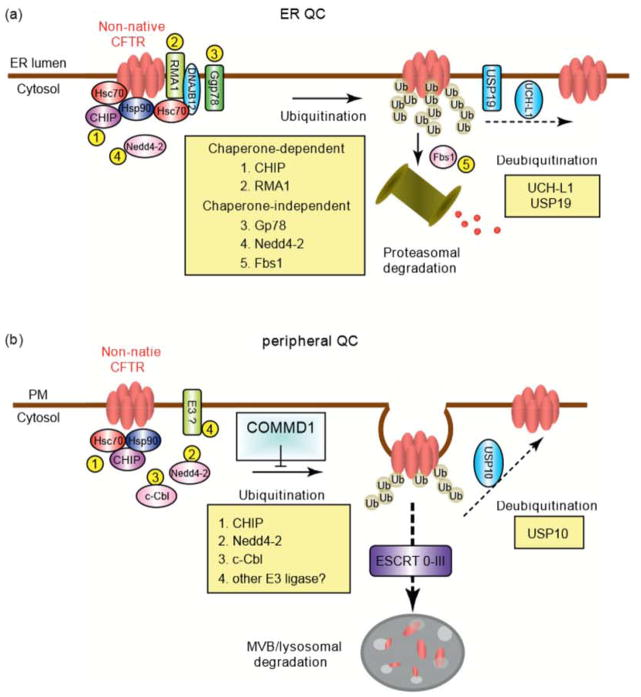
Review-article figure depicting CFTR folding/quality-control checkpoints that determine whether CFTR is trafficked to the plasma membrane or targeted for degradation. It is especially useful for linking the F508del deletion to misfolding and ER-associated quality control, clarifying why CFTR quantity at the membrane falls even if transcription/translation occur. This adds mechanistic depth to the statement that the mutant protein is recognized as faulty and removed before membrane insertion. Source
Another mutation is G551D. This is a substitution mutation that changes one amino acid in the protein. In this case, the CFTR protein may reach the membrane, but the channel does not open properly. The protein is present, but its activity is greatly reduced.
Some mutations create a stop codon too early. Translation ends prematurely, producing a shortened CFTR protein. A shortened protein is usually non-functional and may never become a working membrane channel.
These examples show clearly that cystic fibrosis is not caused by only one specific base change.
Shared outcome of different mutations
Although CF-causing mutations are different, they can have a shared molecular outcome: normal CFTR activity is reduced or lost.
This can happen because:
no CFTR protein is made
CFTR protein is made but misfolded
the protein is broken down before reaching the membrane
the protein reaches the membrane but the channel does not work properly
If chloride transport is disrupted enough, the person develops cystic fibrosis. This is why several different mutations in the same gene can all cause the disorder.
Different mutations do not always have exactly the same effect on the protein. Some cause almost complete loss of function, while others leave a small amount of CFTR activity. This helps explain why the condition can vary between individuals, even though the same gene is involved. A person may also inherit two different mutant versions of the CFTR gene, and the combination influences how much functional protein is produced.
It is also important not to assume that every change in the CFTR base sequence will cause cystic fibrosis. Some changes may have little or no effect on the final protein. A mutation only causes the disease if it changes the protein enough to reduce its normal function significantly.
The essential link is: mutation in the CFTR gene altered CFTR protein reduced protein function cystic fibrosis.
Practice Questions
Explain why cystic fibrosis can be caused by more than one mutation in the CFTR gene. (2)
different mutations can occur in the same gene / cystic fibrosis is not caused by only one specific mutation (1)
different mutations can all produce an altered / non-functional CFTR protein or reduce CFTR function (1)
A scientist studies two CFTR mutations. Mutation A is a deletion of three bases that removes one amino acid from the protein. Mutation B is a substitution that creates a stop codon.
Explain how both mutations can result in cystic fibrosis. (6)
both mutations change the base sequence of the CFTR gene (1)
mutation A removes one amino acid from the polypeptide / changes the primary structure (1)
this can alter folding / three-dimensional shape / processing of CFTR (1)
mutation B creates a premature stop codon / causes translation to end early (1)
this produces a shortened protein that is non-functional or absent (1)
both mutations reduce or prevent normal CFTR activity, leading to cystic fibrosis (1)
FAQ
Some CFTR mutations became more frequent because they were present in ancestral groups and were passed down over many generations.
This is often linked to a founder effect, where a mutation starts in a small population and becomes relatively common there. As a result, the most frequent CFTR mutations can differ between populations, and genetic screening panels may need to be chosen carefully.
CFTR mutations can be named at the DNA level or at the protein level.
For example:
F508del means phenylalanine at position 508 is deleted from the protein
G551D means glycine at position 551 is replaced by aspartic acid
These names help scientists identify exactly what kind of molecular change has occurred and predict how it may affect CFTR function.
Targeted drugs work only if they match the type of defect caused by the mutation.
For example, some drugs help CFTR channels open more effectively, so they may work when the protein reaches the membrane but functions poorly. Other drugs help misfolded protein reach the membrane. If a mutation causes little or no protein to be made at all, these treatments may be much less effective.
Some tests look only for the most common CFTR mutations rather than reading the entire gene.
This means a rare mutation may be missed. In some cases, further testing is needed, such as:
full gene sequencing
tests for deletions or duplications
analysis of less common regions affecting gene expression
That is why a negative result on a limited mutation panel does not always rule out a CFTR-related disorder.
Yes. Many CFTR mutations are rare, and some are found only in a few families or individuals.
When a new variant is found, scientists must decide whether it is actually disease-causing. They look at:
whether the DNA change alters the protein
whether it is linked to cystic fibrosis in families
laboratory evidence showing reduced CFTR function
So discovering a variant is only the first step; proving that it causes disease takes more evidence.
