

Edexcel Syllabus focus:
'Understand how errors during DNA replication can give rise to mutations in the base sequence of a gene.'
DNA is usually copied very accurately, but rare mistakes during replication can change the order of bases in a gene. If the mistake is not corrected, it becomes a mutation.
Why accurate copying matters
The information in a gene depends on its exact base sequence. During DNA replication, each original strand is used to build a new complementary strand.
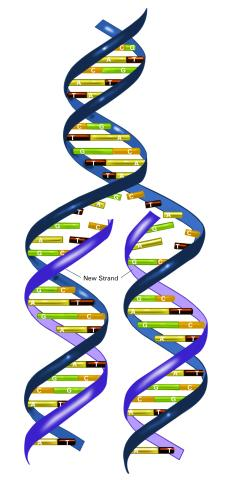
Labeled diagram of semi-conservative DNA replication showing each parental strand acting as a template for a newly synthesized complementary strand. This provides the structural context for why an incorrect nucleotide insertion during synthesis would change the base sequence in a daughter molecule. Source
Most of the time, correct complementary bases are added, so the copied DNA has the same sequence as the original molecule.
Occasionally, however, the wrong base is inserted, a base is missed out, or an extra base is added. A change like this can alter the base sequence of the daughter DNA molecule. If that altered sequence is within a gene, the gene has been mutated.
These permanent changes are called mutations.
Mutation: A permanent change in the base sequence of DNA.
A mutation caused by replication error is usually very small, often involving just one or a few bases, but even a small change can be biologically important because DNA carries coded information.
How replication errors arise
Replication errors happen when base pairing is not carried out perfectly.
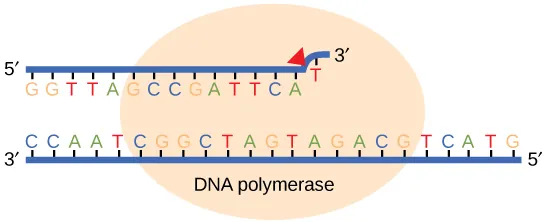
Diagram showing a replication mispair at the growing DNA strand and how DNA polymerase can backtrack to correct the error (proofreading). It highlights that the mismatch is initially a copying mistake that may be removed before replication continues. Source
The bases in DNA should pair specifically, but sometimes a base is temporarily matched incorrectly. If replication continues before the error is corrected, the wrong base may remain in the newly made strand.
Errors can also arise when:
a base is substituted for another base
a base is deleted, so it is left out of the new sequence
an extra base is inserted into the sequence
These changes all alter the order of bases in the gene. The key idea is that the mutation begins as a copying mistake. If the cell corrects the mistake, no mutation is produced. If the mistake remains, the altered base sequence can be copied again in later rounds of replication.
Replication is generally highly accurate, so mutations are relatively rare. This is important because frequent changes in DNA sequence would make genetic information unstable from one cell generation to the next.
Types of mutation produced by replication errors
Base substitution
A base substitution happens when one base is replaced by a different base. For example, a position that should contain one base may end up containing another after a replication mistake.
In a substitution:
the length of the gene does not change
only one position in the sequence is altered
the effect depends on where the change occurs in the gene
Some substitutions may have little or no effect, while others may significantly change the information in that gene. The importance of the mutation depends on the exact base changed and its position in the sequence.
Insertion and deletion
An insertion adds one or more extra bases to the sequence. A deletion removes one or more bases from the sequence. These mutations can be especially disruptive because they change the sequence from the point of the error onward.
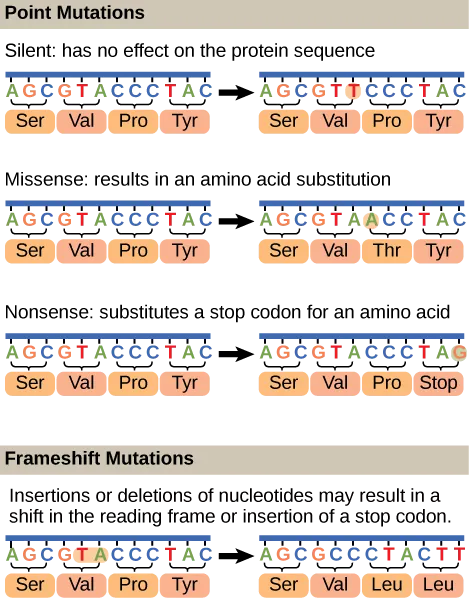
Comparison diagram of point mutations (including substitutions) versus frameshift mutations caused by insertions or deletions. It emphasizes that insertions/deletions shift the reading frame so that many downstream codons—and therefore amino acids—can change. Source
Insertions and deletions may happen if the copying process slips, or if a base that should have been copied is omitted or copied twice. Because they alter the arrangement of bases over a longer stretch of DNA, their effect on a gene can be greater than that of a single base substitution.
A gene mutation may involve:
one base only
several bases close together
a very small section of the gene
When an error becomes a permanent mutation
A copying mistake only becomes a true mutation when it is retained in DNA after replication. At first, the error is present only in the newly formed strand. If it is corrected, the original sequence is preserved.
If it is not corrected, the altered strand can act as a template during the next round of replication. Complementary base pairing will then copy the wrong sequence faithfully. At that stage, the change is fixed in DNA and can be passed on to daughter cells.
This explains why replication errors matter: one brief mistake during copying can create a lasting change in the genetic material.
Why replication errors matter in genes
Because genes carry the instructions for cell activity, a mutation in a gene may change the information it contains. Different mutations have different effects:
some have no noticeable effect
some alter the gene product only slightly
some cause a major change in cell function
Not every replication error leads to a harmful outcome, but all gene mutations begin with a change in base sequence. The severity depends on the position and type of mutation, not simply on the fact that a mutation has occurred.
In any gene, a replication error becomes biologically important only if the altered base sequence remains in the DNA and is copied again during later cell divisions.
Practice Questions
State what is meant by a mutation in a gene and name one type of replication error that can cause it.
[2 marks]
A mutation is a permanent change in the base sequence of DNA or of a gene. (1)
One correct example of a replication error, such as substitution, insertion, deletion, wrong base added, or base missed out. (1)
Describe how errors during DNA replication can lead to mutations in the base sequence of a gene.
[6 marks]
DNA is copied during replication using complementary base pairing / original strands act as templates. (1)
Occasionally a copying mistake occurs / an incorrect base is added. (1)
A base may be substituted, deleted, or inserted. (1)
This changes the base sequence of the gene. (1)
If the mistake is corrected, no mutation remains. (1)
If it is not corrected, the altered sequence is copied in later replications and can be passed to daughter cells / becomes permanent. (1)
FAQ
Repeated sequences can confuse the copying process because several positions look the same.
This can cause strand slippage, where the new strand or template strand misaligns briefly. When copying continues, one or more bases may be added or missed out, leading to a small insertion or deletion.
Usually, no.
A replication error can be inherited by children only if it occurs in a cell that gives rise to gametes, or in a precursor cell that later forms sperm or eggs.
If the mutation happens in a normal body cell, it may still spread to daughter cells within that tissue, but it will not usually be passed to offspring.
Every round of DNA replication creates another chance for a copying mistake.
So tissues with frequent cell division, such as:
skin
the gut lining
bone marrow
have more opportunities for replication errors to occur over time.
This does not mean these tissues mutate constantly, because cells have systems that reduce errors, but the total risk rises as the number of copying events increases.
Scientists usually compare the DNA sequence of a sample with a normal or expected sequence.
Common methods include:
DNA sequencing, which shows the exact base order
PCR-based methods, which amplify a region so it can be studied in detail
mutation-specific probes, which identify known sequence changes
These techniques are sensitive enough to detect a change in just one base.
Mosaicism means that an individual has two or more groups of cells with different DNA sequences.
It can arise if a replication error happens after the first cell divisions of an embryo. Only the cells descended from the mutated cell will carry the mutation, while other cells remain unchanged.
The earlier the error happens, the larger the proportion of mutated cells is likely to be.
