

Edexcel Syllabus focus:
'Understand how expression of a cystic fibrosis gene mutation impairs the gaseous exchange, digestive and reproductive systems.'
Cystic fibrosis damages several organ systems because the mutated gene is expressed in epithelial cells that produce secretions, making mucus unusually thick and sticky.
Cystic fibrosis: A genetic disorder in which abnormally thick, sticky mucus builds up in body systems and disrupts their normal function.
The key idea is that a faulty transport protein in cell membranes changes the water content of secretions, so mucus becomes difficult to move and more likely to block tubes and passages.
How gene expression leads to system damage
Thick secretions in epithelial tissues
The effects of cystic fibrosis are most serious in places where cells normally produce a thin layer of mucus or fluid. In healthy tissues, these secretions help protect surfaces, allow substances to move freely, and keep ducts open. In cystic fibrosis, the secretions become dehydrated and sticky. This causes two major problems:
Blockage of narrow tubes, ducts, and airways
Reduced movement of materials such as air, digestive enzymes, and sperm
Because the mucus is hard to clear, it stays in the body for longer and creates conditions that damage tissues over time.
Impairment of the gaseous exchange system
Reduced ventilation and blocked airways
In the lungs, thick mucus lines the airways and can block smaller bronchioles.
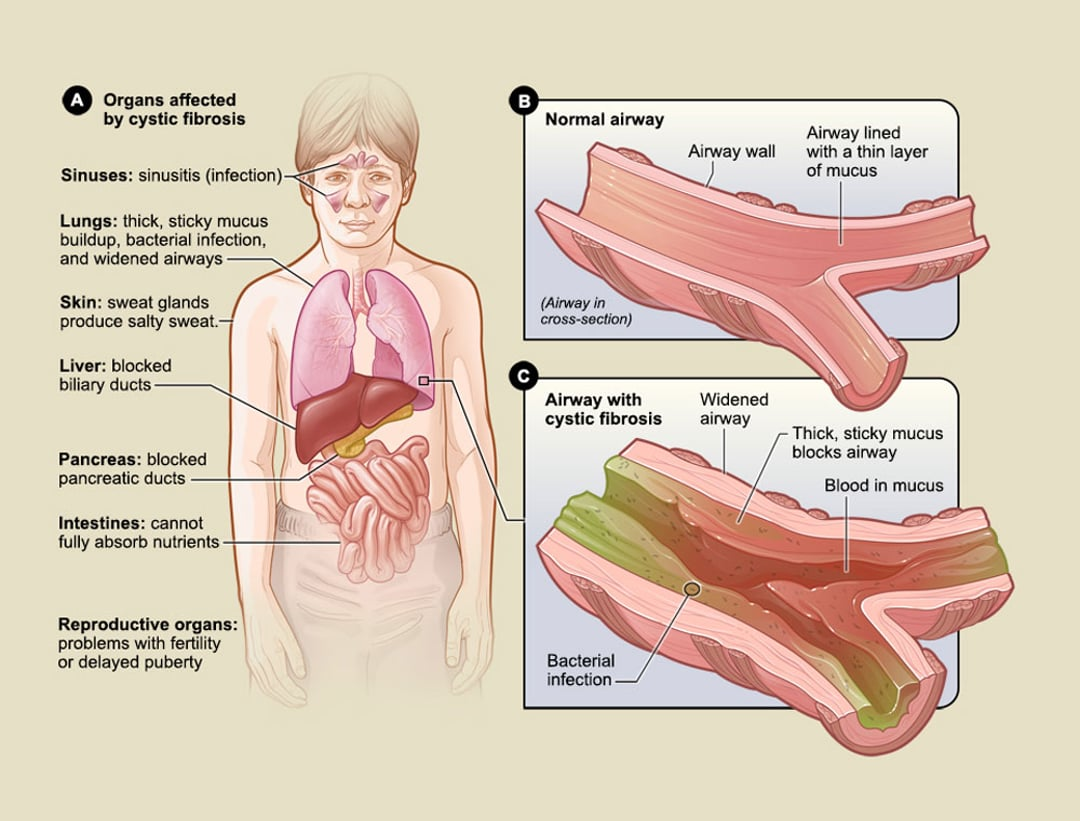
This diagram contrasts a normal airway (with a thin mucus lining) and a cystic fibrosis airway obstructed by thick, viscid mucus. It helps explain why airflow resistance increases, ventilation falls, and why retained mucus can trap microbes and promote recurrent infection. Source
This makes it harder for air to move in and out of the lungs, so ventilation is reduced. If less fresh air reaches the alveoli, oxygen uptake becomes less efficient and carbon dioxide removal also becomes more difficult.
The mucus is also difficult for the cilia to remove.
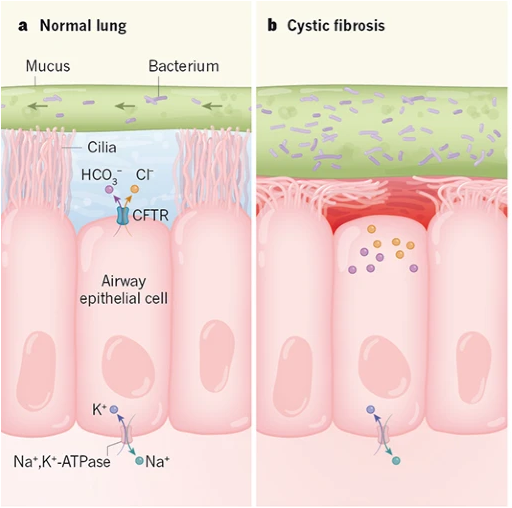
This figure compares normal airway epithelium (mucus over a well-hydrated periciliary layer that allows cilia to beat) with cystic fibrosis (dehydrated surface liquid and thick mucus that compresses cilia). It visually connects altered ion/water transport to reduced mucociliary clearance, helping explain mucus retention and downstream infection/inflammation. Source
As a result:
air passages become narrowed or blocked
breathing requires more effort
less oxygen reaches the gas exchange surfaces
coughing becomes frequent as the body attempts to clear the airways
This means the gaseous exchange system does not work as effectively as it should.
Recurrent infection and tissue damage
Sticky mucus in the lungs provides an environment where bacteria can remain and multiply. Repeated chest infections are therefore common. The immune response to these infections causes inflammation, which damages the lining of the airways. Over time, this can lead to scarring and permanent damage to lung tissue.
As damage accumulates:
airway walls may become less elastic
normal lung structure is disrupted
some gas exchange surfaces work less efficiently
the overall capacity for oxygen absorption decreases
This is why cystic fibrosis can cause persistent coughing, breathlessness, reduced exercise tolerance, and progressive loss of lung function. The main impairment is not just the presence of mucus itself, but the combination of blockage, infection, and long-term tissue damage.
Impairment of the digestive system
Blocked pancreatic ducts
The digestive system is strongly affected because thick mucus can block the ducts of the pancreas. The pancreas normally releases digestive enzymes into the small intestine. These enzymes break down large food molecules so that the products can be absorbed.
When the pancreatic ducts are blocked, fewer enzymes reach the small intestine.
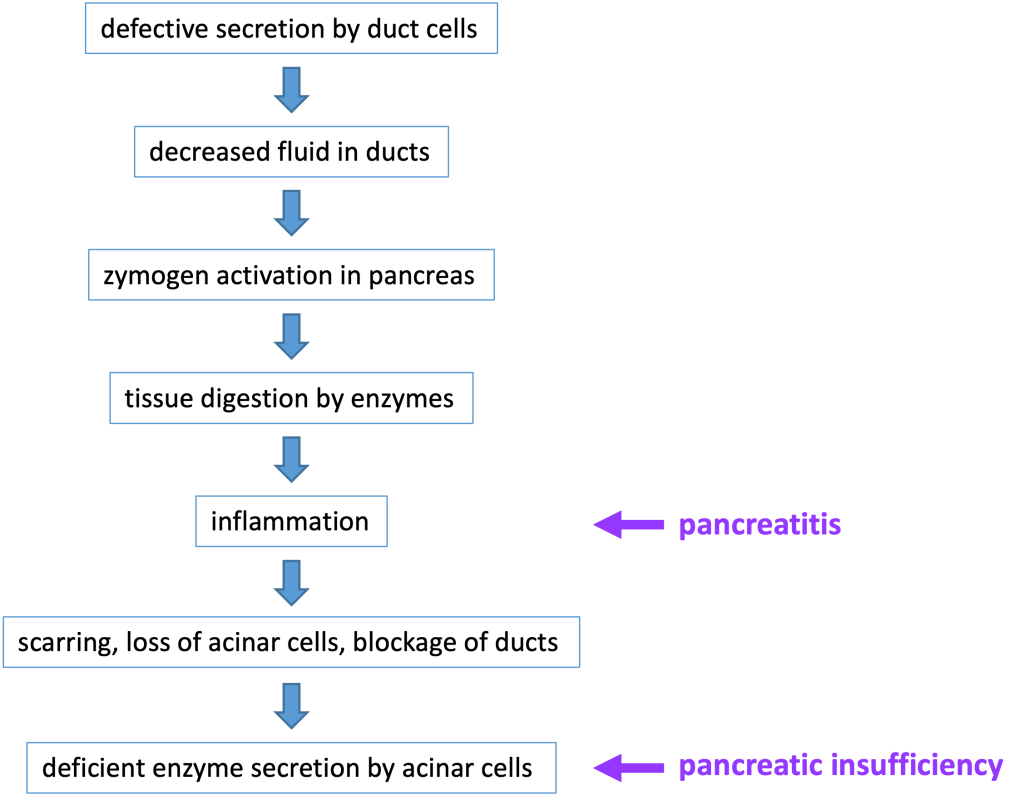
This flow chart summarizes the sequence of events by which cystic fibrosis leads to pancreatic damage and pancreatic insufficiency. It supports the idea that obstructed ducts reduce delivery of digestive enzymes to the small intestine, which then drives poor digestion (especially fats and proteins) and nutrient malabsorption. Source
This means digestion becomes less effective, especially for lipids and proteins. Food may pass through the gut without being fully digested.
Effects on digestion and absorption
Poor digestion leads to poor absorption. Even if a person eats enough food, the body may not receive enough useful nutrients from it. This can cause:
poor weight gain
reduced growth in children
low energy availability
malnutrition
Fats are particularly affected because fat digestion depends heavily on pancreatic enzymes. As a result, the person may have difficulty maintaining body mass and normal health. Thick secretions can also affect the intestines themselves, increasing the risk of blockages and further interfering with movement of food through the digestive tract.
Digestive impairment in cystic fibrosis therefore comes mainly from blocked ducts and the reduced delivery of digestive enzymes, not from a lack of food intake.
Impairment of the reproductive system
Reduced fertility in males
In males, cystic fibrosis often causes infertility. Thick secretions can block the tubes that carry sperm, or these tubes may fail to function normally. As a result, sperm cannot move effectively from the testes into the semen.
This means that:
sperm production may still occur
but sperm are not successfully transported
natural fertilization becomes very unlikely
The reproductive system is therefore impaired because the pathway for sperm delivery is disrupted.
Reduced fertility in females
In females, cystic fibrosis usually causes reduced fertility rather than complete infertility. Thick mucus in the cervix can make it harder for sperm to move through the reproductive tract and reach the egg.
This lowers the chance of fertilization because:
sperm movement is slowed
fewer sperm reach the site of fertilization
conditions in the reproductive tract are less favorable for sperm survival
The reproductive effects in females are often less severe than in males, but cystic fibrosis can still reduce the likelihood of successful conception.
Practice Questions
State two ways cystic fibrosis impairs the digestive system. (2 marks)
Thick mucus blocks the pancreatic ducts. (1)
Fewer digestive enzymes reach the small intestine, so digestion and absorption are reduced. (1)
Explain how expression of a cystic fibrosis gene mutation can impair the gaseous exchange and reproductive systems. (6 marks)
Mutation is expressed as an abnormal transport protein in epithelial cell membranes. (1)
Secretions become thick and sticky. (1)
In the lungs, mucus blocks airways or bronchioles, reducing ventilation. (1)
Mucus traps bacteria, causing infection and inflammation, which damages lung tissue and reduces gas exchange efficiency. (1)
In males, sperm ducts are blocked or do not transport sperm properly, causing infertility. (1)
In females, thick cervical mucus reduces sperm movement to the egg, reducing fertility. (1)
FAQ
Fat digestion is often poor in cystic fibrosis because pancreatic enzymes do not reach the small intestine effectively. This especially affects the absorption of vitamins A, D, E, and K, because they dissolve in fats rather than water.
Without supplements, deficiencies can develop even when food intake seems adequate. These deficiencies can affect vision, bone health, antioxidant protection, and blood clotting.
Exercise can help move mucus in the lungs, making it easier to clear from the airways. It can also improve breathing efficiency and help maintain fitness as lung function changes.
It is not a cure, but it may reduce breathlessness during daily activity and support overall health. Regular exercise is usually most useful when combined with medical treatment and airway clearance techniques.
These capsules replace some of the enzymes that cannot reach the small intestine because pancreatic ducts are blocked. They help break down fats, proteins, and carbohydrates more effectively.
Taking them with meals improves nutrient absorption and can help with weight gain, growth, and energy levels. The capsules work best when the dose matches the size and fat content of the meal.
In many males with cystic fibrosis, the sperm-carrying tubes are absent or severely blocked, so sperm cannot be included in semen. This means natural conception is often very difficult or impossible.
In females, fertility is usually reduced rather than completely lost. Sperm can still sometimes reach the egg, but thick cervical mucus makes this less likely.
The lungs may remain inflamed even between obvious infections. Immune cells and inflammatory chemicals can continue to damage airway walls while the body responds to mucus and small amounts of trapped bacteria.
Over time, this chronic inflammation can cause scarring and loss of normal lung structure. That gradual damage contributes to worsening gaseous exchange even if symptoms temporarily seem more stable.
