

CIE Syllabus focus:
'Understand relative molecular mass and relative formula mass, calculate them from relative atomic masses, and use relative formula mass for compounds with giant structures.'
Relative masses let chemists compare substances without using tiny actual masses. In this topic, you need to decide whether a substance contains molecules or formula units, then calculate the correct value.
Understanding the two terms
Chemists use the symbol for a relative mass found by adding appropriate relative atomic masses.
Relative molecular mass
Relative molecular mass: The sum of the relative atomic masses of all the atoms in a molecule.
This term applies to substances that exist as separate molecules, especially simple covalent substances.
Relative formula mass
Relative formula mass: The sum of the relative atomic masses of all the atoms shown in the chemical formula of a substance.
This is the correct term when the formula does not represent one separate molecule. Both quantities are calculated in the same general way, but the name must match the structure of the substance.
Why two different names are used
A molecule is a distinct group of bonded atoms that can be treated as a single particle. Water, methane, ammonia, and carbon dioxide are all made of separate molecules, so their values are called relative molecular masses.
Many substances, however, do not exist as molecules. Ionic compounds form giant ionic lattices.
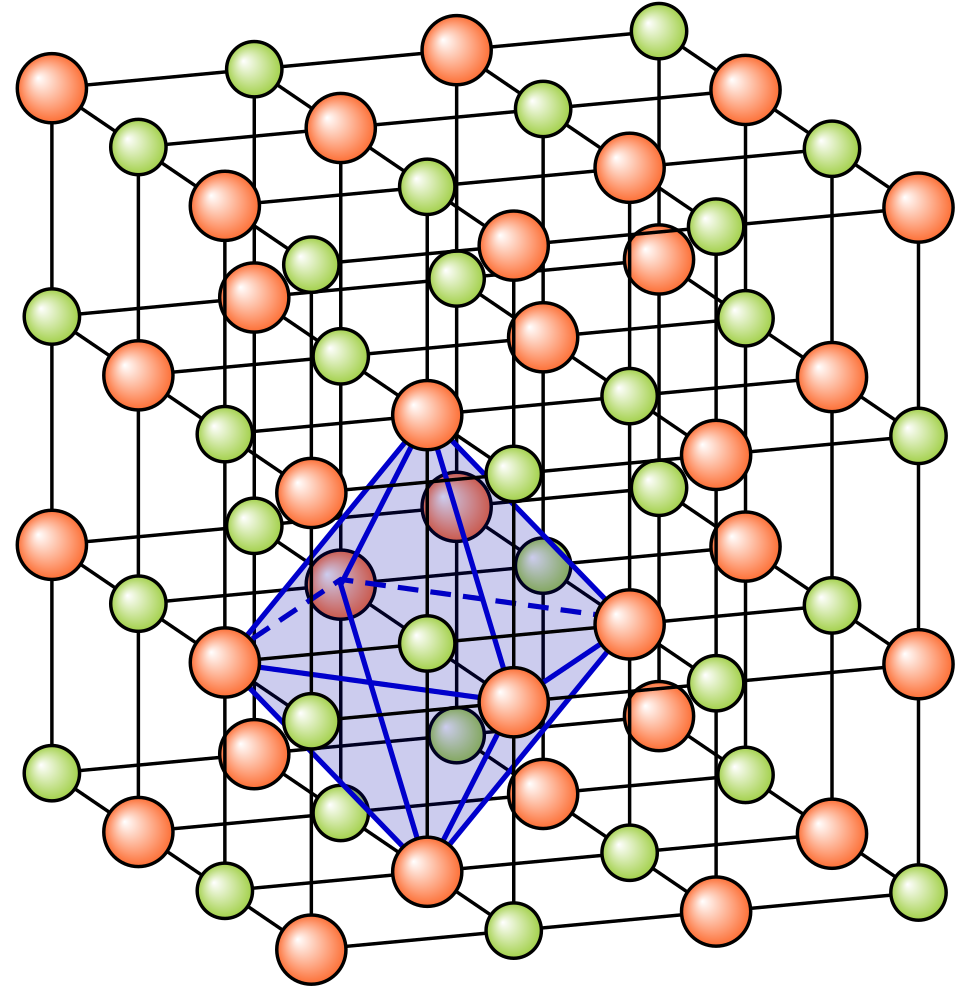
Crystal lattice of sodium chloride showing the repeating 3D arrangement of and ions. This reinforces that the formula represents the simplest whole-number ratio in a giant ionic structure, not a single molecule—so the appropriate term is relative formula mass. Source
In these structures, positive and negative ions repeat throughout the solid. There is no single sodium chloride molecule or magnesium oxide molecule that exists independently within the lattice. The chemical formula only gives the simplest whole-number ratio of ions.
Some covalent compounds also form giant covalent structures. Silicon dioxide is an important example.

Structural representation of silicon dioxide, emphasizing that is best interpreted as a repeating composition within a covalent network rather than as individual molecules. This supports why the correct terminology for its is relative formula mass. Source
Its formula shows the composition of the network, not one individual molecule. Because of that, the correct term is relative formula mass, not relative molecular mass.
In exam questions, students sometimes do the arithmetic correctly but lose marks by using the wrong term. Structure determines the name.
Calculating from relative atomic masses
To calculate either value, add together the relative atomic masses of all the atoms present in the formula.
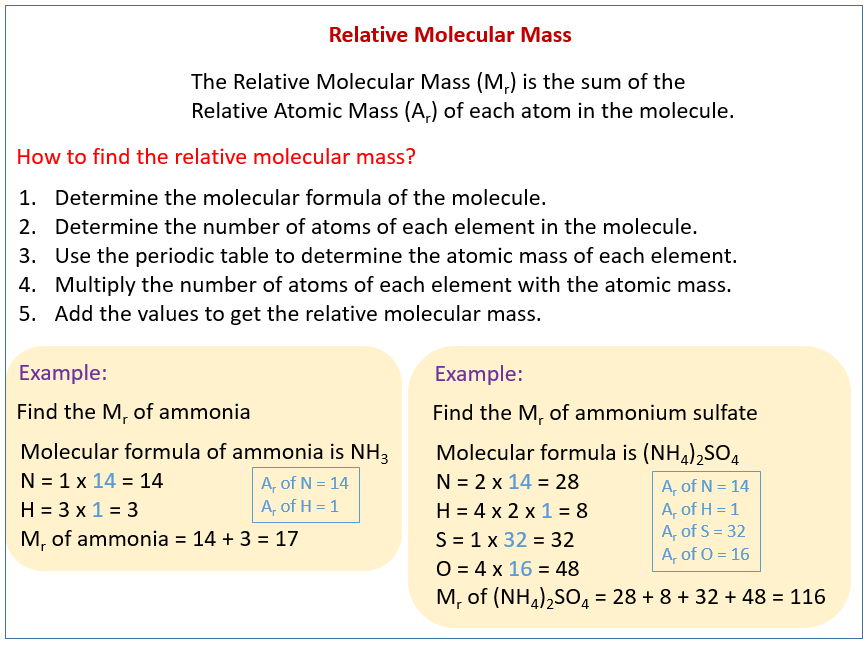
Worked example layout illustrating how to calculate by summing the contributions from each element (e.g., using subscripts as multipliers). This directly models the exam method implied by . Source
= relative molecular mass or relative formula mass, no unit
= number of atoms of each element in the formula
= relative atomic mass of each element, no unit
A correct answer depends on reading the chemical formula accurately.
A subscript tells you how many atoms of an element are present.
If a formula contains brackets, the number outside the brackets multiplies every atom inside them.
Add the contribution from each element to give the final .
Use the relative atomic mass values supplied in the question or data booklet.
Keep sufficient figures during the calculation so that rounding does not affect the final answer.
The result has no unit because is a relative quantity, not an actual measured mass.
Using relative molecular mass correctly
Use relative molecular mass only when the substance is made of separate molecules. In these cases, the chemical formula represents one complete molecule, so every atom shown in that formula contributes to the total.
This means you must use the molecular formula, not a simpler ratio, when calculating the value. If the molecular formula contains several atoms of the same element, each of those atoms must be included. The calculation reflects the composition of one actual molecule, not just a pattern or ratio.
For this subtopic, the key idea is that molecular substances are described in terms of molecules, so the correct name is relative molecular mass.
Using relative formula mass correctly
Use relative formula mass for compounds with giant structures. This includes giant ionic compounds and giant covalent compounds such as silicon dioxide. In each case, the formula describes the composition of the structure rather than one separate molecule.
For ionic compounds, the formula gives the lowest whole-number ratio of ions needed for overall electrical neutrality. For giant covalent compounds, the formula gives the repeating composition of the network. The same method of addition is used in both cases, but the name relative formula mass makes the chemistry accurate.
The same idea applies whether the formula contains two elements or several. The structure, not the arithmetic, decides which term should be used.
Common mistakes to avoid
Students often lose marks through terminology or formula reading rather than calculation. Common errors include:
calling an ionic compound a molecule
using relative molecular mass for a giant structure
forgetting to multiply by a subscript
missing atoms inside brackets
using the wrong chemical formula
giving units to
It is also important to separate the formula of a substance from the coefficient in a chemical equation. A coefficient shows how many particles are involved in a reaction, but it does not change the of one molecule or one formula unit.
Practice Questions
State what is meant by the term relative formula mass. [2 marks]
Sum of the relative atomic masses (1)
of all atoms shown in the formula / formula unit of the substance (1)
Relative atomic masses: H = 1.0, C = 12.0, O = 16.0, Mg = 24.3, Cl = 35.5, Si = 28.1
(a) Calculate the relative molecular mass of ethanol, . [2 marks]
(b) Calculate the relative formula mass of magnesium chloride, . [2 marks]
(c) Explain why silicon dioxide, , is described using relative formula mass rather than relative molecular mass. [2 marks]
(a)
Correct setup, (1)
(1)
(b)
Correct setup, (1)
(1)
(c)
has a giant covalent structure / does not exist as separate molecules (1)
the formula represents composition in the network, so relative formula mass is the correct term (1)
FAQ
Relative atomic masses are usually weighted average values, not exact whole numbers. When those values are added together, the final $M_r$ is often non-integer.
This is expected and does not mean the formula is incorrect.
Use the full formula exactly as written, including the water molecules after the dot. Their hydrogen and oxygen atoms must be included in the total.
So, for a hydrated salt, you are finding the mass of the entire stated formula unit, not just the anhydrous part.
A polymer sample often contains molecules with different chain lengths. Since each chain length has a different molecular mass, the sample can contain a range of $M_r$ values.
Chemists therefore often use an average value rather than a single exact one.
Yes. Different chemical formulas can add to the same total relative mass.
That means $M_r$ alone cannot identify a substance; you also need its formula or other evidence.
In this course, the term is mainly used for compounds with giant structures, such as ionic lattices or giant covalent compounds.
For giant elemental structures like diamond, graphite, or silicon, chemists do not usually focus on a single relative formula mass value because there is no discrete compound formula unit in the same sense.


