

CIE Syllabus focus:
'Predict mass spectra and relative peak heights for diatomic molecules, including chlorine, using isotopic combinations and simple probability.'
Mass spectra of diatomic molecules depend on the isotopes present in each atom. By combining isotopic masses and probabilities, you can predict both peak positions and their relative heights.
Why diatomic molecules give more than one peak
A diatomic molecule contains two atoms. In a mass spectrometer, one important species is the molecular ion, formed when the molecule loses an electron but stays in one piece.
Molecular ion: The ion formed when a molecule loses one electron without breaking apart, so its charge is usually .
For a diatomic molecular ion, the peak position depends on the total mass of the two isotopes present. Since the ion usually has a charge of , the m/z value is numerically equal to the combined isotopic mass.
If an element has only one naturally occurring isotope, its diatomic molecule gives only one molecular ion peak. If the element has two or more isotopes, different isotope pairings are possible, so several molecular ion peaks may appear.
This means that the pattern in a diatomic mass spectrum is controlled by two things:
the masses of the isotopes
the relative abundances of those isotopes
Predicting the m/z values
To predict peak positions for a diatomic molecule:
write down the isotopes that can be present
pair the isotopes in all possible ways
add the isotope masses in each pair
assign the total to the molecular ion peak
For a homonuclear diatomic molecule such as , the possible pairs come from the same element. If the element has two isotopes, there are three different mass totals:
light-light
light-heavy
heavy-heavy
The mixed combination gives only one m/z value, because both arrangements have the same total mass. For example, - and - both give the same molecular ion mass.
Peak positions therefore come from adding isotope masses, not from averaging them.
Using probability to predict relative peak heights
Peak height reflects how likely each isotopic combination is. This is why simple probability can be used to predict relative abundances.
= probability of one ordered isotopic pair
= fractional abundance of isotope
= fractional abundance of isotope
For a homonuclear diatomic molecule with two isotopes, the mixed combination must be counted twice if you are using probability, because it can form in two ordered ways: - and -. These two arrangements have the same m/z value, so their probabilities are added together to give the height of the middle peak.
After calculating the probabilities, the values are usually converted into a simple whole-number ratio for the relative peak heights.
Chlorine as the standard example
Chlorine is especially important because it has two common isotopes, and , with abundances of about 75% and 25%.
For , the possible isotopic combinations are:
- giving m/z 70
- giving m/z 72
- giving m/z 74
These peaks do not have equal heights. Because is more abundant than , the peak at m/z 70 is the tallest and the peak at m/z 74 is the smallest.
Using simple probability gives an approximate relative peak height ratio of:
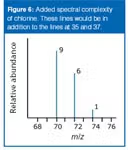
Molecular-ion region of the chlorine mass spectrum showing the three peaks at m/z 70, 72, and 74. The relative line heights illustrate the expected 9:6:1 intensity pattern that results from the different isotopic pair probabilities (–, mixed –, and –). Source
9 : 6 : 1 for m/z 70 : 72 : 74
The middle peak is larger than you might first expect because the mixed isotopic molecule can form in two ways, even though both ways give the same m/z value.
This chlorine pattern is one of the most recognizable isotopic patterns in mass spectrometry.
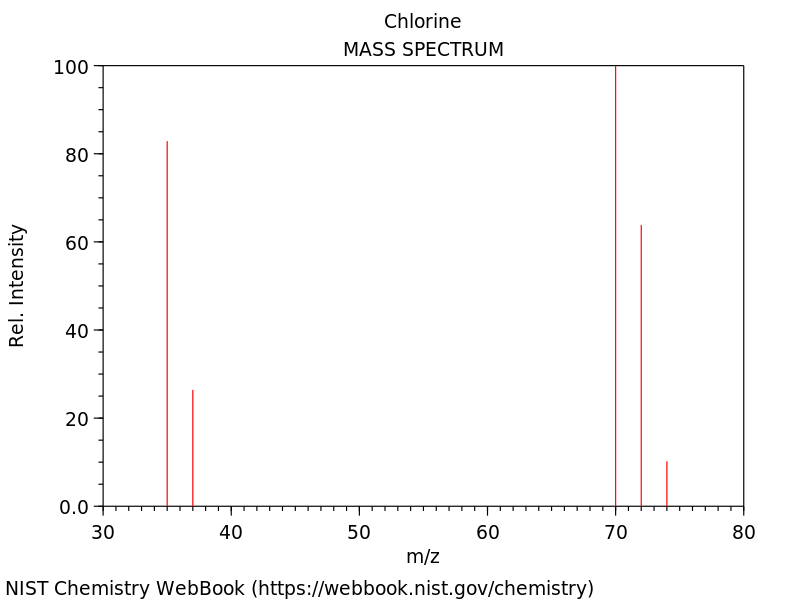
Electron-ionization (EI) mass spectrum for chlorine from the NIST Chemistry WebBook. The plot format (relative intensity vs m/z) matches what students see in exam questions, and it provides a real-data anchor for the distinctive chlorine isotope pattern discussed in the notes. Source
In exam questions, you are often expected to identify all three molecular ion peaks and explain why the middle peak is not the smallest.
Recognizing common patterns
Some general patterns are useful to remember:
if the two isotopes have equal abundance, the three peaks for a homonuclear diatomic molecule are in a 1 : 2 : 1 ratio
if one isotope is much more abundant, the peak made from two of that isotope is the tallest
if there is only one isotope, there is only one molecular ion peak
The number of peaks depends on the number of different isotopic mass combinations, while the peak heights depend on the probabilities of forming each combination.
A reliable method in exam questions
When predicting the spectrum of a diatomic molecule, use this sequence:
identify the isotopes present
list every isotopic pairing
find the m/z value for each pairing by addition
combine any pairings that give the same m/z
use abundance and probability to compare the peak heights
write the final intensities as a ratio
Common mistakes
Forgetting the mixed pair occurs twice in homonuclear molecules
Adding abundances instead of multiplying probabilities
Predicting only two peaks for chlorine instead of three
Using isotope abundances to place peaks rather than using isotope masses
Leaving probability values unsimplified when a ratio is expected
A correct answer must match both parts of the problem: the peak positions and the relative peak heights. In chlorine, the classic pattern is three molecular ion peaks at 70, 72, and 74 with a relative intensity ratio of about 9 : 6 : 1.
Practice Questions
Chlorine exists as the isotopes and .
Predict the m/z values of the molecular ion peaks in the mass spectrum of . (2 marks)
1 mark for identifying three molecular ion peaks
1 mark for the correct m/z values: 70, 72, and 74
Bromine has two isotopes, and , with approximately equal abundances.
Predict the molecular ion peaks in the mass spectrum of and explain the relative peak heights. (5 marks)
1 mark for identifying the - combination
1 mark for identifying the - combination and recognizing that - gives the same m/z
1 mark for identifying the - combination
1 mark for the correct m/z values: 158, 160, and 162
1 mark for the correct relative peak height ratio of 1 : 2 : 1, with explanation that the middle peak comes from two equally likely mixed combinations
FAQ
The 9 : 6 : 1 ratio is an approximation based on rounded natural abundances of about 75% $^{35}Cl$ and 25% $^{37}Cl$.
In real spectra, small differences can come from:
slightly more precise isotope abundances
instrument sensitivity
background noise
data processing and peak measurement
So the observed ratio is usually close to 9 : 6 : 1, not perfectly exact.
For HCl, you combine one hydrogen isotope choice with one chlorine isotope choice.
Since hydrogen is mostly $^1H$, the main pattern comes from chlorine:
$^1H$-$^{35}Cl$
$^1H$-$^{37}Cl$
That gives two main molecular ion peaks separated by 2 mass units, often in a ratio close to 3 : 1.
So heteronuclear molecules do not automatically give the same three-peak pattern as homonuclear chlorine.
Mass spectrometry separates ions by m/z, not by the order of atoms in the ion.
So $^{35}Cl$-$^{37}Cl$ and $^{37}Cl$-$^{35}Cl$:
have the same total mass
usually have the same charge
therefore have the same m/z
They appear as one peak, but its intensity includes both possibilities.
More isotopic combinations become possible, so the molecular ion pattern becomes more complex.
You would need to:
list all possible pairings
add isotope masses for each pair
combine pairings with the same total mass
compare their probabilities
Some different combinations may still produce the same m/z, so the number of peaks can be smaller than the number of pairings.
Yes. Predicting the isotopic pattern tells you where peaks should be and how they compare with each other, but not how intense the whole molecular ion signal will be overall.
A weak molecular ion can happen if:
the molecule breaks apart easily
ionization is inefficient
fragment ions are formed more readily than the intact molecular ion
So the pattern may still be correct even if the molecular ion peaks are small.
